## System Diagram: MCP Architecture
### Overview
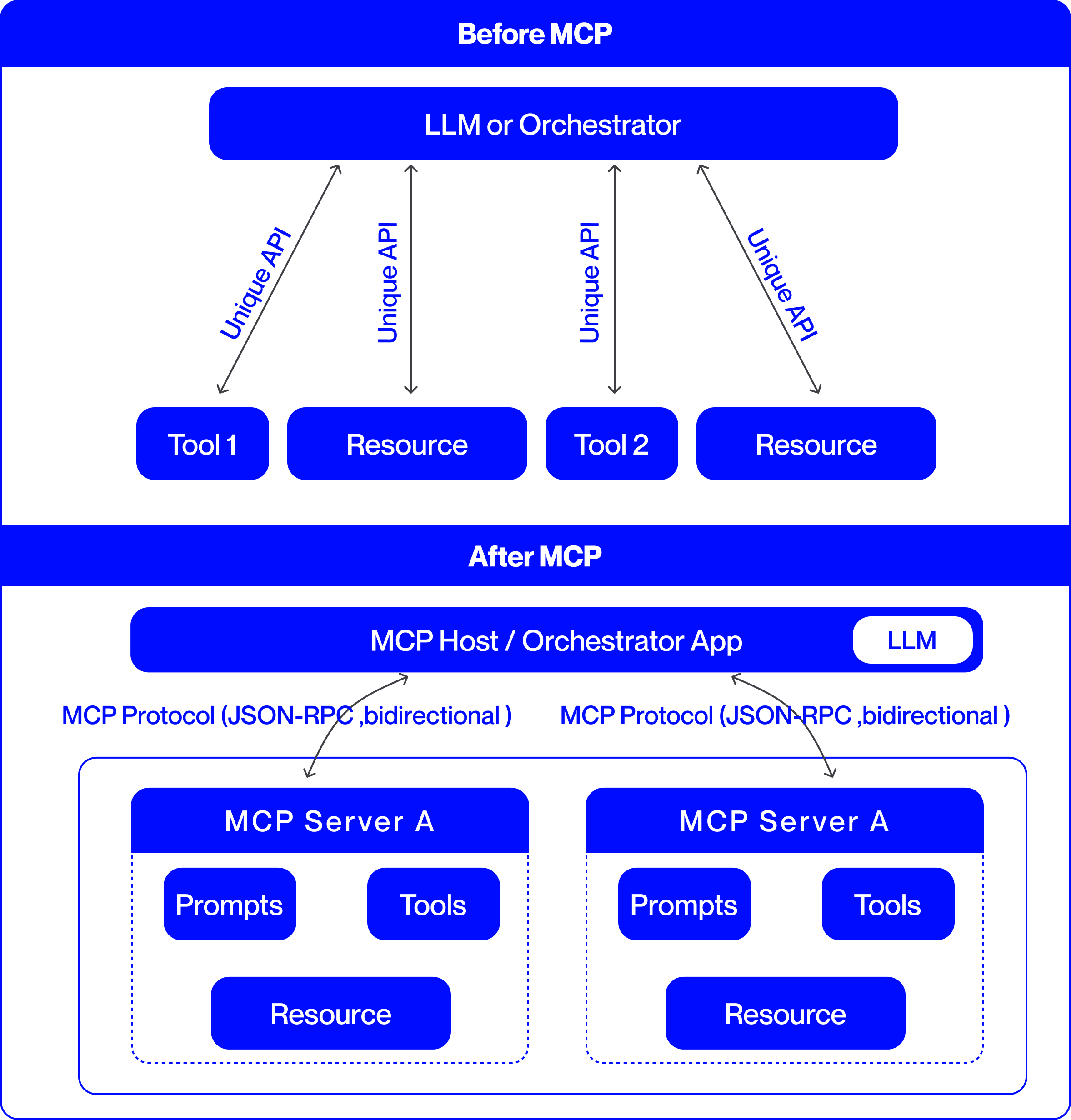
The image presents a system diagram illustrating the architecture of a system "Before MCP" and "After MCP". It shows the components and their interactions, focusing on the role of an LLM (Large Language Model) or Orchestrator and the introduction of MCP (presumably a protocol or system component).
### Components/Axes
**Header:**
* "Before MCP"
* "After MCP"
**Top Section (Before MCP):**
* LLM or Orchestrator: A central component.
* Tool 1, Resource, Tool 2, Resource: Represented as separate entities.
* Unique API: Label on arrows indicating the communication method.
**Bottom Section (After MCP):**
* MCP Host / Orchestrator App: A central component.
* LLM: A separate component connected to the MCP Host.
* MCP Protocol (JSON-RPC, bidirectional): Describes the communication protocol.
* MCP Server A (x2): Each containing "Prompts", "Tools", and "Resource".
### Detailed Analysis or ### Content Details
**Before MCP:**
* The "LLM or Orchestrator" communicates with "Tool 1", "Resource", "Tool 2", and "Resource" via "Unique API" calls.
* The arrows indicate a one-way communication from the "LLM or Orchestrator" to each of the other components.
**After MCP:**
* The "MCP Host / Orchestrator App" communicates with two instances of "MCP Server A" using "MCP Protocol (JSON-RPC, bidirectional)".
* Each "MCP Server A" contains "Prompts", "Tools", and "Resource".
* The "LLM" is a separate component connected to the "MCP Host / Orchestrator App".
### Key Observations
* The diagram highlights a shift from direct "Unique API" calls to a more structured communication via "MCP Protocol".
* The introduction of "MCP Server A" components suggests a modularization or encapsulation of functionalities.
* The "LLM" is integrated differently in the "After MCP" architecture, being a separate component connected to the "MCP Host".
### Interpretation
The diagram illustrates a transition in system architecture, likely aimed at improving modularity, communication efficiency, or standardization. The "Before MCP" architecture appears to have a central "LLM or Orchestrator" directly interacting with various tools and resources via unique APIs. This could lead to tight coupling and potential maintenance challenges.
The "After MCP" architecture introduces an "MCP Host / Orchestrator App" that communicates with "MCP Server A" instances using a standardized "MCP Protocol (JSON-RPC, bidirectional)". This suggests a move towards a more service-oriented architecture, where functionalities are encapsulated within "MCP Server A" instances and communication is standardized. The separation of the "LLM" in the "After MCP" architecture could indicate a decoupling of the language model from the core orchestration logic, allowing for easier updates or replacements of the LLM.