\n
## Diagram: Before and After MCP Architecture
### Overview
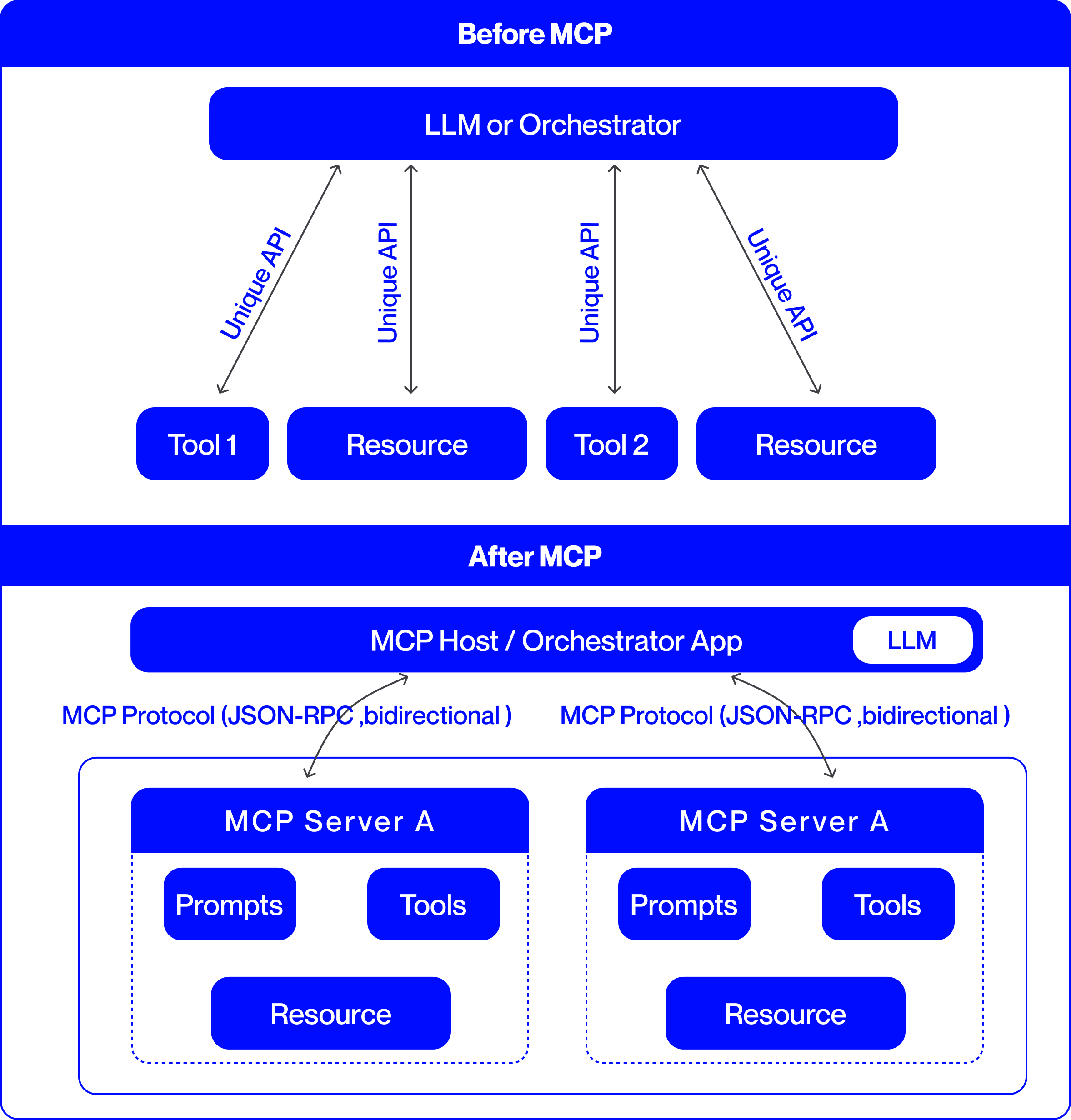
This diagram illustrates a system architecture comparison, showing the structure "Before MCP" (Multi-tool Communication Protocol) and "After MCP". The diagram highlights how the introduction of MCP streamlines communication between a Large Language Model (LLM) or Orchestrator and various tools and resources.
### Components/Axes
The diagram is divided into two main sections: "Before MCP" (top) and "After MCP" (bottom).
**Before MCP:**
* **LLM or Orchestrator:** A rectangular box at the top center, labeled "LLM or Orchestrator".
* **Tool 1 & Tool 2:** Two rectangular boxes labeled "Tool 1" and "Tool 2" respectively.
* **Resource:** Two rectangular boxes labeled "Resource".
* **Unique API:** Arrows labeled "Unique API" connecting the LLM/Orchestrator to each Tool and Resource.
**After MCP:**
* **MCP Host / Orchestrator App:** A rectangular box at the top center, labeled "MCP Host / Orchestrator App".
* **LLM:** A rectangular box to the right of the MCP Host, labeled "LLM".
* **MCP Server A (x2):** Two identical rectangular boxes labeled "MCP Server A".
* **Prompts:** Rectangular boxes within each MCP Server A, labeled "Prompts".
* **Tools:** Rectangular boxes within each MCP Server A, labeled "Tools".
* **Resource:** Rectangular boxes below each MCP Server A, labeled "Resource".
* **MCP Protocol (JSON-RPC, bidirectional):** Arrows labeled "MCP Protocol (JSON-RPC, bidirectional)" connecting the MCP Host to each MCP Server A.
### Detailed Analysis or Content Details
**Before MCP:**
The LLM or Orchestrator directly interacts with each Tool and Resource via a "Unique API". This implies a separate communication channel and protocol for each interaction. There are four distinct connections.
**After MCP:**
The LLM interacts with the "MCP Host / Orchestrator App". The MCP Host then communicates with two "MCP Server A" instances using the "MCP Protocol (JSON-RPC, bidirectional)". Each MCP Server A manages "Prompts", "Tools", and a "Resource". This suggests a centralized communication layer. Each MCP Server A has its own "Prompts", "Tools", and "Resource". The MCP Protocol is bidirectional.
### Key Observations
* The "After MCP" architecture introduces a layer of abstraction with the MCP Host and Servers.
* The "Before MCP" architecture shows a direct connection between the LLM and each tool, while the "After MCP" architecture uses a standardized protocol (MCP) for communication.
* The "After MCP" architecture appears to be scalable, with the potential to add more MCP Servers as needed.
* The "After MCP" architecture uses two instances of "MCP Server A", suggesting redundancy or parallel processing.
### Interpretation
The diagram demonstrates a shift from a point-to-point communication model ("Before MCP") to a centralized, protocol-driven model ("After MCP"). This likely aims to simplify integration, improve scalability, and standardize communication between the LLM and various tools. The use of JSON-RPC suggests a lightweight and widely supported protocol. The bidirectional nature of the protocol allows for both requests and responses to flow seamlessly. The duplication of "MCP Server A" suggests a design focused on reliability and potentially increased throughput. The diagram highlights a move towards a more manageable and efficient system for orchestrating LLM interactions with external tools and resources. The diagram does not provide any quantitative data, but rather a qualitative comparison of two architectural approaches.