## Diagram: System Architecture Comparison Before and After MCP Implementation
### Overview
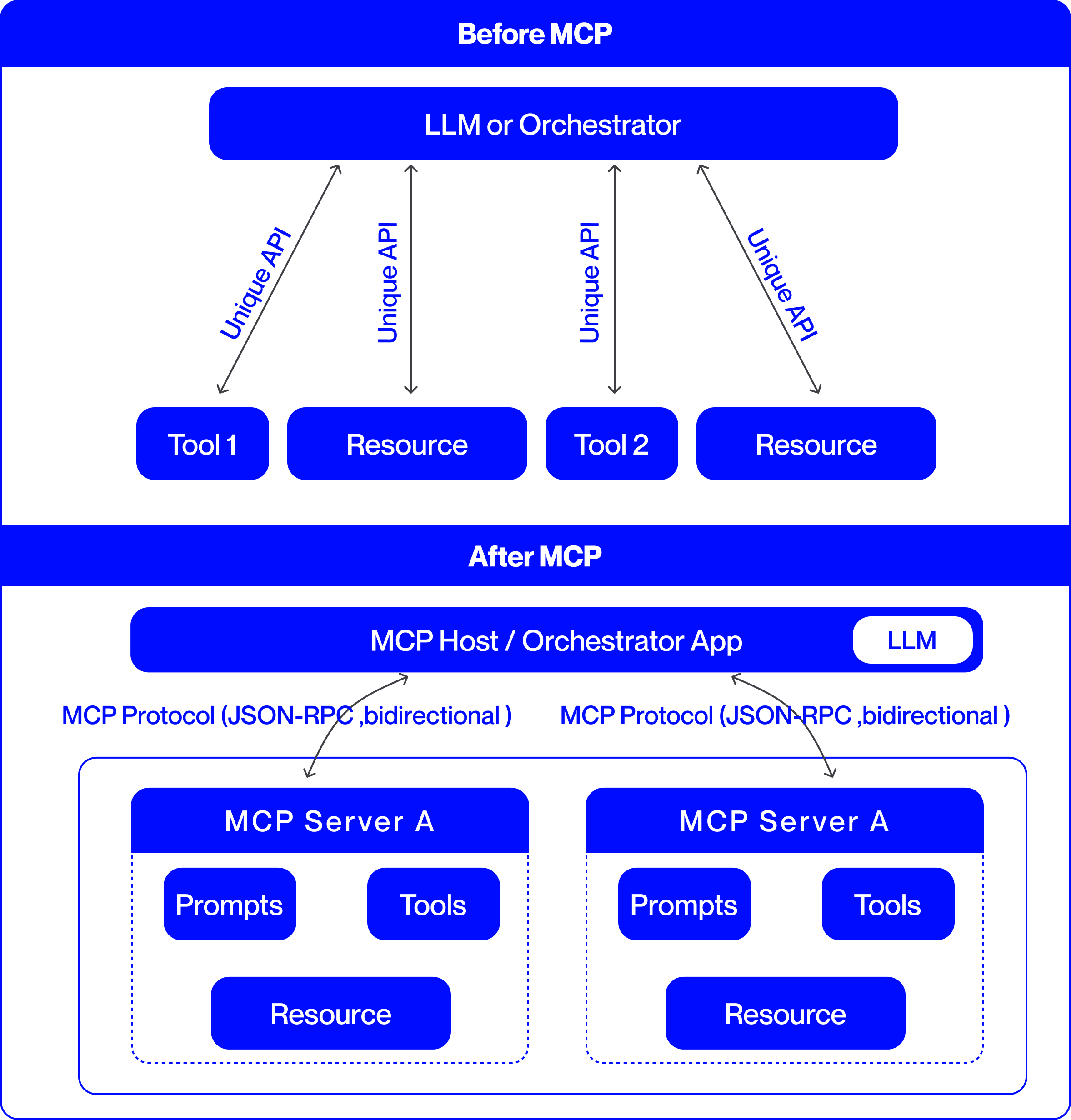
The diagram illustrates a system architecture comparison before and after implementing an MCP (Model Context Protocol) protocol. It shows a transition from a fragmented API-based system to a standardized bidirectional communication framework using JSON-RPC.
### Components/Axes
**Before MCP Section:**
- **Top Component:** LLM or Orchestrator (central node)
- **Connections:**
- Three downward arrows labeled "Unique API"
- Connected to: Tool 1, Resource, Tool 2, Resource
- **Key Elements:**
- Four distinct components (2 tools, 2 resources)
- No shared communication protocol
**After MCP Section:**
- **Top Component:** MCP Host / Orchestrator App (with LLM integration)
- **Protocol:** MCP Protocol (JSON-RPC, bidirectional)
- **Subcomponents:**
- Two identical MCP Server A instances
- Each server contains: Prompts, Tools, Resource
- **Connections:**
- Bidirectional arrows between MCP Host and both servers
- Labeled "MCP Protocol (JSON-RPC, bidirectional)"
### Detailed Analysis
**Before MCP:**
- **Communication Pattern:**
- Point-to-point unique APIs for each connection
- No shared protocol between components
- **Component Relationships:**
- LLM/Orchestrator acts as central hub
- Tools and Resources operate in isolation
- No direct communication between Tools/Resources
**After MCP:**
- **Protocol Standardization:**
- Unified JSON-RPC bidirectional protocol
- Eliminates multiple unique APIs
- **Component Architecture:**
- Centralized MCP Host manages communication
- Two identical MCP Server A instances (potential redundancy/scalability)
- Each server contains: Prompts, Tools, Resource
- **Communication Flow:**
- Bidirectional data exchange between Host and Servers
- LLM integrated into Orchestrator App
### Key Observations
1. **Protocol Reduction:**
- From 3 unique APIs to single bidirectional protocol
- Suggests significant simplification of communication layers
2. **Bidirectional Communication:**
- Enables real-time data exchange between components
- Contrasts with implied unidirectional "Unique API" connections
3. **Server Redundancy:**
- Two identical MCP Server A instances
- Could indicate load balancing or failover capability
4. **LLM Integration:**
- LLM moves from standalone component to Orchestrator App
- Suggests enhanced contextual awareness in orchestration
### Interpretation
The MCP implementation represents a fundamental architectural shift:
1. **From Siloed to Integrated:**
- Eliminates API sprawl through protocol standardization
- Creates unified communication plane via JSON-RPC
2. **Enhanced Orchestration:**
- Centralized MCP Host provides better control
- LLM integration enables context-aware decision making
3. **Scalability Considerations:**
- Dual MCP Server A instances suggest horizontal scaling
- Resource duplication may improve fault tolerance
4. **Operational Efficiency:**
- Bidirectional communication reduces latency
- Standardized protocol simplifies maintenance
The diagram demonstrates a move toward modern API ecosystems where protocol standardization and bidirectional communication replace fragmented point-to-point integrations. The MCP protocol appears to enable more efficient resource coordination while maintaining separation of concerns through dedicated server components.