## Flow Diagram: Multi-Agent Task Execution
### Overview
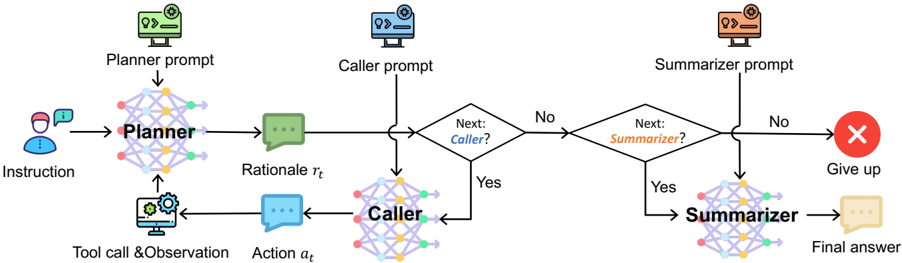
The image is a flow diagram illustrating a multi-agent system designed for task execution. The system involves a Planner, Caller, and Summarizer, each represented as a neural network. The diagram outlines the flow of information and actions between these agents, guided by prompts and decision points.
### Components/Axes
* **Agents:** Planner, Caller, Summarizer (each depicted as a neural network)
* **Inputs:** Instruction, Planner prompt, Caller prompt, Summarizer prompt, Tool call & Observation
* **Outputs:** Rationale r_t, Action a_t, Final answer, Give up
* **Decision Points:** "Next: Caller?", "Next: Summarizer?" (diamond shapes)
* **Flow Direction:** Arrows indicate the direction of information and control flow.
* **Icons:**
* Person icon with speech bubble: Represents the initial instruction.
* Computer screen icons: Represent prompts for each agent (Planner, Caller, Summarizer).
* Speech bubble icons: Represent Rationale, Action, and Final answer.
* Gear icon on a computer screen: Represents Tool call & Observation.
* Red "X" icon: Represents giving up.
### Detailed Analysis or ### Content Details
1. **Instruction:** The process begins with an "Instruction" given to the "Planner".
2. **Planner:**
* Receives an "Instruction" and a "Planner prompt".
* Outputs a "Rationale r_t".
* Receives "Tool call & Observation" as feedback.
3. **Caller:**
* Receives a "Caller prompt" and the "Rationale r_t".
* Outputs an "Action a_t".
4. **Decision Point 1: "Next: Caller?"**
* If "Yes", the flow returns to the "Caller" with "Tool call & Observation".
* If "No", the flow proceeds to the next decision point.
5. **Decision Point 2: "Next: Summarizer?"**
* If "Yes", the flow proceeds to the "Summarizer".
* If "No", the process ends with "Give up".
6. **Summarizer:**
* Receives a "Summarizer prompt".
* Outputs a "Final answer".
### Key Observations
* The system uses a cyclical process involving the Planner and Caller, potentially iterating multiple times based on the "Next: Caller?" decision.
* The Summarizer is invoked only after the Caller process is deemed complete.
* The system has a "Give up" exit point if neither the Caller nor the Summarizer is deemed the next step.
### Interpretation
The diagram illustrates a multi-agent system designed to solve tasks through iterative planning, action, and summarization. The Planner generates a rationale, the Caller executes an action based on that rationale, and the system decides whether to iterate on the action or summarize the results. The decision points ("Next: Caller?", "Next: Summarizer?") suggest a mechanism for adaptive task execution, where the system can dynamically adjust its strategy based on the intermediate results. The "Tool call & Observation" feedback loop allows the Planner to refine its rationale based on the outcomes of the Caller's actions. The "Give up" exit point indicates a mechanism for handling tasks that cannot be solved within the defined framework.