## Joint Contour Plot with Marginal Distributions: General Text vs. Medical Text
### Overview
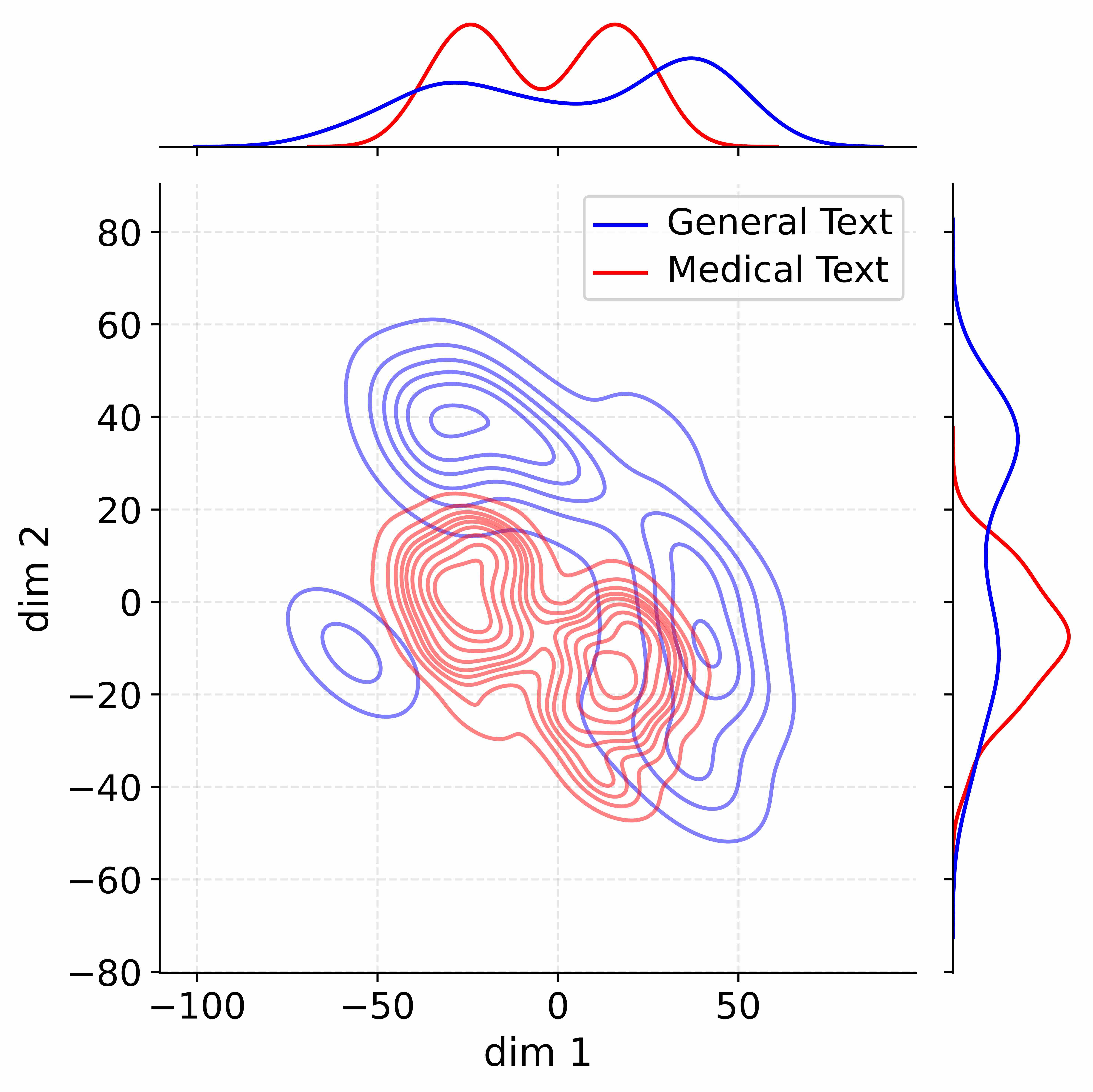
The image is a joint plot visualizing the two-dimensional distribution of two datasets, labeled "General Text" and "Medical Text." It consists of a central contour plot showing the density of data points across two dimensions (`dim 1` and `dim 2`), accompanied by marginal distribution plots (density curves) on the top and right edges. The plot compares the spatial distribution and density of these two text categories in a reduced-dimensional space.
### Components/Axes
* **Main Plot (Center):**
* **X-axis:** Labeled `dim 1`. Ticks are at -100, -50, 0, 50.
* **Y-axis:** Labeled `dim 2`. Ticks are at -80, -60, -40, -20, 0, 20, 40, 60, 80.
* **Data Series:** Represented by contour lines.
* **Blue Contours:** Correspond to "General Text" (confirmed by legend).
* **Red Contours:** Correspond to "Medical Text" (confirmed by legend).
* **Legend:** Located in the top-right quadrant of the main plot area. It contains:
* A blue line segment followed by the text "General Text".
* A red line segment followed by the text "Medical Text".
* **Top Marginal Plot:**
* Displays the kernel density estimate (KDE) for `dim 1`.
* Contains a blue curve (General Text) and a red curve (Medical Text).
* **Right Marginal Plot:**
* Displays the kernel density estimate (KDE) for `dim 2`.
* Contains a blue curve (General Text) and a red curve (Medical Text).
### Detailed Analysis
**1. Main Contour Plot (dim 1 vs. dim 2):**
* **General Text (Blue):** The distribution is broad and multi-modal. The primary density cluster is centered approximately at (`dim 1` ≈ -25, `dim 2` ≈ 40). A secondary, less dense cluster appears around (`dim 1` ≈ 40, `dim 2` ≈ -10). The contours span a wide range: `dim 1` from roughly -80 to +60, and `dim 2` from roughly -50 to +60.
* **Medical Text (Red):** The distribution is more concentrated and appears bimodal. One dense cluster is centered near (`dim 1` ≈ -20, `dim 2` ≈ 0). A second, slightly less dense cluster is near (`dim 1` ≈ 20, `dim 2` ≈ -20). The overall spread is narrower than the General Text: `dim 1` ranges from about -50 to +40, and `dim 2` from about -40 to +20.
* **Overlap:** There is significant overlap between the two distributions in the central region of the plot, roughly between `dim 1` -40 to +30 and `dim 2` -30 to +20.
**2. Marginal Distribution for `dim 1` (Top Plot):**
* **General Text (Blue):** Shows a broad, slightly bimodal distribution. Peaks are approximately at `dim 1` ≈ -30 and `dim 1` ≈ +30. The distribution has a wide base, extending from below -80 to above +60.
* **Medical Text (Red):** Shows a sharper, clearly bimodal distribution. The two peaks are more pronounced and closer together, located approximately at `dim 1` ≈ -20 and `dim 1` ≈ +10. The distribution is narrower, confined mostly between -50 and +40.
**3. Marginal Distribution for `dim 2` (Right Plot):**
* **General Text (Blue):** Exhibits a broad, unimodal (or very subtly bimodal) distribution. The single major peak is centered around `dim 2` ≈ +30. The distribution spans from approximately -60 to +80.
* **Medical Text (Red):** Shows a distinct bimodal distribution. The two peaks are located at approximately `dim 2` ≈ 0 and `dim 2` ≈ -20. The distribution is more compact, ranging from about -50 to +20.
### Key Observations
1. **Dispersion:** The "General Text" dataset is significantly more dispersed in both dimensions compared to the "Medical Text" dataset.
2. **Modality:** The "Medical Text" distribution is clearly bimodal in both the `dim 1` and `dim 2` marginals, suggesting two distinct sub-groups or clusters within this category. The "General Text" is more broadly distributed, with weaker evidence for multiple modes.
3. **Central Tendency:** The center of mass for "Medical Text" is shifted towards lower values on both `dim 1` and `dim 2` compared to the primary cluster of "General Text."
4. **Separation:** While there is overlap, the highest density regions (innermost contours) of the two datasets are distinct. The core of "General Text" is in the upper-left quadrant (negative `dim 1`, positive `dim 2`), while the cores of "Medical Text" are in the lower-central region (near-zero `dim 1`, negative `dim 2`).
### Interpretation
This plot likely visualizes the output of a dimensionality reduction technique (like PCA, t-SNE, or UMAP) applied to text data, where `dim 1` and `dim 2` represent the two most significant derived features.
The data suggests that **"Medical Text" occupies a more specialized and constrained region of this feature space** compared to "General Text." This could reflect the use of a more standardized, technical vocabulary and formulaic structures in medical writing, leading to less variation. The bimodality might indicate two common types of medical documents (e.g., clinical notes vs. research abstracts) or two distinct sub-domains within the medical corpus.
Conversely, **"General Text" is more heterogeneous**, covering a wider range of topics, styles, and vocabularies, which manifests as a broader, more diffuse distribution. The overlap region represents text that shares characteristics with both categories, potentially indicating general health articles or patient-facing materials written in plain language.
The clear separation of the dense cores implies that, based on these two dimensions, it is possible to distinguish between typical medical text and general text with reasonable accuracy. The marginal distributions reinforce this, showing that the statistical properties of the individual dimensions also differ markedly between the two categories.