## Diagram: Comparison of Attention Mechanisms in Transformer Architectures
### Overview
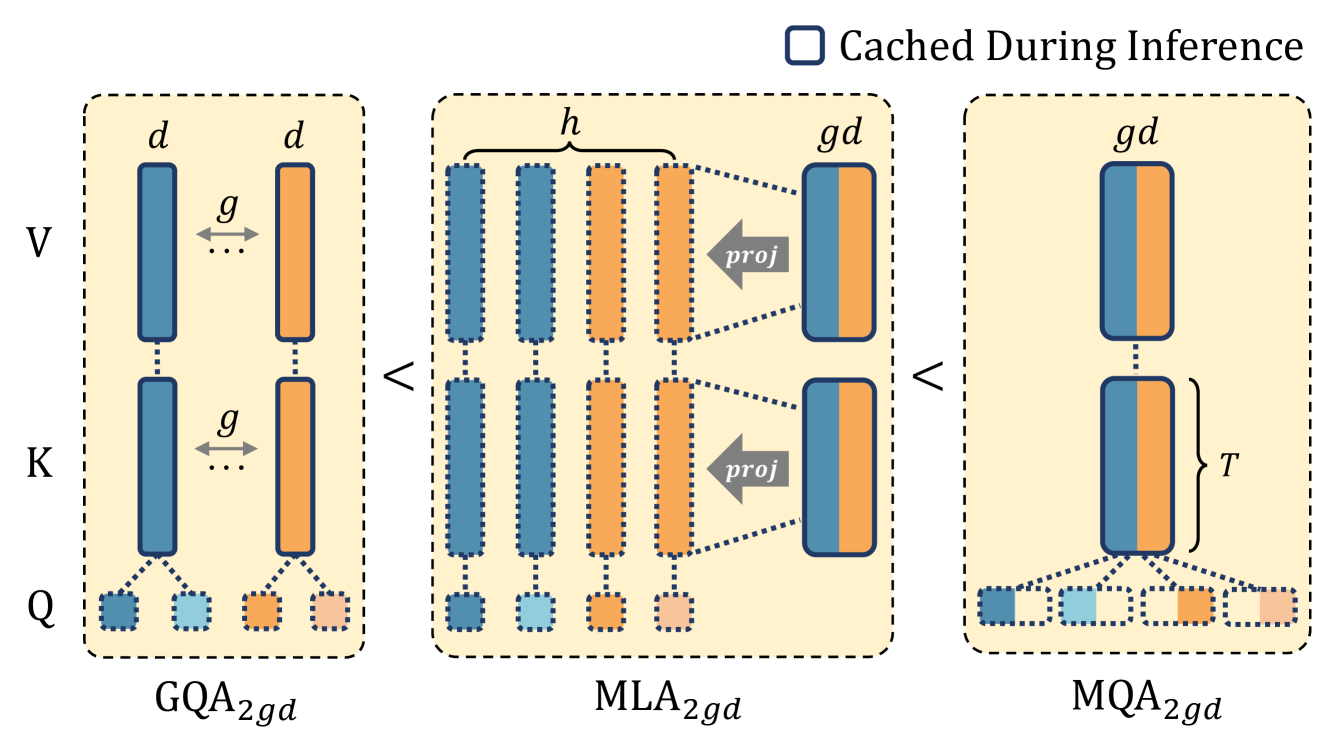
The diagram illustrates three transformer-based attention mechanisms: **GQA2gd**, **MLA2gd**, and **MQA2gd**. Each block represents a distinct architectural approach, with components labeled for query (Q), key (K), value (V), and projection operations. Arrows indicate information flow, and the legend highlights elements "Cached During Inference."
### Components/Axes
1. **GQA2gd Block**:
- **V, K, Q**: Vertical stacks labeled "V" (value), "K" (key), and "Q" (query), with bidirectional arrows labeled "g" between them.
- **Structure**: Simplest configuration, with direct interactions between Q, K, and V.
2. **MLA2gd Block**:
- **h Layers**: Multiple horizontal layers (labeled "h") with alternating blue and orange segments.
- **Projection Arrows**: Labeled "proj," connecting layers to "gd" blocks on the right.
- **Caching**: Blue squares marked "Cached During Inference" at the bottom.
3. **MQA2gd Block**:
- **gd Blocks**: Stacked "gd" components with a "T" block below, connected by arrows.
- **Caching**: Blue and orange squares marked "Cached During Inference" at the bottom.
4. **Legend**:
- **Cached During Inference**: Blue square symbol, applied to specific components in MLA2gd and MQA2gd.
### Detailed Analysis
- **GQA2gd**:
- Direct interactions between Q, K, and V via "g" arrows. No projections or caching.
- Simplest architecture, likely representing a baseline.
- **MLA2gd**:
- Introduces **h layers** with internal structure (blue/orange segments).
- Projections ("proj") aggregate outputs into "gd" blocks.
- Caching applied to bottom-layer components (blue squares).
- **MQA2gd**:
- Stacked "gd" blocks with a "T" component below, suggesting hierarchical processing.
- Caching applied to both blue and orange squares, indicating broader reuse.
### Key Observations
- **Complexity Progression**: GQA2gd < MLA2gd < MQA2gd in terms of architectural layers and operations.
- **Caching Strategy**: MQA2gd caches more components (both colors) than MLA2gd (only blue).
- **Projection Usage**: MLA2gd relies heavily on projections to consolidate layer outputs.
### Interpretation
This diagram highlights trade-offs in transformer attention mechanisms:
1. **GQA2gd** prioritizes simplicity, with minimal computational overhead but limited scalability.
2. **MLA2gd** introduces layered processing (via "h") and selective caching, balancing efficiency and complexity.
3. **MQA2gd** optimizes further by caching both query and key-value components (via "T"), likely reducing redundant computations during inference.
The "Cached During Inference" label suggests these mechanisms aim to improve latency by reusing precomputed values. MQA2gd’s dual caching (blue/orange) may reflect a more aggressive optimization strategy compared to MLA2gd’s single-color caching. The progression implies a design philosophy where later architectures (MLA2gd, MQA2gd) address scalability and efficiency challenges inherent in simpler models like GQA2gd.