## Diagram: Sequential Process Simulation
### Overview
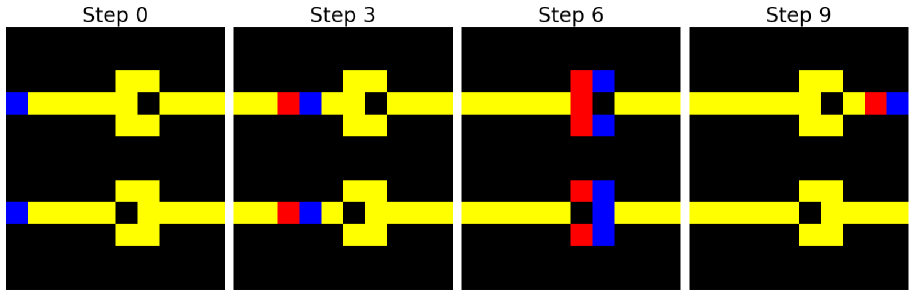
The image displays a four-panel sequence illustrating a process over discrete time steps. Each panel is labeled with a step number (Step 0, Step 3, Step 6, Step 9) and contains two identical rows, suggesting a parallel or redundant system. The diagram uses a simple grid-based visual language with colored blocks on a black background to represent states and movements.
### Components/Axes
* **Panels:** Four distinct panels arranged horizontally, labeled at the top center of each: "Step 0", "Step 3", "Step 6", "Step 9".
* **Rows:** Each panel contains two identical horizontal rows. Each row consists of a central yellow structure and colored blocks.
* **Yellow Structure:** A horizontal yellow line with a central square "node" or "gate". This structure is static across all steps and rows.
* **Colored Blocks:** Three colors are used:
* **Blue:** Appears as a single block.
* **Red:** Appears as a single block.
* **Yellow:** Forms the static pathway structure.
* **Spatial Layout:** The yellow structure runs horizontally across the center of each row. The colored blocks appear on this line, to the left or right of the central yellow square.
### Detailed Analysis
The process depicts the movement and interaction of a blue block and a red block along the yellow pathway.
* **Step 0:**
* **Top Row:** A blue block is positioned at the far left end of the yellow line.
* **Bottom Row:** Identical to the top row. A blue block is at the far left end.
* **Trend:** Initial state. Only blue blocks are present, located at the entry point (left).
* **Step 3:**
* **Top Row:** A red block and a blue block are now present. The red block is immediately to the left of the central yellow square. The blue block is immediately to the right of the central yellow square.
* **Bottom Row:** Identical configuration to the top row.
* **Trend:** Both colored blocks have appeared and moved towards the center. The red block approaches from the left, the blue from the right (or has passed through).
* **Step 6:**
* **Top Row:** The red and blue blocks are now overlapping or merged at the central yellow square. The visual shows a red block on the left half and a blue block on the right half of the central node.
* **Bottom Row:** Identical configuration to the top row.
* **Trend:** The two blocks have converged at the central node, indicating an interaction, collision, or processing step.
* **Step 9:**
* **Top Row:** The red and blue blocks are now together at the far right end of the yellow line. The red block is to the left of the blue block.
* **Bottom Row:** Identical configuration to the top row.
* **Trend:** The combined red-blue entity has exited the central node and moved to the endpoint (right).
### Key Observations
1. **Perfect Synchronization:** The top and bottom rows in every panel are perfectly identical, indicating a deterministic process or a system with two parallel, synchronized channels.
2. **Discrete Movement:** The blocks move in discrete jumps between key positions (left end, center-left, center, right end) rather than continuous motion.
3. **Interaction at Center:** The central yellow square acts as a meeting point or processing unit where the red and blue blocks interact (Step 6).
4. **Combined Output:** The process concludes with both blocks exiting together as a pair (Step 9).
### Interpretation
This diagram is an abstract representation of a **sequential process involving two distinct entities (red and blue) that interact within a system (yellow structure)**.
* **What it demonstrates:** It models a workflow where two inputs (red and blue) are introduced into a system, converge at a central processing node, and are then output together. The identical rows suggest the process is reliable or duplicated for redundancy.
* **Relationships:** The yellow structure defines the system's pathway and processing point. The red and blue blocks are the dynamic elements being processed. Their movement from left to right defines the process flow.
* **Notable Patterns:** The symmetry and determinism are striking. There are no deviations or errors shown. The "merging" in Step 6 is the critical transformation step. The final state (Step 9) shows the outputs are co-located but retain their individual identities (red left of blue).
* **Potential Analogies:** This could represent:
* Data packets (red/blue) traveling through a network switch (central node).
* Two chemical reactants flowing through a channel and mixing in a reactor.
* A simple state machine or cellular automaton rule.
* A logic gate simulation where two inputs produce a combined output.
The diagram prioritizes clarity of sequence and interaction over physical realism, making it effective for explaining a fundamental process flow.