\n
## Line Chart: Similarity vs. Reasoning Step
### Description
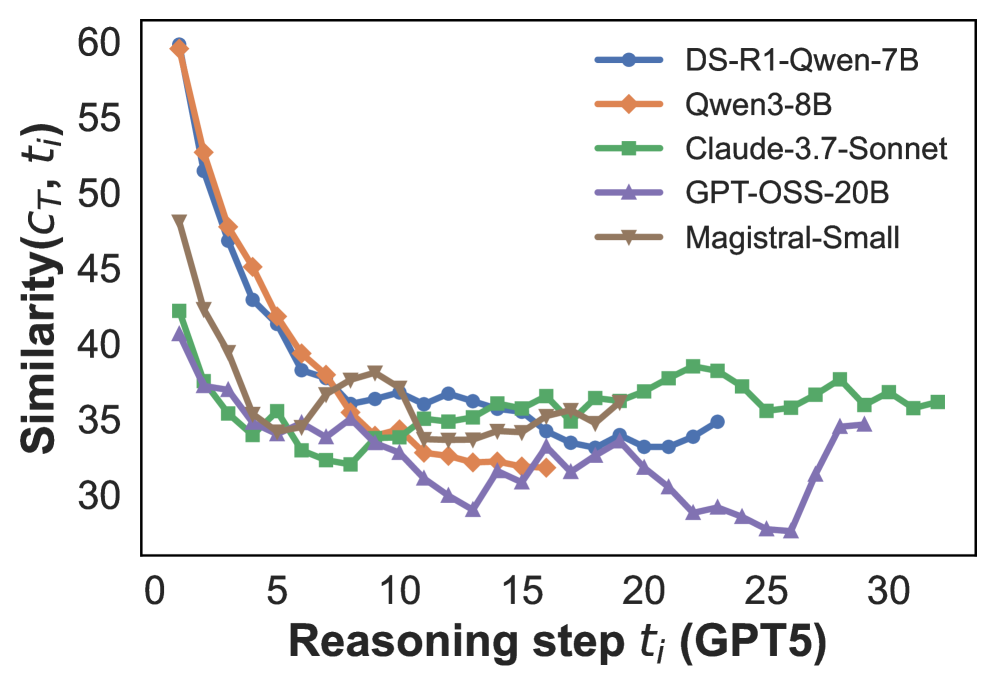
This line chart visualizes the relationship between similarity scores and reasoning steps. The x-axis represents the reasoning step (from 0 to 7), and the y-axis represents the similarity score (ranging from 0.0 to 1.0).
### Data
The chart displays two lines:
* **Train Data:** This line shows the similarity scores for the training dataset. It generally starts at a higher similarity score (around 0.8) at step 0 and gradually decreases as the reasoning step increases, eventually leveling off around 0.2-0.3 by step 7. There are some fluctuations along the way.
* **Test Data:** This line represents the similarity scores for the test dataset. It begins at a lower similarity score (around 0.4) at step 0 compared to the train data. It also decreases with increasing reasoning steps, but at a slower rate, ending around 0.1-0.2 at step 7. It exhibits more pronounced fluctuations than the train data.
### Key Observations
* The train data consistently exhibits higher similarity scores than the test data across all reasoning steps.
* Both train and test data show a negative correlation between reasoning step and similarity score – as the reasoning step increases, the similarity score tends to decrease.
* The test data demonstrates greater variability in similarity scores compared to the train data.
### Potential Implications
This suggests that the model performs better on the training data, as expected, and that the similarity between the model's reasoning and the ground truth decreases as the reasoning process becomes more complex (i.e., more reasoning steps are involved). The higher variability in the test data could indicate that the model is less robust or generalizes less effectively to unseen examples.
```