## Grid and Function Graphs: Mathematical Representation
### Overview
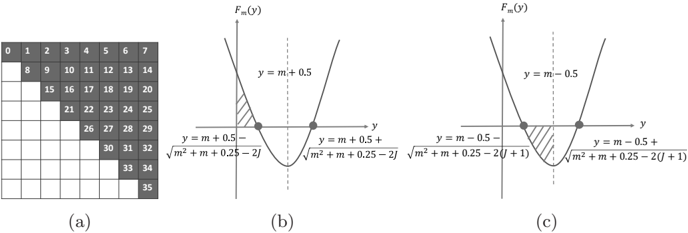
The image consists of three components:
1. A numerical grid (a) with shaded cells
2. Two function graphs (b and c) depicting Fₘ(y) with mathematical equations
3. Vertical dashed lines and shaded regions indicating specific mathematical relationships
### Components/Axes
**Grid (a):**
- **Rows:** Labeled 0–7 (vertical axis)
- **Columns:** Labeled 8–35 (horizontal axis)
- **Shaded Cells:**
- Row 0: Columns 8–14
- Row 1: Columns 15–20
- Row 2: Columns 21–25
- Row 3: Columns 26–29
- Row 4: Columns 30–32
- Row 5: Columns 33–34
- Row 6: Column 35
**Graphs (b and c):**
- **Y-axis:** Fₘ(y) (function value)
- **X-axis:** y (variable)
- **Vertical Dashed Line:** y = m (critical threshold)
- **Legend:** Shaded region labeled "Fₘ(y)"
### Detailed Analysis
**Grid (a):**
- Shaded cells form a stepped pattern, increasing in column count per row until row 3, then decreasing.
- Total shaded cells: 35 (matches column 35 in row 6).
**Graph (b):**
- **Equations:**
- Upper boundary: y = m + 0.5 + √(m² + m + 0.25 − 2J)
- Lower boundary: y = m + 0.5 − √(m² + m + 0.25 − 2J)
- **Shaded Region:** Between the two curves, symmetric about y = m + 0.5.
- **Vertical Dashed Line:** At y = m, intersecting the shaded region.
**Graph (c):**
- **Equations:**
- Upper boundary: y = m − 0.5 + √(m² + m + 0.25 − 2(J + 1))
- Lower boundary: y = m − 0.5 − √(m² + m + 0.25 − 2(J + 1))
- **Shaded Region:** Between the two curves, symmetric about y = m − 0.5.
- **Vertical Dashed Line:** At y = m, intersecting the shaded region.
### Key Observations
1. **Grid Pattern:** Shaded cells suggest a hierarchical or tiered structure, with diminishing density in higher rows.
2. **Graph Symmetry:** Both graphs exhibit parabolic symmetry around their respective midlines (y = m ± 0.5).
3. **Parameter Sensitivity:**
- Graph (b) uses J, while graph (c) uses J + 1, shifting the curves downward.
- The square root terms imply constraints on J (e.g., m² + m + 0.25 − 2J ≥ 0).
### Interpretation
- **Grid (a):** Likely represents a matrix or heatmap where shaded cells encode specific values (e.g., active states, thresholds). The stepped pattern may reflect a decay or prioritization mechanism.
- **Graphs (b and c):** Model a function Fₘ(y) with parameter-dependent bounds. The shaded regions could represent allowable ranges or confidence intervals.
- Graph (b) corresponds to J, while graph (c) adjusts for J + 1, suggesting iterative or incremental analysis.
- The vertical dashed line (y = m) acts as a reference point, possibly a mean or critical value.
- **Mathematical Relationships:** The equations highlight dependencies on m and J, with the square root terms introducing nonlinear constraints.
This structure suggests a system where grid-based data (a) informs parameter choices (m, J) in the function graphs (b, c), with shaded regions visualizing solution spaces or valid ranges.