\n
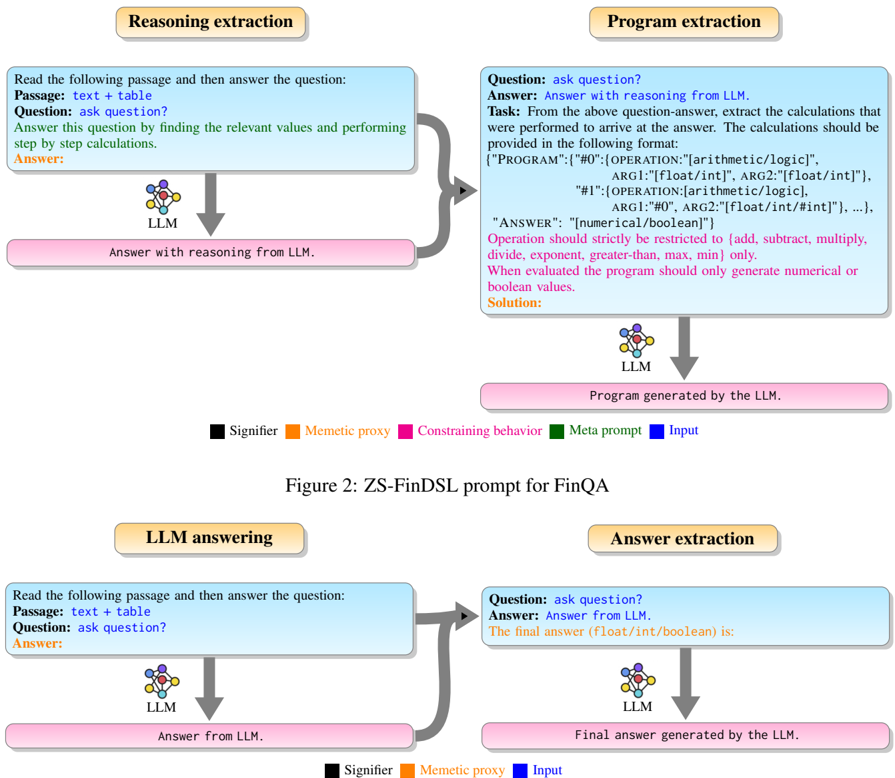
## Diagram: ZS-FinDSL Prompt for FinQA
### Overview
This diagram illustrates the process of using a ZS-FinDSL (Zero-Shot Financial Domain-Specific Language) prompt for Financial Question Answering (FinQA). It depicts two main workflows: Reasoning Extraction and Program Extraction, each with an LLM (Large Language Model) at its core. The diagram highlights the input, processing steps, and output for each workflow.
### Components/Axes
The diagram is segmented into four main sections, each representing a stage in the process. These are:
1. **Reasoning Extraction (Top-Left):** Input: Passage + Table, Question. Output: Answer with reasoning from LLM.
2. **Program Extraction (Top-Right):** Input: Question. Output: Program generated by the LLM.
3. **LLM Reasoning and Answering (Bottom-Left):** Input: Passage + Table, Question. Output: Answer from LLM.
4. **Answer Extraction (Bottom-Right):** Input: Question. Output: Final answer generated by the LLM.
A legend at the bottom of the diagram defines the color coding:
* **Signifier** (Red)
* **Memetic proxy** (Orange)
* **Constraining behavior** (Green)
* **Meta prompt** (Blue)
* **Input** (Grey)
The diagram also includes a title: "Figure 2: ZS-FinDSL prompt for FinQA".
### Detailed Analysis or Content Details
**Reasoning Extraction:**
* Input is labeled "Passage: text + table" and "Question: ask question?".
* The LLM is depicted as a rounded rectangle labeled "LLM".
* Output is labeled "Answer with reasoning from LLM."
* The flow is from Input -> LLM -> Output.
**Program Extraction:**
* Input is labeled "Question: ask question?".
* The task description within the input box states: "Answer: Answer with reasoning from LLM. Task: From the above question-answer, extract the calculations that were performed to arrive at the answer. The calculations should be provided in the following format: {"PROGRAM": "#0": OPERATION: [arithmetic/logic], ARG1: [float/int], ARG2: [float/int"], "#1": OPERATION: [arithmetic/logic], ARG1: [float/int], ARG2: [float/int"]...}. Operation should strictly be restricted to [add, subtract, multiply, divide, exponent, greater-than, max, min] only. When evaluated the program should only generate numerical or boolean values. Solution:".
* The LLM is depicted as a rounded rectangle labeled "LLM".
* Output is labeled "Program generated by the LLM."
* The flow is from Input -> LLM -> Output.
**LLM Reasoning and Answering:**
* Input is labeled "Passage: text + table" and "Question: ask question?".
* The LLM is depicted as a rounded rectangle labeled "LLM".
* Output is labeled "Answer from LLM."
* The flow is from Input -> LLM -> Output.
**Answer Extraction:**
* Input is labeled "Question: ask question?".
* The task description within the input box states: "Answer: Answer from LLM. The final answer (float/int/boolean) is:".
* The LLM is depicted as a rounded rectangle labeled "LLM".
* Output is labeled "Final answer generated by the LLM."
* The flow is from Input -> LLM -> Output.
The color coding is applied to the arrows connecting the components, indicating the type of process or information flow.
### Key Observations
The diagram clearly shows a two-pronged approach to FinQA: one focusing on reasoning and the other on program extraction. Both workflows utilize an LLM as the central processing unit. The diagram emphasizes the importance of structured input and output formats, particularly in the Program Extraction workflow. The legend provides a visual key to understanding the different types of information flow within the system.
### Interpretation
The diagram illustrates a sophisticated approach to FinQA that leverages the capabilities of LLMs in two distinct ways. The Reasoning Extraction workflow aims to provide a human-understandable explanation for the answer, while the Program Extraction workflow focuses on identifying the underlying calculations or logic used to arrive at the answer. This dual approach allows for both interpretability and verifiability of the LLM's responses. The use of a specific program format suggests a desire to create a system that can be easily evaluated and debugged. The color coding helps to visualize the different aspects of the process, such as the input data, the LLM's reasoning, and the constraints imposed on the output. The diagram suggests a system designed for both accuracy and transparency in financial question answering. The separation of reasoning and program extraction indicates a modular design, potentially allowing for independent improvement of each component.