## Diagram: AI System Architecture
### Overview
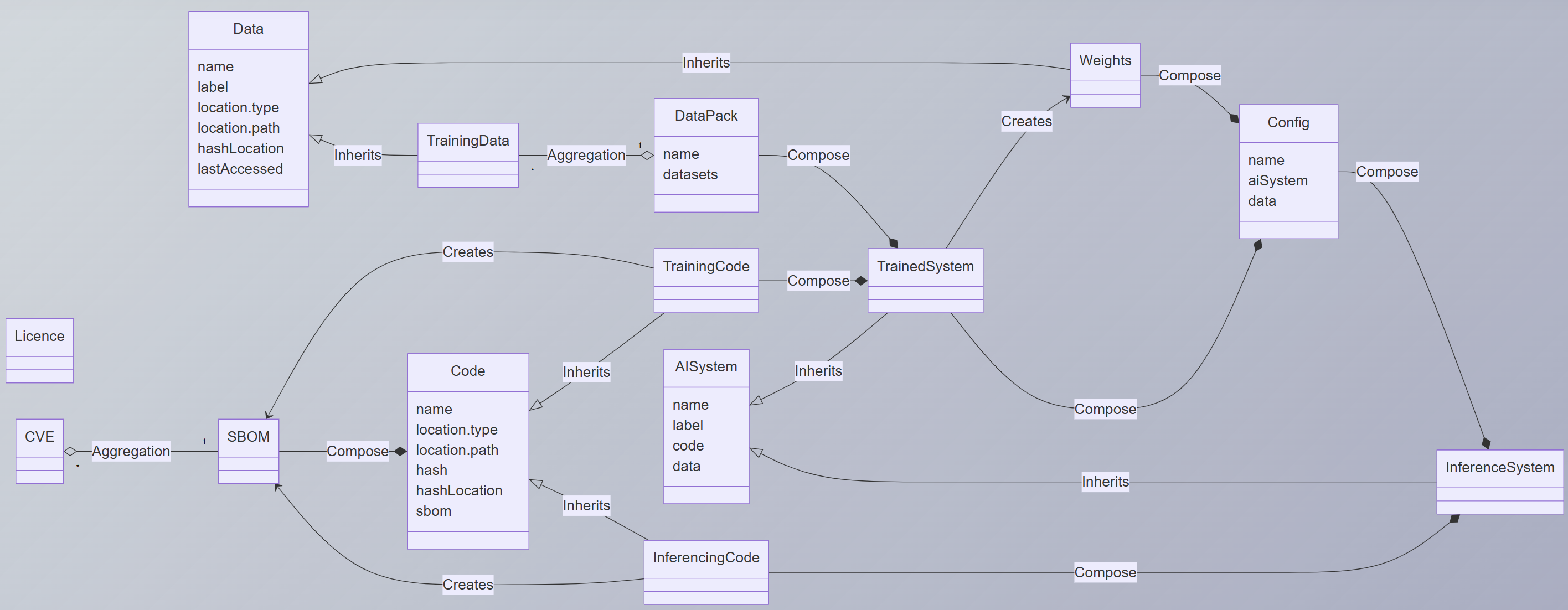
The image is a diagram illustrating the architecture of an AI system, showing the relationships between various components such as data, code, models, and configurations. The diagram uses UML-like notation to represent classes and their relationships (inheritance, composition, aggregation).
### Components/Axes
The diagram consists of several rectangular boxes representing different components of the AI system. Each box is divided into two sections: the top section contains the name of the component, and the bottom section lists attributes or properties associated with that component. The relationships between components are indicated by arrows labeled with the type of relationship (e.g., "Inherits", "Compose", "Aggregation", "Creates").
The components are:
* **Data**: Attributes include name, label, location.type, location.path, hashLocation, lastAccessed. Located at the top-left of the diagram.
* **TrainingData**: No attributes listed. Located below and to the right of "Data".
* **DataPack**: Attributes include name, datasets. Located to the right of "TrainingData".
* **TrainingCode**: No attributes listed. Located below "DataPack".
* **TrainedSystem**: No attributes listed. Located to the right of "TrainingCode".
* **Weights**: No attributes listed. Located at the top-right of the diagram.
* **Config**: Attributes include name, aiSystem, data. Located below "Weights".
* **InferenceSystem**: No attributes listed. Located at the bottom-right of the diagram.
* **Code**: Attributes include name, location.type, location.path, hash, hashLocation, sbom. Located in the bottom-left quadrant of the diagram.
* **AISystem**: Attributes include name, label, code, data. Located to the right and slightly above "Code".
* **InferencingCode**: No attributes listed. Located below "AISystem".
* **Licence**: No attributes listed. Located at the bottom-left of the diagram.
* **CVE**: No attributes listed. Located to the left of "SBOM".
* **SBOM**: No attributes listed. Located to the right of "CVE".
The relationships are:
* **Inherits**: Data inherits from TrainingData, Code inherits from AISystem, Code inherits from InferencingCode, AISystem inherits from TrainedSystem, Config inherits from InferenceSystem.
* **Aggregation**: TrainingData aggregates DataPack, CVE aggregates SBOM. The multiplicity is indicated as "*" for TrainingData and CVE, and "1" for DataPack and SBOM.
* **Compose**: DataPack composes TrainedSystem, TrainingCode composes TrainedSystem, Weights composes Config, Config composes InferenceSystem, SBOM composes TrainedSystem, AISystem composes TrainedSystem, InferencingCode composes InferenceSystem.
* **Creates**: TrainingData creates TrainingCode, Weights creates Config, Code creates InferencingCode.
### Detailed Analysis or ### Content Details
* **Data** inherits into **TrainingData**.
* **TrainingData** has an aggregation relationship with **DataPack** (many to one).
* **DataPack** composes into **TrainedSystem**.
* **DataPack** also composes into **TrainingCode**.
* **TrainingCode** composes into **TrainedSystem**.
* **Weights** composes into **Config**.
* **Config** composes into **InferenceSystem**.
* **Code** inherits into **AISystem**.
* **AISystem** inherits into **TrainedSystem**.
* **AISystem** has attributes name, label, code, and data.
* **Code** has attributes name, location.type, location.path, hash, hashLocation, and sbom.
* **Code** creates **InferencingCode**.
* **InferencingCode** composes into **InferenceSystem**.
* **Config** has attributes name, aiSystem, and data.
* **CVE** has an aggregation relationship with **SBOM** (many to one).
* **SBOM** composes into **TrainedSystem**.
### Key Observations
* The diagram illustrates a hierarchical structure with inheritance and composition relationships.
* The "TrainedSystem" component appears to be a central hub, composed of multiple other components.
* Data and code are separated into distinct components, with clear relationships defined.
* The diagram includes security-related components like "CVE" and "SBOM", suggesting a focus on security considerations.
### Interpretation
The diagram provides a high-level overview of the architecture of an AI system, emphasizing the relationships between different components. It highlights the flow of data and code through the system, from initial data collection and training to inference and deployment. The use of inheritance and composition suggests a modular and reusable design. The inclusion of security-related components indicates a focus on addressing potential vulnerabilities and ensuring the integrity of the system. The diagram suggests that the TrainedSystem is the core component, integrating data, code, and configurations to perform its intended function.