## UML Class Diagram: AI System Lifecycle and Components
### Overview
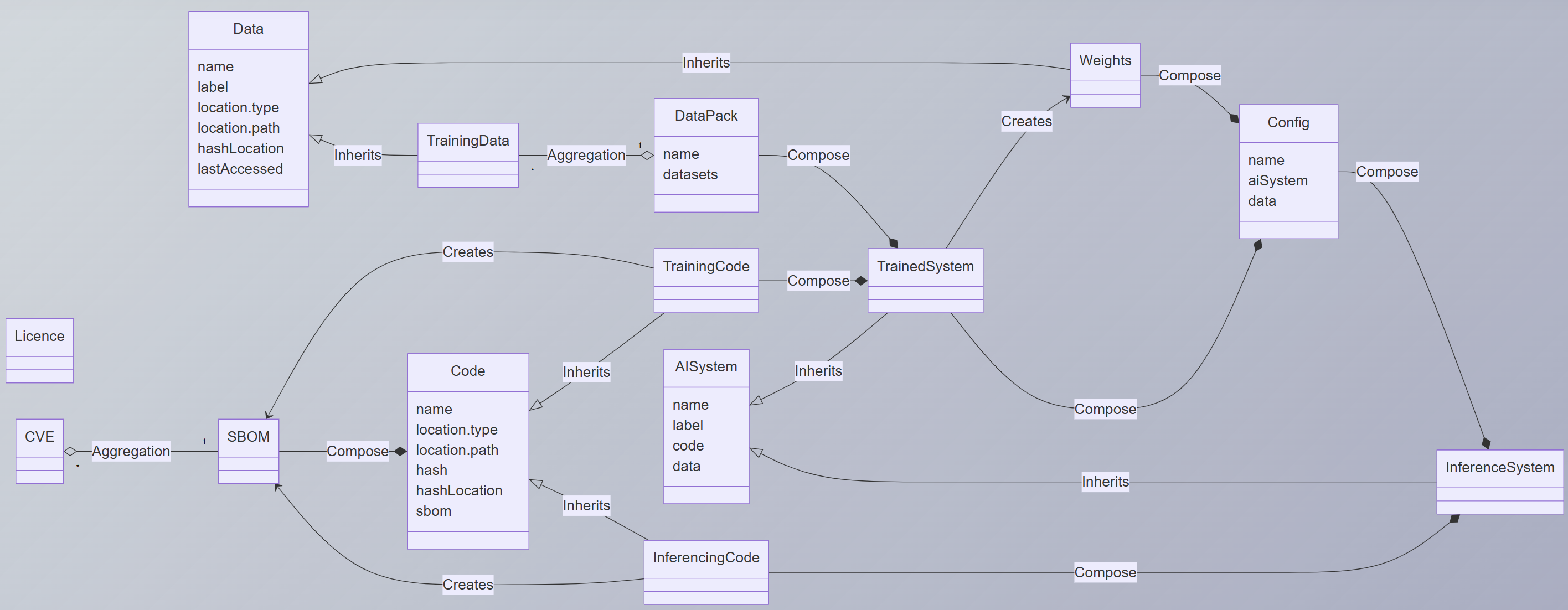
This image is a Unified Modeling Language (UML) class diagram illustrating the structural relationships and data flow between components involved in the lifecycle of an Artificial Intelligence (AI) system. It models entities from raw data and code, through training, to a deployed inference system, including aspects of security and licensing.
### Components/Classes
The diagram consists of 14 distinct classes (represented as boxes) connected by labeled relationship arrows. Each class contains a list of its attributes.
**Classes and their Attributes:**
1. **Data** (Top-left)
* `name`
* `label`
* `location.type`
* `location.path`
* `hashLocation`
* `lastAccessed`
2. **TrainingData** (Below Data)
* (No attributes listed in the visible compartment)
3. **DataPack** (Center-top)
* `name`
* `datasets`
4. **Weights** (Top-right)
* (No attributes listed in the visible compartment)
5. **Config** (Right of Weights)
* `name`
* `aiSystem`
* `data`
6. **TrainingCode** (Center)
* (No attributes listed in the visible compartment)
7. **TrainedSystem** (Center-right)
* (No attributes listed in the visible compartment)
8. **AISystem** (Below TrainedSystem)
* `name`
* `label`
* `code`
* `data`
9. **InferenceSystem** (Bottom-right)
* (No attributes listed in the visible compartment)
10. **Code** (Center-left)
* `name`
* `location.type`
* `location.path`
* `hash`
* `hashLocation`
* `sbom`
11. **InferencingCode** (Below Code)
* (No attributes listed in the visible compartment)
12. **SBOM** (Left, connected to Code)
* (No attributes listed in the visible compartment)
13. **Licence** (Far left, isolated)
* (No attributes listed in the visible compartment)
14. **CVE** (Far left, below Licence)
* (No attributes listed in the visible compartment)
### Detailed Analysis: Relationships and Flow
The classes are interconnected through four primary types of relationships, indicated by arrow styles and labels:
1. **Inheritance (Generalization):** Represented by a solid line with a hollow, triangular arrowhead pointing to the parent class.
* `TrainingData` **Inherits** from `Data`.
* `AISystem` **Inherits** from `TrainedSystem`.
* `InferenceSystem` **Inherits** from `AISystem`.
* `Code` **Inherits** from `InferencingCode` (Note: The arrow direction suggests `InferencingCode` is a subclass of `Code`).
2. **Aggregation:** Represented by a solid line with a hollow diamond at the container end.
* `DataPack` has an **Aggregation** relationship with `TrainingData`. The multiplicity is `1` DataPack to `*` (many) TrainingData items.
* `SBOM` has an **Aggregation** relationship with `CVE`. The multiplicity is `1` SBOM to `*` (many) CVEs.
3. **Composition:** Represented by a solid line with a filled diamond at the container end. This implies a strong "owns" relationship.
* `DataPack` **Composes** `TrainedSystem`.
* `TrainingCode` **Composes** `TrainedSystem`.
* `Weights` **Composes** `Config`.
* `Config` **Composes** `InferenceSystem`.
* `AISystem` **Composes** `InferenceSystem`.
* `Code` **Composes** `SBOM`.
* `InferencingCode` **Composes** `InferenceSystem`.
4. **Creation Dependency:** Represented by a dashed line with an open arrowhead and the label "Creates".
* `TrainingCode` **Creates** `SBOM`.
* `InferencingCode` **Creates** `SBOM`.
### Key Observations
* **Central Hub:** The `TrainedSystem` class acts as a central hub, composed by both `DataPack` (data) and `TrainingCode` (code), and is the parent of the `AISystem`.
* **Lifecycle Flow:** The diagram suggests a clear pipeline: `Data` -> `TrainingData` -> `DataPack` -> `TrainedSystem`. Parallel to this, `Code` -> `TrainingCode` -> `TrainedSystem`. The `TrainedSystem` then evolves into an `AISystem` and finally an `InferenceSystem` for deployment.
* **Security & Compliance Integration:** The inclusion of `SBOM` (Software Bill of Materials) and `CVE` (Common Vulnerabilities and Exposures) as components created by code and aggregating security vulnerabilities highlights a focus on supply chain security and vulnerability management.
* **Configuration Separation:** The `Config` class, which composes `Weights` and is itself composed by the `InferenceSystem`, separates model configuration and parameters from the core system logic.
* **Isolated Element:** The `Licence` class is present but has no connecting relationships in this view, suggesting it may be a metadata element not directly tied to the operational flow depicted.
### Interpretation
This diagram provides a structural blueprint for an AI system's asset management and lifecycle. It emphasizes **modularity** and **traceability**.
* **What it demonstrates:** It models how an AI system is not a monolithic entity but an assembly of distinct, traceable components: data assets (`Data`, `TrainingData`), code artifacts (`Code`, `TrainingCode`), and the resulting trained models (`TrainedSystem`, `Weights`). The relationships show provenance—what creates or owns what.
* **How elements relate:** The flow moves from raw ingredients (Data, Code) through a training process (involving DataPack and TrainingCode) to produce a trained asset (TrainedSystem). This asset is then specialized (AISystem) and packaged with configuration (Config) for deployment (InferenceSystem). The parallel creation of an SBOM by the code components integrates security auditing directly into the development lifecycle.
* **Notable Implications:** The model prioritizes **reproducibility** (via hashing attributes in `Data` and `Code`) and **security** (via SBOM/CVE aggregation). The inheritance hierarchy (`TrainedSystem` -> `AISystem` -> `InferenceSystem`) suggests a progressive specialization of the system for different purposes, from a general trained model to a deployable service. The absence of a link to `Licence` might indicate a gap in modeling legal compliance within this specific diagram view.