## Diagram: Network Transformation with β Operator
### Overview
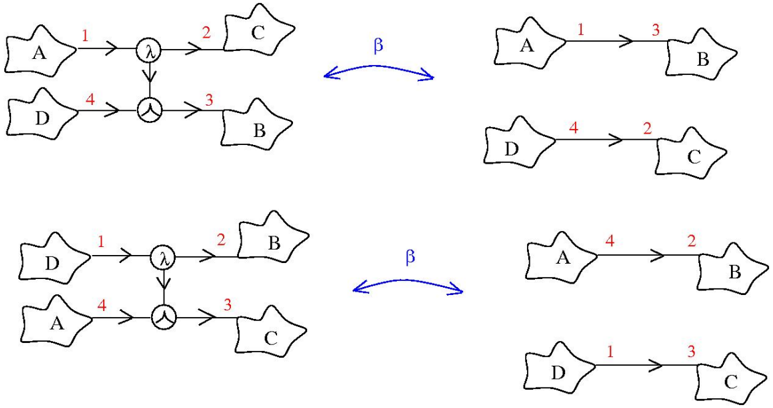
The image presents two interconnected diagrams illustrating a network transformation process mediated by a β operator. Each diagram consists of four nodes (A, B, C, D) connected by labeled pathways (1-4), with a central λ node acting as an intermediary. The β operator (blue bidirectional arrows) indicates a reversible transformation between the two network configurations.
### Components/Axes
- **Nodes**:
- A, B, C, D (represented as irregular polygons)
- λ (central circular node with bidirectional arrows)
- **Pathways**:
- Labeled 1-4 (red numerals) indicating directional connections
- β operator (blue bidirectional arrows) between diagrams
- **Flow Direction**:
- Top diagram: A→λ→C (1→2), D→λ→B (4→3)
- Bottom diagram: A→B (4→2), D→C (1→3)
- **Transformation**:
- β operator connects top and bottom diagrams bidirectionally
### Detailed Analysis
1. **Top Diagram Configuration**:
- A connects to λ via pathway 1 (A→λ)
- λ connects to C via pathway 2 (λ→C)
- D connects to λ via pathway 4 (D→λ)
- λ connects to B via pathway 3 (λ→B)
2. **Bottom Diagram Configuration**:
- A connects directly to B via pathway 4 (A→B)
- D connects directly to C via pathway 1 (D→C)
- Pathways 2 and 3 are absent in this configuration
3. **β Operator Function**:
- Reversible transformation between configurations
- Preserves pathway numbering but alters node connections
- Suggests permutation of network topology
### Key Observations
- Pathway 4 maintains consistent directionality (A→B in bottom, D→λ in top)
- Pathway 1 changes from A→λ (top) to D→C (bottom)
- Central λ node disappears in bottom configuration
- β operator enables bidirectional network reconfiguration
### Interpretation
This diagram illustrates a network reconfiguration process where the β operator facilitates:
1. **Topological Permutation**: Rearrangement of node connections while preserving pathway labels
2. **Central Node Elimination**: The λ node's role is bypassed in the transformed network
3. **Directional Consistency**: Some pathways maintain their original directionality despite network changes
The transformation suggests a system capable of dynamic reconfiguration while maintaining certain operational constraints (pathway numbering). The disappearance of the central λ node in the transformed state implies a shift from a hub-and-spoke model to a more direct peer-to-peer configuration. The β operator's bidirectional nature indicates the process is reversible, allowing the network to toggle between these two states.