## Heatmap: Loudspeaker Acoustic Transfer Function
### Overview
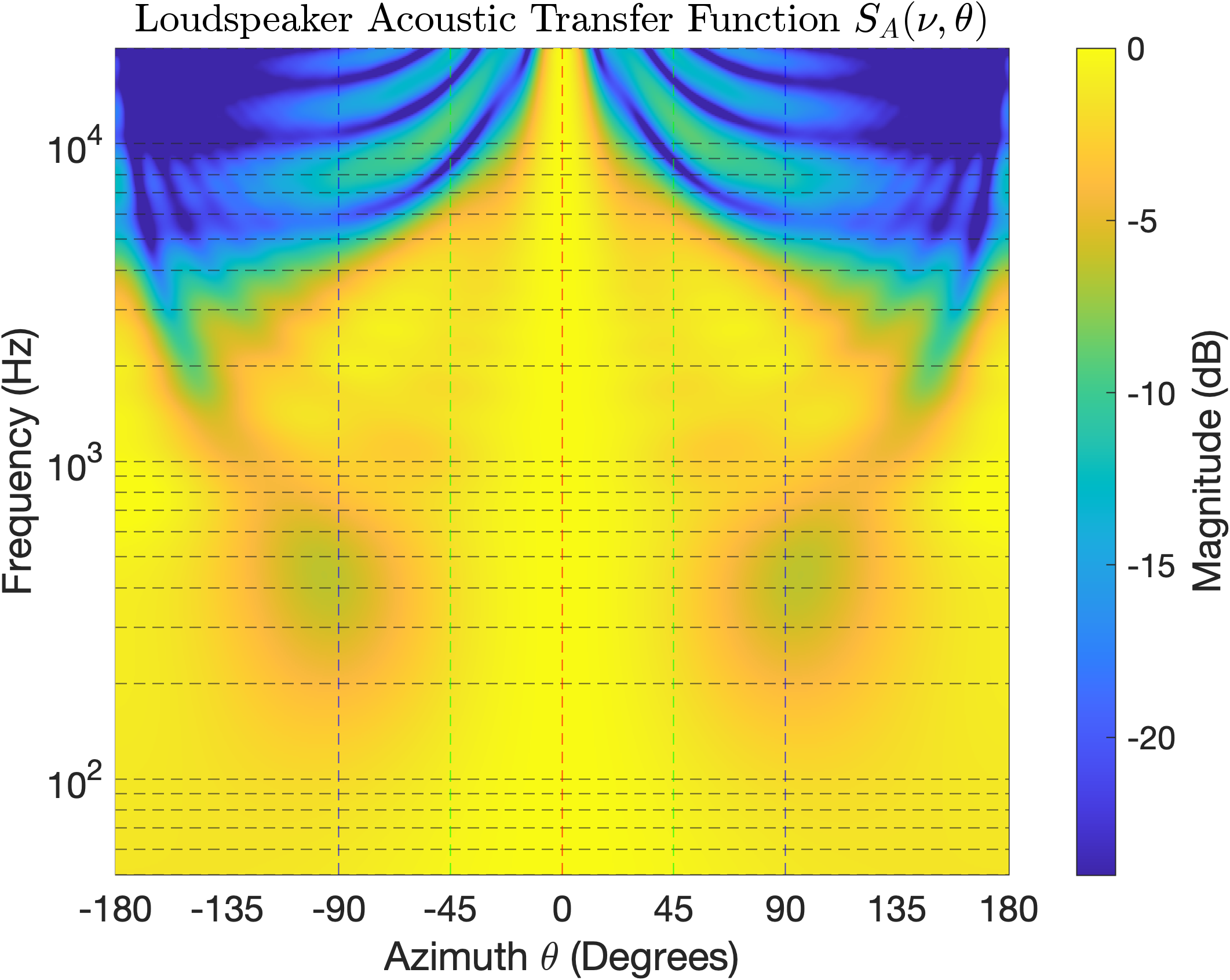
The image is a heatmap visualizing the acoustic transfer function of a loudspeaker, denoted as S_A(ν, θ). The heatmap displays the magnitude (in dB) as a function of frequency (Hz) and azimuth angle θ (degrees). The color scale represents the magnitude, ranging from 0 dB (yellow) to -20 dB (dark blue).
### Components/Axes
* **Title:** Loudspeaker Acoustic Transfer Function S_A(ν, θ)
* **X-axis:** Azimuth θ (Degrees), ranging from -180 to 180 degrees, with markers at -180, -135, -90, -45, 0, 45, 90, 135, and 180.
* **Y-axis:** Frequency (Hz), on a logarithmic scale, with markers at 10^2 (100 Hz), 10^3 (1000 Hz), and 10^4 (10000 Hz).
* **Colorbar (Magnitude):** Magnitude (dB), ranging from 0 dB (yellow) to -20 dB (dark blue), with markers at 0, -5, -10, -15, and -20.
### Detailed Analysis
The heatmap shows the magnitude of the acoustic transfer function across different frequencies and azimuth angles.
* **Low Frequencies (100 Hz):** The magnitude is relatively uniform and high (yellow, near 0 dB) across all azimuth angles.
* **Mid Frequencies (1000 Hz):** The magnitude varies with azimuth angle. There are regions of higher magnitude (yellow/green) around 0 degrees and lower magnitudes (blue) at larger angles (e.g., +/- 90 to +/- 180 degrees).
* **High Frequencies (10000 Hz):** The magnitude exhibits a more complex pattern with distinct lobes of high and low magnitude. The highest magnitude is concentrated around 0 degrees, with significant drops in magnitude at larger angles.
### Key Observations
* The loudspeaker exhibits a relatively uniform response at low frequencies across all azimuth angles.
* At higher frequencies, the response becomes more directional, with the highest magnitude concentrated around the forward direction (0 degrees azimuth).
* There are distinct patterns of constructive and destructive interference at higher frequencies, resulting in lobes of high and low magnitude.
### Interpretation
The heatmap provides a visual representation of the loudspeaker's acoustic characteristics. It demonstrates that the loudspeaker's performance is frequency-dependent and directional. At low frequencies, the sound is radiated relatively uniformly in all directions. However, as the frequency increases, the sound becomes more focused in the forward direction. The observed lobes at higher frequencies suggest the presence of interference effects, which are likely due to the physical dimensions and design of the loudspeaker. This information is crucial for understanding the loudspeaker's performance in different acoustic environments and for optimizing its placement and usage.