## Diagram: LLM Question Answering Process
### Overview
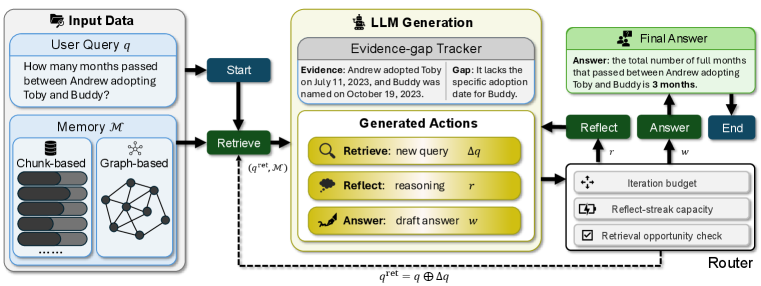
The image is a diagram illustrating the process of a Large Language Model (LLM) answering a user's question. It shows the flow of information and actions taken by the LLM, including retrieving information, reflecting on it, and generating an answer.
### Components/Axes
The diagram consists of the following key components:
1. **Input Data:**
* **User Query (q):** "How many months passed between Andrew adopting Toby and Buddy?"
* **Memory (M):** Divided into "Chunk-based" and "Graph-based" storage.
2. **Start:** The initial step in the process.
3. **Retrieve:** Retrieves information from memory based on the query. Output is (q^ret, M).
4. **LLM Generation:**
* **Evidence-gap Tracker:**
* **Evidence:** "Andrew adopted Toby on July 11, 2023, and Buddy was named on October 19, 2023."
* **Gap:** "It lacks the specific adoption date for Buddy."
* **Generated Actions:**
* **Retrieve:** new query Δq
* **Reflect:** reasoning r
* **Answer:** draft answer w
5. **Final Answer:**
* **Answer:** "The total number of full months that passed between Andrew adopting Toby and Buddy is 3 months."
6. **Reflect, Answer, End:** The final steps in generating the answer.
7. **Router:**
* Iteration budget
* Reflect-streak capacity
* Retrieval opportunity check
* Equation: q^ret = q ⊕ Δq
### Detailed Analysis or Content Details
* The process begins with a user query (q).
* The LLM retrieves relevant information from its memory (M), which is structured in both chunk-based and graph-based formats.
* The LLM Generation phase involves an Evidence-gap Tracker, which identifies relevant evidence and gaps in the information.
* The LLM generates actions: Retrieve (new query Δq), Reflect (reasoning r), and Answer (draft answer w).
* The Router component uses the equation q^ret = q ⊕ Δq.
* The process culminates in a Final Answer.
### Key Observations
* The diagram highlights the iterative nature of the LLM's question-answering process, involving retrieval, reflection, and answer generation.
* The Evidence-gap Tracker plays a crucial role in identifying missing information and guiding the retrieval process.
* The Router component appears to manage the flow of information and actions within the LLM.
### Interpretation
The diagram illustrates a sophisticated question-answering system that leverages both structured and unstructured memory to retrieve relevant information. The Evidence-gap Tracker is a key component that enables the LLM to identify and address gaps in its knowledge. The iterative process of retrieval, reflection, and answer generation allows the LLM to refine its understanding of the question and provide a more accurate and complete answer. The Router component likely manages the overall flow of information and actions, ensuring that the LLM efficiently utilizes its resources to answer the user's question.