## Flowchart: LLM-Powered Question Answering System with Memory and Evidence Tracking
### Overview
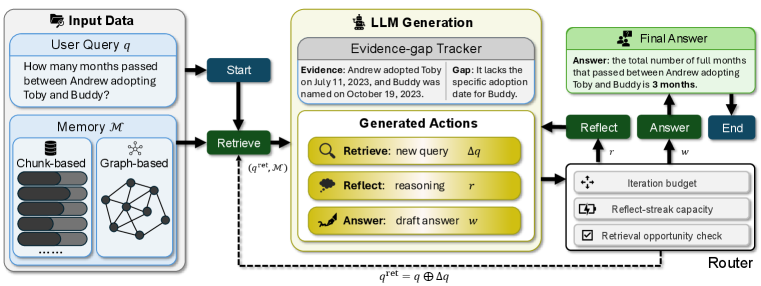
This flowchart illustrates a technical system for answering user queries using a combination of memory retrieval, LLM generation, and evidence tracking. The process begins with a user query, progresses through memory retrieval and LLM generation with evidence gap detection, and concludes with a final answer after iterative refinement checks.
### Components/Axes
1. **Input Data Section** (Top-left):
- **User Query (q)**: "How many months passed between Andrew adopting Toby and Buddy?"
- **Memory (M)**:
- Chunk-based storage (stacked horizontal bars)
- Graph-based storage (network diagram with nodes/edges)
2. **LLM Generation Section** (Center):
- **Evidence-gap Tracker**:
- Evidence: "Andrew adopted Toby on July 11, 2023"
- Gap: "It lacks the specific adoption date for Buddy"
- **Generated Actions**:
- Retrieve: "new query Δq" (magnifying glass icon)
- Reflect: "reasoning r" (lightbulb icon)
- Answer: "draft answer w" (writing hand icon)
3. **Router Section** (Bottom-right):
- **Iteration Budget**: Unspecified constraint
- **Reflect-streak Capacity**: Unspecified constraint
- **Retrieval Opportunity Check**: Binary decision (✓/✗)
4. **Final Answer Section** (Top-right):
- **Answer**: "3 months"
- **End State**: Terminal node
### Detailed Analysis
- **Flow Direction**: Left-to-right with feedback loops from Router to Retrieve
- **Key Nodes**:
- Start node (blue) → Retrieve node (green) → LLM Generation (yellow) → Router (gray) → Final Answer (green)
- **Memory Representation**:
- Chunk-based: 5 horizontal bars (4 dark gray, 1 light gray)
- Graph-based: 6 interconnected nodes with 9 edges
- **Evidence-gap Tracker**:
- Evidence timestamp: July 11, 2023
- Gap timestamp: October 19, 2023 (implied by Buddy's naming date)
### Key Observations
1. The system explicitly tracks evidence gaps (missing Buddy's adoption date)
2. Three iterative refinement steps (Retrieve/Reflect/Answer) before finalizing
3. Memory uses both chunked and graph-based storage modalities
4. Router enforces three constraints before answer acceptance
5. Final answer requires 3 full months between adoption dates
### Interpretation
This system demonstrates a hybrid approach to QA that combines:
1. **Retrieval Augmentation**: Using both chunked and graph-based memory for context
2. **Evidence Validation**: Explicit gap detection prevents hallucinated answers
3. **Iterative Refinement**: Multiple reasoning cycles improve answer quality
4. **Constraint Enforcement**: The router's checks ensure answer reliability
The evidence gap detection is particularly critical - without Buddy's adoption date (October 19, 2023), the system correctly identifies missing information before calculating the 3-month difference from Toby's adoption (July 11, 2023). The graph-based memory suggests semantic relationships between entities, while chunk-based storage provides temporal context. The router's constraints likely prevent infinite loops while maintaining answer quality through controlled iteration.