\n
## Diagram: Relationship of Computational Problems
### Overview
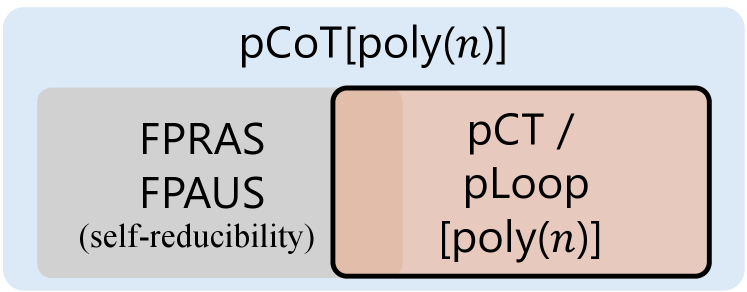
The image is a diagram illustrating the relationship between different computational problems, represented as overlapping rectangles. The diagram uses text labels to identify the problems and a parenthetical note to indicate a property.
### Components/Axes
The diagram consists of two overlapping rectangles:
* A larger, light blue rectangle labeled "pCoT[poly(n)]".
* A smaller, peach-colored rectangle labeled "pCT / pLoop [poly(n)]".
* Within the light blue rectangle, but not overlapping the peach rectangle, is a gray rectangle labeled "FPRAS / FPAUS (self-reducibility)".
### Detailed Analysis or Content Details
The diagram shows a hierarchical relationship. The "pCoT[poly(n)]" problem encompasses both "FPRAS / FPAUS" and "pCT / pLoop [poly(n)]". The "FPRAS / FPAUS" problem is distinct from "pCT / pLoop [poly(n)]", as they do not overlap.
The label "FPRAS / FPAUS" is accompanied by the note "(self-reducibility)".
The label "pCT / pLoop [poly(n)]" indicates that this problem involves both "pCT" and "pLoop" and has a time complexity of "poly(n)".
The label "pCoT[poly(n)]" indicates a problem with a time complexity of "poly(n)".
### Key Observations
The diagram visually represents a containment relationship. "pCoT[poly(n)]" is the most general problem, containing the other two. "FPRAS / FPAUS" has a specific property ("self-reducibility") that distinguishes it. "pCT / pLoop [poly(n)]" is a distinct problem within the broader "pCoT[poly(n)]" category.
### Interpretation
The diagram likely illustrates the complexity classes of computational problems. "pCoT[poly(n)]" could represent a class of problems solvable in polynomial time. "FPRAS / FPAUS" and "pCT / pLoop [poly(n)]" are specific sub-problems within this class. The "self-reducibility" property of "FPRAS / FPAUS" suggests that instances of this problem can be reduced to smaller instances of the same problem, potentially simplifying the solution process. The diagram suggests that "pCT / pLoop [poly(n)]" is a different type of polynomial-time problem than "FPRAS / FPAUS". The notation "[poly(n)]" indicates that the problems are related to polynomial time complexity. The diagram is a high-level overview of the relationships between these problems, and doesn't provide specific details about their algorithms or applications.