## Diagram: Nested Complexity Class Relationships
### Overview
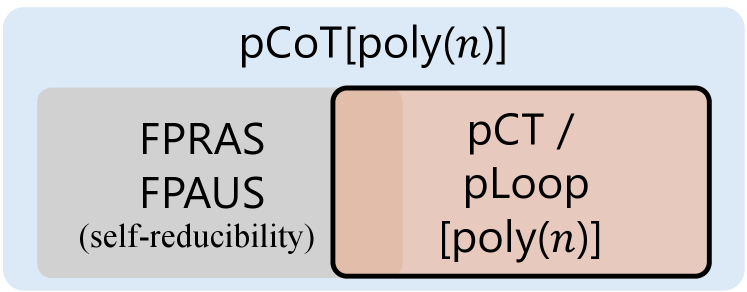
The image is a conceptual diagram illustrating the hierarchical and subset relationships between several computational complexity classes or algorithmic concepts. It uses nested, colored boxes to represent containment, with text labels identifying each class. The diagram appears to be from a theoretical computer science or algorithm analysis context.
### Components/Axes
The diagram consists of three primary visual components:
1. **Outer Container (Light Blue Box):**
* **Label:** `pCoT[poly(n)]`
* **Position:** Forms the background and outermost boundary of the diagram.
* **Meaning:** Represents a broad complexity class or problem family parameterized by a polynomial function `poly(n)`.
2. **Left Inner Box (Gray):**
* **Labels:**
* `FPRAS`
* `FPAUS`
* `(self-reducibility)`
* **Position:** Located in the left portion of the outer container. It is partially overlapped by the right inner box.
* **Meaning:** Represents a set of concepts or classes (FPRAS, FPAUS) characterized by the property of "self-reducibility."
3. **Right Inner Box (Peach with Black Border):**
* **Label:** `pCT / pLoop [poly(n)]`
* **Position:** Located in the right portion of the outer container, overlapping the right side of the gray box. It has a distinct, thick black border.
* **Meaning:** Represents another class or set of techniques (pCT, pLoop), also parameterized by `poly(n)`. The black border and overlapping placement suggest it is a specific, emphasized subset within the broader `pCoT[poly(n)]` class and has a relationship with the concepts in the gray box.
### Detailed Analysis
* **Text Transcription:** All text is in English, using standard technical abbreviations.
* `pCoT[poly(n)]`
* `FPRAS`
* `FPAUS`
* `(self-reducibility)`
* `pCT / pLoop [poly(n)]`
* **Spatial Relationships:**
* The diagram establishes a clear hierarchy: `pCT/pLoop [poly(n)]` and the `FPRAS/FPAUS` set are both contained within `pCoT[poly(n)]`.
* The overlap between the gray and peach boxes indicates an intersection or a specific relationship between the `FPRAS/FPAUS` concepts (with self-reducibility) and the `pCT/pLoop` class. This could mean that problems in `pCT/pLoop` may exhibit self-reducibility, or that techniques from one area apply to the other.
* The black border around the peach box highlights it as a focal point or a distinct, important subclass.
### Key Observations
1. **Parameterization:** Both the outer class (`pCoT`) and the inner class (`pCT/pLoop`) are explicitly parameterized by `[poly(n)]`, indicating their complexity or runtime scales polynomially with the input size `n`.
2. **Self-Reducibility:** The term `(self-reducibility)` is explicitly associated with the `FPRAS` and `FPAUS` concepts, defining a key algorithmic property for that group.
3. **Visual Emphasis:** The `pCT / pLoop [poly(n)]` box is visually emphasized with a black border and a distinct color, suggesting it is the primary subject of interest or a newly introduced class within the broader `pCoT` framework.
4. **Subset Implication:** The containment within the light blue box implies that `FPRAS`, `FPAUS`, `pCT`, and `pLoop` are all, in some form, subclasses or instances of `pCoT[poly(n)]`.
### Interpretation
This diagram visually summarizes a theoretical framework in computational complexity or randomized algorithms.
* **What it suggests:** It proposes a structural relationship where `pCoT[poly(n)]` is a unifying class encompassing both established concepts like FPRAS (Fully Polynomial Randomized Approximation Scheme) and FPAUS (likely a related approximation or sampling class), as well as a specific subclass `pCT/pLoop`. The property of "self-reducibility" is highlighted as a defining characteristic of the FPRAS/FPAUS group.
* **How elements relate:** The overlap is the most critical relational element. It suggests that the `pCT/pLoop` class is not entirely separate but intersects with the world of self-reducible approximation schemes. This could imply that `pCT/pLoop` algorithms can be applied to self-reducible problems, or that problems in this intersection have specific, advantageous properties.
* **Notable emphasis:** The black border around `pCT/pLoop` draws the viewer's attention, indicating that this is likely the novel contribution, the specific focus of the accompanying research, or a class with particularly interesting properties that warrant distinction from the broader `pCoT` family. The diagram efficiently communicates that understanding `pCT/pLoop` requires understanding its place within `pCoT` and its connection to self-reducibility.