## Diagram: Evidence and Innocence
### Overview
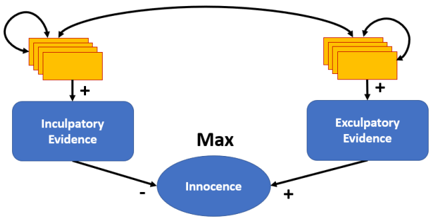
The image is a diagram illustrating the relationship between inculpatory evidence, exculpatory evidence, and innocence. It shows how these elements interact, with evidence influencing the perception of innocence.
### Components/Axes
* **Inculpatory Evidence:** Represented by a blue rounded rectangle on the left side of the diagram.
* **Exculpatory Evidence:** Represented by a blue rounded rectangle on the right side of the diagram.
* **Innocence:** Represented by a blue oval at the bottom center of the diagram.
* **Evidence Stacks:** Represented by stacks of orange rectangles above both "Inculpatory Evidence" and "Exculpatory Evidence".
* **Arrows:** Indicate the direction and nature of influence.
* Arrows pointing downwards from the evidence stacks to the "Inculpatory Evidence" and "Exculpatory Evidence" boxes, labeled with "+".
* An arrow pointing from "Inculpatory Evidence" to "Innocence", labeled with "-".
* An arrow pointing from "Exculpatory Evidence" to "Innocence", labeled with "+".
* A curved arrow looping back from the evidence stacks to themselves.
* A curved arrow connecting the two evidence stacks.
* **Max:** Text label positioned above the "Innocence" oval.
### Detailed Analysis or ### Content Details
* **Evidence Stacks:** The stacks of orange rectangles represent the accumulation of evidence. The curved arrows looping back to the stacks suggest a self-reinforcing effect, where more evidence of a particular type leads to even more evidence.
* **Influence on Evidence:** The "+" signs indicate that the evidence stacks positively influence the respective evidence categories (Inculpatory and Exculpatory).
* **Influence on Innocence:**
* Inculpatory evidence negatively influences innocence (indicated by the "-" sign), suggesting that more inculpatory evidence decreases the perception of innocence.
* Exculpatory evidence positively influences innocence (indicated by the "+" sign), suggesting that more exculpatory evidence increases the perception of innocence.
* **Max:** The "Max" label above "Innocence" suggests that the diagram is aiming to maximize the perception of innocence.
### Key Observations
* The diagram illustrates a balance between inculpatory and exculpatory evidence in determining the perception of innocence.
* The self-reinforcing loops on the evidence stacks suggest that evidence tends to accumulate in one direction or the other.
### Interpretation
The diagram presents a simplified model of how evidence influences the perception of innocence. It suggests that innocence is not an absolute state but rather a perception that is influenced by the balance of inculpatory and exculpatory evidence. The self-reinforcing loops on the evidence stacks highlight the potential for bias, where initial evidence can lead to the accumulation of more evidence in the same direction, potentially skewing the perception of innocence. The "Max" label suggests that the goal is to maximize the perception of innocence, which could be achieved by increasing exculpatory evidence and/or decreasing inculpatory evidence.