## Diagram: Evidence-Innocence Relationship Model
### Overview
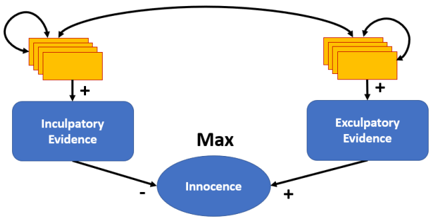
The image is a conceptual flowchart or influence diagram illustrating the relationship between two types of evidence and a central concept of "Innocence." It models how inculpatory and exculpatory evidence contribute to an assessment of innocence, with a "Max" objective.
### Components/Axes
The diagram consists of the following labeled components, arranged in a specific spatial layout:
1. **Top-Left Component:** A stack of yellow document icons. An arrow with a **"+"** sign points downward from this stack to a blue rectangular box.
2. **Top-Right Component:** A stack of yellow document icons, visually identical to the left stack. An arrow with a **"+"** sign points downward from this stack to a blue rectangular box.
3. **Left Blue Box:** Labeled **"Inculpatory Evidence"**. It receives a positive input from the left document stack. An arrow with a **"-"** (minus) sign points from this box toward the central oval.
4. **Right Blue Box:** Labeled **"Exculpatory Evidence"**. It receives a positive input from the right document stack. An arrow with a **"+"** (plus) sign points from this box toward the central oval.
5. **Central Oval:** Labeled **"Innocence"**. It is the convergence point for the arrows from the two evidence boxes.
6. **Central Label:** The word **"Max"** is positioned directly above the "Innocence" oval, suggesting a goal or objective function.
7. **Feedback Loops:** Each yellow document stack has a curved arrow looping back onto itself, indicating a self-reinforcing or iterative process within each evidence category.
**Spatial Grounding:** The "Inculpatory Evidence" box is on the left, the "Exculpatory Evidence" box is on the right, and the "Innocence" oval is centered below them. The "Max" label is centered above the "Innocence" oval. The legend is implicit in the labels on the boxes and arrows.
### Detailed Analysis
The diagram defines a clear directional flow and relationship between components:
* **Evidence Generation:** Both inculpatory and exculpatory evidence are generated or accumulated from their respective document stacks (indicated by the **"+"** arrows from the stacks to the boxes). The self-looping arrows on the stacks suggest this generation process may be continuous or self-reinforcing.
* **Influence on Innocence:** The two evidence types have opposing effects on the central "Innocence" node:
* **Inculpatory Evidence** has a **negative (-)** influence, meaning it decreases the measure or assessment of innocence.
* **Exculpatory Evidence** has a **positive (+)** influence, meaning it increases the measure or assessment of innocence.
* **Objective:** The label **"Max"** above "Innocence" indicates the system's or model's goal is to **maximize** the state or value of "Innocence."
### Key Observations
1. **Symmetry and Opposition:** The diagram is structurally symmetrical, highlighting the direct opposition between inculpatory and exculpatory evidence.
2. **Binary Influence:** The model simplifies evidence influence to a binary positive/negative effect on innocence.
3. **Closed System:** The diagram represents a closed conceptual system with no external inputs or outputs shown beyond the evidence stacks.
4. **Visual Coding:** Color is used functionally: yellow for raw evidence/documents, blue for processed evidence categories and the central concept.
### Interpretation
This diagram presents a simplified, formal model of legal or investigative reasoning. It suggests that "Innocence" is not a fixed state but a variable that is dynamically influenced by the balance of evidence.
* **What it demonstrates:** The core idea is that innocence is maximized by minimizing inculpatory evidence and maximizing exculpatory evidence. The "Max" objective implies an active process of seeking exculpatory evidence or arguing against inculpatory evidence to achieve the highest possible level of innocence.
* **Relationships:** The model establishes a direct, quantifiable (in a conceptual sense) relationship between evidence and a legal conclusion. The feedback loops on the evidence stacks could represent the ongoing discovery process, where finding one piece of evidence leads to the search for more of the same type.
* **Anomalies/Limitations:** The model's primary limitation is its simplification. It does not account for the weight or credibility of individual pieces of evidence, the possibility of evidence being both inculpatory and exculpatory, or the role of a trier of fact (e.g., a jury) in interpreting the evidence. It presents a mechanistic view of a deeply human and interpretive process. The diagram is best understood as a heuristic for thinking about evidence balance rather than a literal representation of legal procedure.