## Flowchart: Evidence-Innocence Relationship Model
### Overview
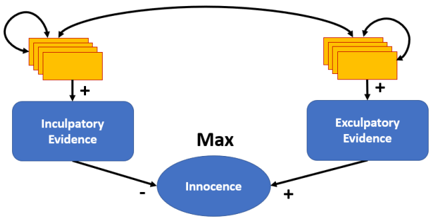
The diagram illustrates a conceptual model showing how inculpatory (guilt-suggesting) and exculpatory (innocence-suggesting) evidence interact to influence the determination of innocence. The central oval labeled "Innocence" acts as the outcome variable, with bidirectional relationships to two evidence stacks.
### Components/Axes
- **Left Stack**: Orange rectangles labeled "Inculpatory Evidence" with a "+" sign above, indicating accumulation/strength.
- **Right Stack**: Orange rectangles labeled "Exculpatory Evidence" with a "+" sign above.
- **Central Oval**: Blue ellipse labeled "Innocence" with:
- A "-" sign connecting to Inculpatory Evidence (reduction relationship)
- A "+" sign connecting to Exculpatory Evidence (enhancement relationship)
- **Top Label**: "Max" positioned above the Innocence oval, suggesting maximum value context.
### Detailed Analysis
- **Evidence Stacks**:
- Both stacks contain 4 identical orange rectangles (no numerical values provided)
- "+" signs above each stack imply quantitative accumulation
- **Relationship Arrows**:
- Inculpatory Evidence → Innocence: Negative influence (arrow with "-")
- Exculpatory Evidence → Innocence: Positive influence (arrow with "+")
- **Spatial Layout**:
- Evidence stacks positioned symmetrically left/right
- Innocence oval centered between stacks
- "Max" label positioned directly above central oval
### Key Observations
1. No numerical values or quantitative scales present
2. Symmetrical evidence stack placement suggests balanced consideration
3. Opposing signs (-/+ ) create clear directional relationships
4. "Max" label implies theoretical maximum innocence state
### Interpretation
This model demonstrates a zero-sum relationship between evidence types and innocence determination:
- Inculpatory evidence acts as a "guilt burden" reducing innocence
- Exculpatory evidence functions as an "innocence booster"
- The "Max" designation suggests an ideal state where exculpatory evidence is maximized while inculpatory evidence is minimized
- The bidirectional arrows imply dynamic interaction rather than static values
- The absence of quantitative measures indicates this is a conceptual rather than statistical model
The diagram appears designed for legal or forensic decision-making frameworks, visualizing how evidence balance affects innocence assessments. The "Max" label particularly emphasizes the pursuit of optimal innocence determination through evidence evaluation.