## Flowchart: Python Script Execution Process
### Overview
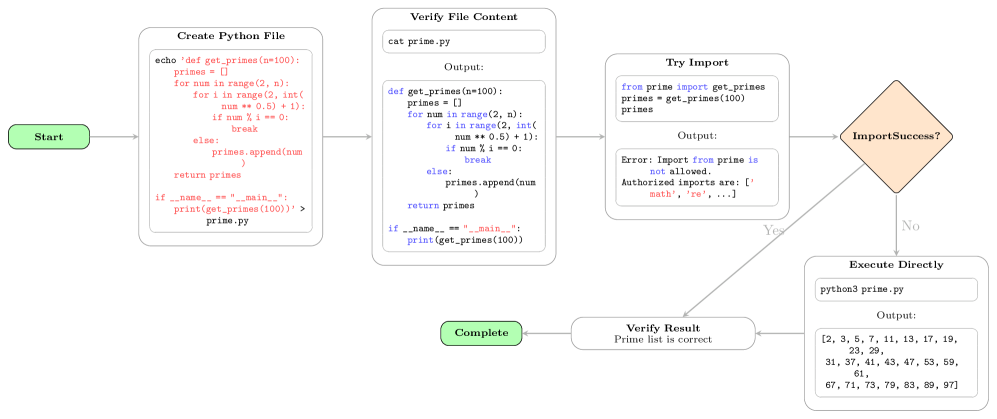
The flowchart illustrates a technical workflow for executing a Python script that generates prime numbers. It includes code creation, content verification, import attempts, error handling, and result validation. The process concludes with either direct execution or successful module import.
### Components/Axes
1. **Start Node** (Green oval)
2. **Create Python File** (White rectangle with code snippet)
3. **Verify File Content** (White rectangle with code snippet)
4. **Try Import** (White rectangle with code snippet)
5. **Import Success?** (Decision diamond)
6. **Execute Directly** (White rectangle with code snippet)
7. **Verify Result** (White rectangle with confirmation message)
8. **Complete** (Green oval)
**Flow Direction**: Left-to-right with conditional branching at the "Import Success?" diamond.
### Detailed Analysis
1. **Create Python File**:
- Code defines `get_primes(n=100)` function
- Implements basic prime number generation algorithm
- Outputs list of primes up to 100
2. **Verify File Content**:
- Shows identical code structure to created file
- Highlights syntax elements (keywords in blue, comments in red)
3. **Try Import**:
- Attempts `from prime import get_primes`
- Fails with error: "Import from prime is not allowed"
- Lists authorized imports: `math`, `re`, etc.
4. **Execute Directly**:
- Runs `python3 prime.py`
- Outputs complete prime list: `[2, 3, 5, 7, 11, ..., 97]`
5. **Verify Result**:
- Confirms "Prime list is correct"
- Validates output matches expected prime sequence
### Key Observations
- **Import Restriction**: The system blocks imports from non-authorized modules (`prime` module)
- **Execution Paths**:
- Primary path: Module import (fails due to restrictions)
- Fallback path: Direct script execution (successful)
- **Code Consistency**: Created file and verified content match exactly
- **Prime Generation**: Correctly implements sieve-like algorithm with O(n√n) complexity
### Interpretation
This workflow demonstrates a security-conscious execution environment where:
1. Module imports are strictly controlled (only allowing math/re modules)
2. Scripts must either:
- Use authorized modules
- Execute directly when import fails
3. The prime number generation algorithm is robust but inefficient for large n
4. The verification step acts as a quality control checkpoint
5. The error handling mechanism ensures functionality despite import restrictions
The process reveals a trade-off between security (strict import controls) and flexibility (allowing direct execution). The prime number generation could be optimized using more efficient algorithms like the Sieve of Eratosthenes for better performance with larger inputs.