## Technical Diagram: Quantum State Representation and Cavity Interaction
### Overview
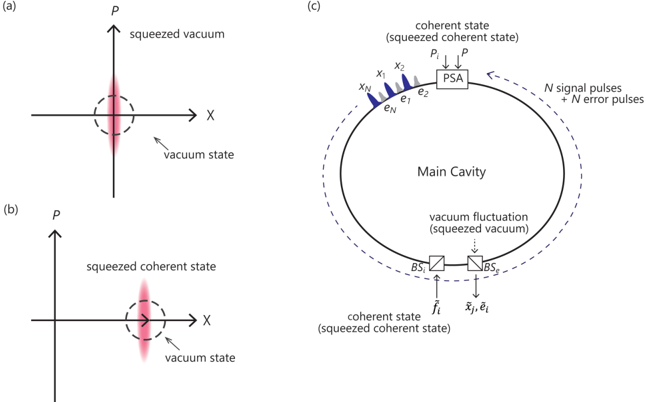
The image consists of three labeled sections (a, b, c) depicting quantum states and their interactions within a cavity system. Sections (a) and (b) show 2D plots of quantum states, while section (c) illustrates a cavity interaction process with labeled components.
### Components/Axes
#### Section (a) & (b): Quantum State Plots
- **Axes**:
- Vertical axis: **P** (Momentum/Phase)
- Horizontal axis: **X** (Position)
- **Labels**:
- **Vacuum state**: Dashed circle centered at origin
- **Squeezed vacuum**: Pink shaded region elongated along P-axis (a) and X-axis (b)
- **Squeezed coherent state**: Pink shaded region shifted along X-axis (b)
- **Legend**:
- Pink: Squeezed states (vacuum/coherent)
- Dashed circle: Vacuum state boundary
#### Section (c): Cavity Interaction Diagram
- **Main components**:
- **Main Cavity**: Central circular region
- **Coherent state (squeezed coherent state)**: Top arc with blue spikes labeled $x_1, x_2, ..., x_N$
- **Vacuum fluctuation (squeezed vacuum)**: Bottom arc with gray ellipses labeled $e_1, e_2, ..., e_N$
- **PSA (Photonic Squeezing Amplifier)**: Rectangular box at top center
- **BS₁/BS₂**: Beam splitters at bottom left/right
- **Arrows**:
- Dashed arrows: $N$ signal pulses + $N$ error pulses circulating clockwise
- Solid arrows: Input/output paths for $f_t, \tilde{x}_j, \tilde{e}_l$
- **Legend**:
- Blue: Coherent state components
- Gray: Vacuum fluctuation components
- Black: Structural elements (cavity, beam splitters)
### Detailed Analysis
#### Section (a): Squeezed Vacuum vs. Vacuum State
- The squeezed vacuum state (pink) shows reduced uncertainty along the P-axis compared to the vacuum state (dashed circle), indicating quantum squeezing in phase space.
- The vacuum state maintains equal uncertainty in P and X directions.
#### Section (b): Squeezed Coherent State
- The squeezed coherent state (pink) combines displacement along the X-axis (coherent state) with squeezing along the P-axis, creating an off-center, elongated distribution.
#### Section (c): Cavity Interaction Process
1. **Signal Generation**:
- Coherent state components ($x_i$) and vacuum fluctuations ($e_i$) enter the cavity.
2. **Interaction**:
- PSA modulates the coherent state, while vacuum fluctuations interact with beam splitters (BS₁/BS₂).
3. **Output**:
- Processed signals ($f_t, \tilde{x}_j, \tilde{e}_l$) exit the cavity, representing modified quantum states.
### Key Observations
1. **Spatial Shifts**:
- Squeezed states (a, b) show directional uncertainty reduction (P-axis in a, X-axis in b).
- Squeezed coherent state (b) exhibits both displacement and squeezing.
2. **Cavity Dynamics**:
- The diagram emphasizes quantum noise separation (coherent vs. vacuum fluctuations) and error correction via pulse management.
3. **Component Roles**:
- PSA and beam splitters are critical for state manipulation and noise reduction.
### Interpretation
This diagram illustrates quantum state engineering in cavity QED systems. The squeezed states (a, b) demonstrate Heisenberg uncertainty trade-offs, while the cavity diagram (c) models practical implementations for quantum information processing. The separation of coherent states and vacuum fluctuations suggests applications in quantum error correction and photonic squeezing technologies. The absence of numerical values implies a conceptual rather than quantitative representation, focusing on operational principles over measurable parameters.