## Diagram: Feedforward Neural Network Architecture
### Overview
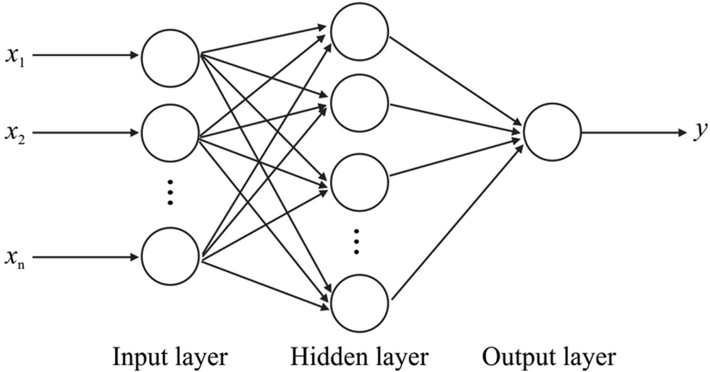
The image is a black-and-white schematic diagram illustrating the architecture of a simple feedforward neural network (also known as a multilayer perceptron). It depicts the flow of data from input nodes, through a single hidden layer, to a single output node. The diagram is designed to show the network's structure and connectivity pattern.
### Components/Axes
The diagram is organized into three distinct vertical columns, each representing a layer of the network. The layers are labeled with text placed directly beneath them.
1. **Input Layer (Left Column):**
* **Label:** "Input layer" (text centered below the column).
* **Components:** Three circular nodes are explicitly drawn. The top node is labeled with the mathematical variable **`x₁`** to its left. The middle node is labeled **`x₂`**. The bottom node is labeled **`xₙ`**.
* **Ellipsis:** Between the `x₂` and `xₙ` nodes, a vertical ellipsis (three dots) is drawn, indicating that there are an arbitrary number of additional input nodes not shown.
* **Function:** This layer receives the raw input features.
2. **Hidden Layer (Center Column):**
* **Label:** "Hidden layer" (text centered below the column).
* **Components:** Four circular nodes are explicitly drawn in a vertical column. No individual labels are assigned to these nodes.
* **Ellipsis:** Between the third and fourth visible nodes, a vertical ellipsis is drawn, indicating that the hidden layer can contain an arbitrary number of neurons.
* **Function:** This layer performs intermediate computations and feature transformations.
3. **Output Layer (Right Column):**
* **Label:** "Output layer" (text centered below the column).
* **Components:** A single circular node.
* **Output Label:** An arrow points from this node to the right, terminating at the mathematical variable **`y`**.
* **Function:** This layer produces the final prediction or output of the network.
4. **Connections (Arrows):**
* **Pattern:** The diagram shows a **fully connected** (dense) architecture.
* **Input to Hidden:** Every node in the Input layer has a directed arrow pointing to every node in the Hidden layer. This creates a dense web of connections between the first two columns.
* **Hidden to Output:** Every node in the Hidden layer has a directed arrow pointing to the single node in the Output layer.
* **Direction:** All arrows point from left to right, indicating the forward flow of data during inference.
### Detailed Analysis
* **Spatial Layout:** The components are arranged linearly from left to right, following the standard convention for depicting data flow in neural networks. The labels are positioned clearly beneath their respective columns.
* **Node Representation:** All neurons (nodes) are represented as identical, empty circles. The diagram does not depict biases, activation functions, or specific weights on the connections.
* **Variable Notation:** The inputs are denoted using standard mathematical subscript notation (`x₁`, `x₂`, `xₙ`), and the output is denoted as `y`. This is a common convention in machine learning literature.
* **Scalability Indication:** The use of ellipses (`...`) in both the input and hidden layers is a critical detail. It explicitly communicates that the diagram is a generic template, and the actual network can have a variable number of input features (`n`) and hidden neurons.
### Key Observations
1. **Single Hidden Layer:** The network architecture consists of exactly one hidden layer, classifying it as a "shallow" neural network as opposed to a "deep" network with multiple hidden layers.
2. **Full Connectivity:** The dense web of arrows between layers confirms that every neuron in one layer is connected to every neuron in the next layer, which is the defining characteristic of a dense or fully connected layer.
3. **Dimensionality:** The input layer has `n` nodes (where `n` is variable), the hidden layer has an unspecified number of nodes (let's call it `m`), and the output layer has 1 node. This suggests the network is designed for a regression task or binary classification (where the output `y` could be a probability).
4. **No Biases Shown:** The diagram is a high-level architectural view and omits the bias terms that are typically associated with each neuron in the hidden and output layers.
### Interpretation
This diagram serves as a fundamental visual abstraction of a neural network's structure. Its primary purpose is pedagogical and conceptual.
* **What it Demonstrates:** It visually explains the core concept of a feedforward neural network: input data (`x₁...xₙ`) is propagated forward through a series of transformations (the hidden layer) to produce an output (`y`). The hidden layer acts as a learned representation of the input data, extracting intermediate features that are useful for making the final prediction.
* **Relationship Between Elements:** The arrows represent the learnable parameters (weights) of the model. The strength of these connections is adjusted during training. The diagram implies that the output `y` is a complex, non-linear function of all inputs, mediated by the hidden layer.
* **Notable Implications:**
* **Universal Approximation:** A network with this architecture (one hidden layer with a sufficient number of neurons and appropriate activation functions) is theoretically capable of approximating any continuous function, a property known as the Universal Approximation Theorem.
* **Simplicity vs. Depth:** While powerful, this shallow architecture may struggle with very complex patterns in high-dimensional data (like images or language) compared to deep networks, which can learn hierarchical representations.
* **Template for Complexity:** This diagram is the foundational building block. More complex architectures (convolutional, recurrent, transformers) add specialized layers and connection patterns on top of this basic premise of layered, differentiable computation.