## Diagram: Neural Network Architecture
### Overview
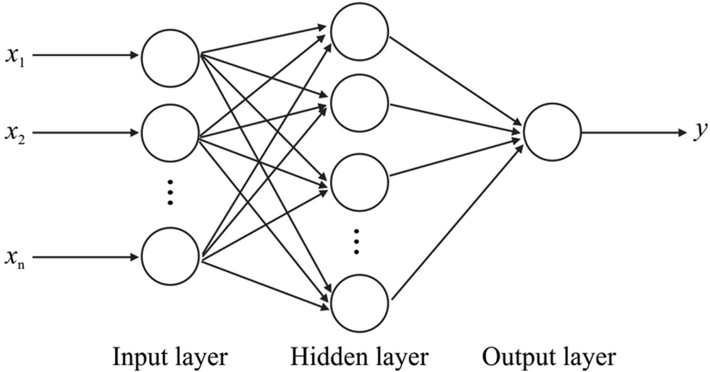
The image is a diagram illustrating the architecture of a simple neural network. It shows the flow of information from the input layer, through a hidden layer, to the output layer. The diagram highlights the connections between neurons in adjacent layers.
### Components/Axes
* **Layers:**
* Input layer: Labeled "Input layer" below the layer. Contains nodes labeled x1, x2, ..., xn.
* Hidden layer: Labeled "Hidden layer" below the layer. Contains an unspecified number of nodes, indicated by an ellipsis.
* Output layer: Labeled "Output layer" below the layer. Contains a single node labeled y.
* **Connections:** Arrows indicate the flow of information between nodes in adjacent layers. Each node in the input layer is connected to every node in the hidden layer. Each node in the hidden layer is connected to the single node in the output layer.
### Detailed Analysis
* **Input Layer:** The input layer consists of three explicitly shown nodes labeled x1, x2, and xn. An ellipsis between x2 and xn suggests that there are additional input nodes. Each input node has an arrow pointing towards it, indicating the input of data.
* **Hidden Layer:** The hidden layer consists of three explicitly shown nodes. An ellipsis suggests that there are additional hidden nodes. Each node in the input layer is connected to each node in the hidden layer via arrows.
* **Output Layer:** The output layer consists of a single node labeled y. Each node in the hidden layer is connected to the output node via arrows. An arrow points away from the output node, indicating the output of the network.
### Key Observations
* The diagram illustrates a fully connected neural network, where each node in one layer is connected to every node in the subsequent layer.
* The ellipsis in the input and hidden layers indicates that the number of nodes in these layers is variable and can be adjusted depending on the specific application.
* The diagram is a simplified representation of a neural network, focusing on the basic architecture and flow of information.
### Interpretation
The diagram provides a visual representation of how information flows through a neural network. The input layer receives data, which is then processed by the hidden layer(s). The output layer produces the final result. The connections between nodes represent the weights and biases that are learned during the training process. The diagram highlights the key components of a neural network and their relationships, making it easier to understand the underlying principles of this powerful machine learning technique.