\n
## Diagram: Artificial Neural Network
### Overview
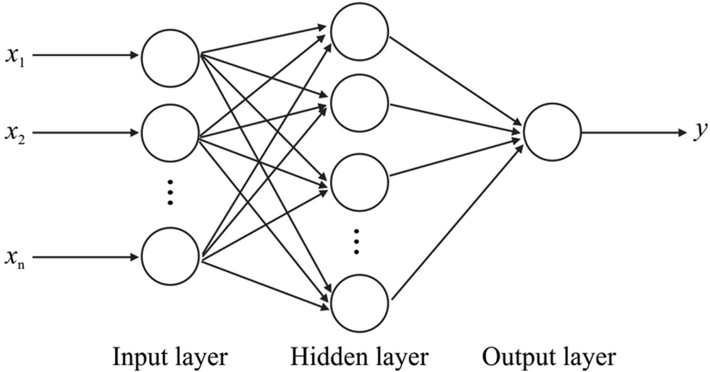
The image depicts a simplified diagram of an artificial neural network. It illustrates the basic structure of a feedforward neural network with an input layer, a hidden layer, and an output layer. The diagram shows the connections between neurons in adjacent layers.
### Components/Axes
The diagram is labeled with the following components:
* **Input layer:** Located on the left side of the diagram.
* **Hidden layer:** Positioned in the center of the diagram.
* **Output layer:** Situated on the right side of the diagram.
* **x₁ to xₙ:** Input variables, each connected to a neuron in the input layer.
* **y:** Output variable, resulting from the output layer.
* Ellipses represent neurons or nodes within each layer.
* Arrows represent weighted connections between neurons.
### Detailed Analysis or Content Details
The diagram shows the following:
* **Input Layer:** Contains 'n' number of input neurons, labeled as x₁, x₂, ..., xₙ. Each input neuron receives a single input value.
* **Hidden Layer:** Contains an unspecified number of neurons, indicated by the ellipsis (...). Each neuron in the hidden layer receives input from all neurons in the input layer.
* **Output Layer:** Contains a single neuron, which produces the output 'y'. This neuron receives input from all neurons in the hidden layer.
* **Connections:** Every neuron in the input layer is connected to every neuron in the hidden layer. Similarly, every neuron in the hidden layer is connected to the single neuron in the output layer. The connections are represented by arrows, implying a weighted connection.
* The diagram does not provide any specific numerical values for weights, biases, or activation functions. It is a purely structural representation.
### Key Observations
* The diagram represents a fully connected feedforward neural network.
* The number of neurons in the hidden layer is not specified, indicating it can vary.
* The diagram is a simplified representation and does not include details like biases, activation functions, or the specific architecture of the network.
### Interpretation
The diagram illustrates the fundamental architecture of a neural network, a computational model inspired by the structure and function of biological neural networks. The input layer receives data, the hidden layer performs computations on that data, and the output layer produces a result. The connections between neurons represent pathways for information flow, and the weights associated with these connections determine the strength of the signal. This type of network is capable of learning complex patterns from data through a process of adjusting the weights based on training examples. The diagram highlights the core concept of distributed representation and parallel processing inherent in neural networks. The ellipsis (...) suggests that the network can be scaled to accommodate more complex problems by adding more layers or neurons. The absence of specific values emphasizes the diagram's purpose as a conceptual illustration rather than a concrete implementation.