## Code Snippet: Theorem Definition and Proof
### Overview
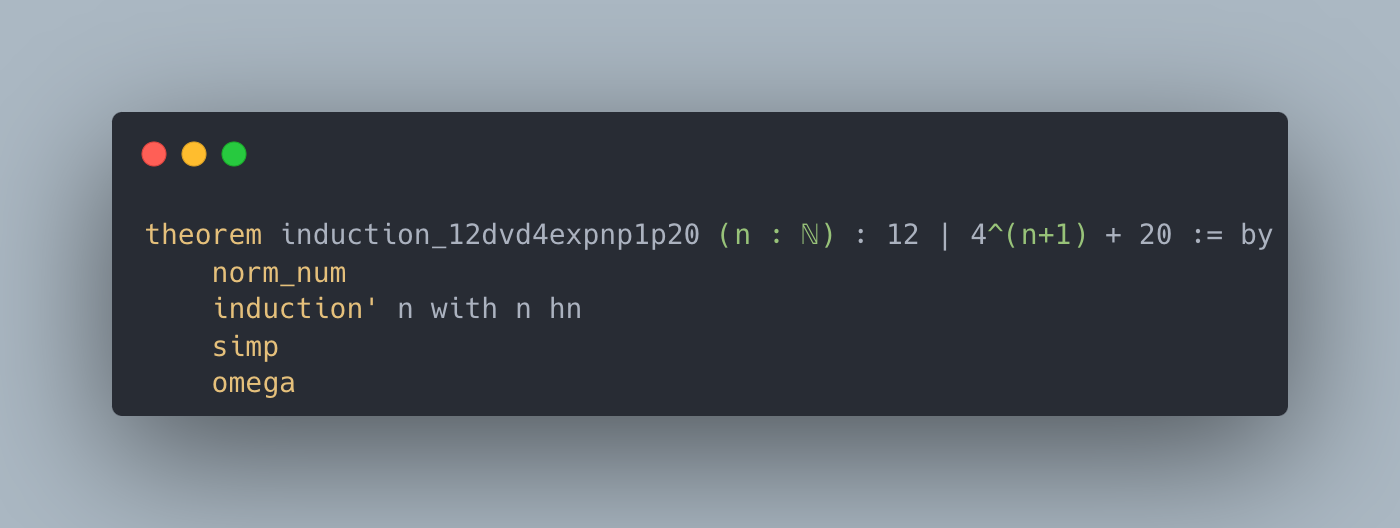
The image shows a code snippet, likely from a formal verification system or proof assistant, defining a theorem and outlining its proof strategy. The code defines a theorem named "induction_12dvd4expnp1p20" which states that for any natural number 'n', 12 divides 4^(n+1) + 20. The proof uses induction and simplification techniques.
### Components/Axes
* **Theorem Definition:** `theorem induction_12dvd4expnp1p20 (n : N) : 12 | 4^(n+1) + 20 := by`
* `theorem`: Keyword indicating the start of a theorem definition.
* `induction_12dvd4expnp1p20`: Name of the theorem.
* `(n : N)`: Declares 'n' as a variable of type 'N', where 'N' likely represents the set of natural numbers.
* `: 12 | 4^(n+1) + 20`: States that 12 divides 4^(n+1) + 20. The symbol '|' likely represents "divides".
* `:= by`: Indicates the start of the proof.
* **Proof Steps:**
* `norm_num`: Normalizes numerical expressions.
* `induction' n with n hn`: Applies induction on the variable 'n'. 'hn' likely represents the inductive hypothesis.
* `simp`: Simplifies the expression.
* `omega`: A tactic for solving arithmetic goals.
### Detailed Analysis or Content Details
The code snippet defines a theorem and provides a proof strategy. The theorem states that for any natural number 'n', the expression 4^(n+1) + 20 is divisible by 12. The proof strategy involves normalizing numerical expressions, applying induction, simplifying the expression, and using an omega tactic to solve arithmetic goals.
### Key Observations
The code uses a formal language for defining and proving theorems. The proof strategy is concise and relies on automated tactics like `norm_num`, `simp`, and `omega`.
### Interpretation
The code snippet demonstrates a formal approach to proving mathematical theorems. The use of induction and simplification techniques is common in mathematical proofs. The automated tactics suggest that the system is capable of performing complex reasoning steps automatically. The theorem itself relates to divisibility properties of exponential expressions.