\n
## Screenshot: Lean 4 Theorem Proof Snippet
### Overview
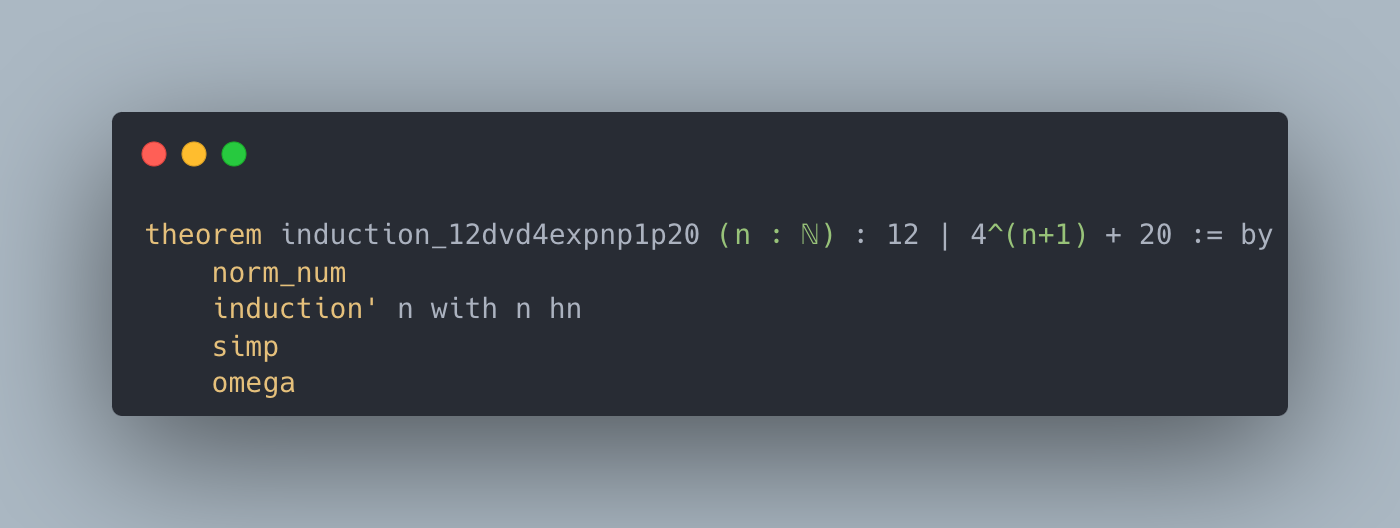
The image is a screenshot of a code editor or terminal window displaying a formal mathematical theorem and its proof written in the Lean 4 proof assistant language. The window has a dark theme with syntax-highlighted text. The content is a self-contained proof of a number theory statement.
### Components/Axes
* **Window Frame:** A dark gray rectangular window with rounded corners, centered on a light gray background.
* **Window Controls:** Three colored circles (red, yellow, green) are positioned in the top-left corner of the window, typical of macOS window controls.
* **Code Content:** The main body of the window contains six lines of monospaced text with syntax highlighting. Keywords (`theorem`, `by`, `norm_num`, `induction'`, `with`, `simp`, `omega`) are in a gold/yellow color. The theorem name and other identifiers are in a light gray/white. The type `ℕ` (natural numbers) is highlighted in green.
### Detailed Analysis
The text content is transcribed precisely below. The language is English with mathematical notation.
**Line 1:** `theorem induction_12dvd4expnp1p20 (n : ℕ) : 12 | 4^(n+1) + 20 := by`
* **Theorem Name:** `induction_12dvd4expnp1p20`
* **Variable Declaration:** `(n : ℕ)` declares a variable `n` of type `ℕ` (the set of natural numbers {0, 1, 2, ...}).
* **Theorem Statement:** `12 | 4^(n+1) + 20`
* The symbol `|` denotes "divides". The statement asserts that for any natural number `n`, the integer 12 divides the number `4^(n+1) + 20`.
* **Proof Start:** `:= by` indicates the beginning of the proof script.
**Lines 2-6 (Proof Script):**
* **Line 2:** ` norm_num` - A tactic that solves goals involving numeric computations.
* **Line 3:** ` induction' n with n hn` - The core proof strategy. It performs induction on the variable `n`. The `with n hn` clause introduces the inductive hypothesis: for a given `n`, assume the statement holds (this is `hn`), and then prove it for `n+1`.
* **Line 4:** ` simp` - A tactic that simplifies expressions using a set of predefined rules.
* **Line 5:** ` omega` - A tactic that solves linear arithmetic goals, often used to handle the remaining arithmetic after simplification.
### Key Observations
1. **Conciseness:** The proof is remarkably short (4 tactic lines), indicating the use of powerful, automated tactics (`norm_num`, `omega`) in Lean 4.
2. **Proof Structure:** The proof follows a classic induction pattern: establish a base case (handled implicitly by `norm_num` or the induction principle) and then prove the inductive step.
3. **Syntax Highlighting:** The color scheme aids readability by distinguishing language keywords from user-defined names and types.
4. **Mathematical Content:** The theorem is a specific divisibility property. The expression `4^(n+1) + 20` can be rewritten as `4 * 4^n + 20`. The proof likely shows that this expression is always a multiple of 12 by analyzing it modulo 12.
### Interpretation
This image captures a moment of formal verification in mathematics. It demonstrates how modern proof assistants like Lean can encode and automatically verify number-theoretic statements.
* **What the data suggests:** The code successfully proves the proposition `∀ n ∈ ℕ, 12 divides (4^(n+1) + 20)`. This is a true mathematical fact. For example:
* n=0: `4^(1) + 20 = 24`, which is 12 * 2.
* n=1: `4^(2) + 20 = 36`, which is 12 * 3.
* n=2: `4^(3) + 20 = 84`, which is 12 * 7.
* **How elements relate:** The `induction'` tactic sets up the logical framework. The `simp` and `omega` tactics then perform the algebraic manipulation and arithmetic reasoning needed to discharge the goal for the inductive step, relying on the inductive hypothesis `hn`.
* **Notable aspects:** The proof's brevity highlights the effectiveness of Lean's tactic framework. The theorem name `induction_12dvd4expnp1p20` is a descriptive, machine-generated identifier that encodes the method (`induction`), the divisor (`12dvd`), and the expression (`4expnp1p20` for `4^(n+1)+20`). This is a common practice in formal mathematics libraries for traceability.