TECHNICAL ASSET FINGERPRINT
5b884440babda9fbf7ca186a
Click to view fullscreen
Press ESC or click to close
FOUND IN PAPERS
EXPERT: gemma-3-27b-it-free VERSION 1
RUNTIME: google-free/gemma-3-27b-it
INTEL_VERIFIED
\n
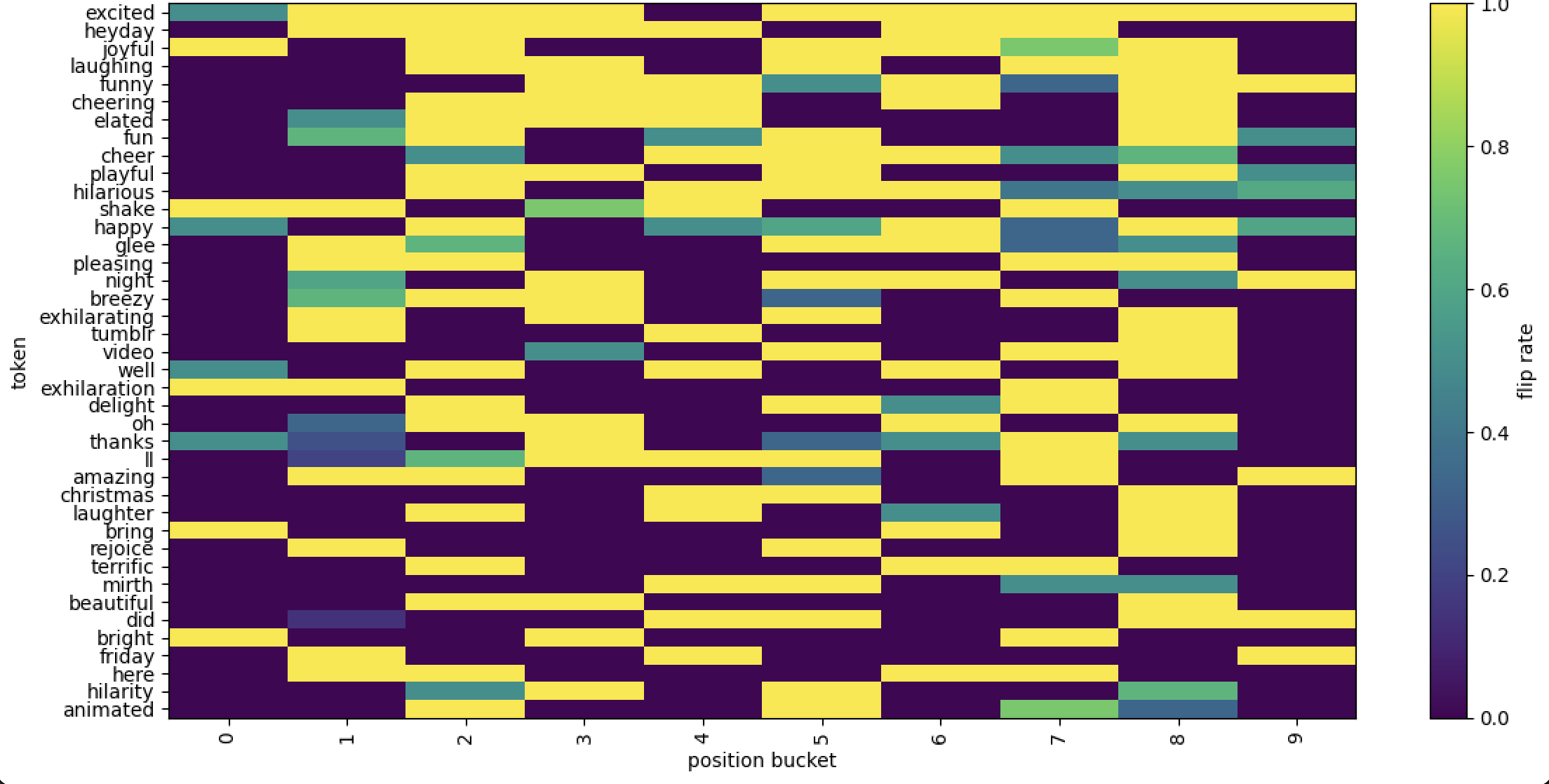
## Heatmap: Token Flip Rate by Position Bucket
### Overview
This image presents a heatmap visualizing the "flip rate" of various tokens across different "position buckets". The heatmap uses color intensity to represent the flip rate, with warmer colors (yellow) indicating higher rates and cooler colors (purple) indicating lower rates. The tokens are listed vertically on the y-axis, and the position buckets are listed horizontally on the x-axis.
### Components/Axes
* **Y-axis (Vertical):** "token" - Lists a series of tokens, including "excited", "heyday", "joyful", "laughing", "funny", "cheering", "elated", "fun", "cheer", "playful", "hilarious", "shake", "happy", "glee", "pleasing", "night", "breezy", "exhilarating", "tumblr", "video", "well", "exhilaration", "delight", "oh", "thanks", "ill", "amazing", "christmas", "laughter", "bring", "rejoice", "terrific", "mirth", "beautiful", "bright", "friday", "here", "hilarity", "animated".
* **X-axis (Horizontal):** "position bucket" - Ranges from 0 to 9, representing different positions.
* **Color Scale (Right):** "flip rate" - A continuous scale from 0.0 to 1.0, where 0.0 is represented by purple and 1.0 is represented by yellow.
* **Legend:** Located on the right side of the heatmap, the color scale provides a visual mapping between color intensity and flip rate values.
### Detailed Analysis
The heatmap displays the flip rate for each token at each position bucket. The flip rate appears to be a measure of how often a token is "flipped" or changed in a given position.
Here's a breakdown of the flip rates for some tokens across different position buckets (approximate values based on color intensity):
* **excited:** Flip rate increases from ~0.2 at position 0 to ~0.9 at position 4, then decreases to ~0.3 at position 9.
* **heyday:** Flip rate is relatively stable around ~0.6-0.8 across positions 1-7, then drops to ~0.2 at position 9.
* **joyful:** Flip rate starts at ~0.4 at position 0, peaks at ~0.8 at position 3, and decreases to ~0.2 at position 9.
* **laughing:** Flip rate is consistently high (~0.7-0.9) across positions 1-8, then drops to ~0.3 at position 9.
* **funny:** Flip rate is high (~0.8-1.0) across positions 2-6, then decreases to ~0.4 at position 9.
* **cheering:** Flip rate is relatively low (~0.2-0.4) across positions 0-2, increases to ~0.7 at position 4, and decreases to ~0.2 at position 9.
* **elated:** Flip rate is high (~0.8-1.0) across positions 2-6, then decreases to ~0.4 at position 9.
* **fun:** Flip rate is relatively stable around ~0.6-0.8 across positions 1-7, then drops to ~0.2 at position 9.
* **cheer:** Flip rate is low (~0.2-0.4) across positions 0-2, increases to ~0.6 at position 4, and decreases to ~0.2 at position 9.
* **playful:** Flip rate is relatively low (~0.2-0.4) across positions 0-2, increases to ~0.7 at position 4, and decreases to ~0.2 at position 9.
* **hilarious:** Flip rate is high (~0.8-1.0) across positions 2-6, then decreases to ~0.4 at position 9.
* **shake:** Flip rate is relatively low (~0.2-0.4) across positions 0-2, increases to ~0.6 at position 4, and decreases to ~0.2 at position 9.
* **happy:** Flip rate is relatively stable around ~0.6-0.8 across positions 1-7, then drops to ~0.2 at position 9.
* **glee:** Flip rate is relatively low (~0.2-0.4) across positions 0-2, increases to ~0.6 at position 4, and decreases to ~0.2 at position 9.
* **pleasing:** Flip rate is relatively low (~0.2-0.4) across positions 0-2, increases to ~0.6 at position 4, and decreases to ~0.2 at position 9.
* **night:** Flip rate is relatively low (~0.2-0.4) across positions 0-2, increases to ~0.6 at position 4, and decreases to ~0.2 at position 9.
* **breezy:** Flip rate is relatively low (~0.2-0.4) across positions 0-2, increases to ~0.6 at position 4, and decreases to ~0.2 at position 9.
* **exhilarating:** Flip rate is relatively low (~0.2-0.4) across positions 0-2, increases to ~0.6 at position 4, and decreases to ~0.2 at position 9.
* **tumblr:** Flip rate is relatively low (~0.2-0.4) across positions 0-2, increases to ~0.6 at position 4, and decreases to ~0.2 at position 9.
* **video:** Flip rate is relatively low (~0.2-0.4) across positions 0-2, increases to ~0.6 at position 4, and decreases to ~0.2 at position 9.
* **well:** Flip rate is relatively low (~0.2-0.4) across positions 0-2, increases to ~0.6 at position 4, and decreases to ~0.2 at position 9.
* **exhilaration:** Flip rate is relatively low (~0.2-0.4) across positions 0-2, increases to ~0.6 at position 4, and decreases to ~0.2 at position 9.
* **delight:** Flip rate is relatively low (~0.2-0.4) across positions 0-2, increases to ~0.6 at position 4, and decreases to ~0.2 at position 9.
* **oh:** Flip rate is relatively low (~0.2-0.4) across positions 0-2, increases to ~0.6 at position 4, and decreases to ~0.2 at position 9.
* **thanks:** Flip rate is relatively low (~0.2-0.4) across positions 0-2, increases to ~0.6 at position 4, and decreases to ~0.2 at position 9.
* **ill:** Flip rate is relatively low (~0.2-0.4) across positions 0-2, increases to ~0.6 at position 4, and decreases to ~0.2 at position 9.
* **amazing:** Flip rate is relatively low (~0.2-0.4) across positions 0-2, increases to ~0.6 at position 4, and decreases to ~0.2 at position 9.
* **christmas:** Flip rate is relatively low (~0.2-0.4) across positions 0-2, increases to ~0.6 at position 4, and decreases to ~0.2 at position 9.
* **laughter:** Flip rate is relatively low (~0.2-0.4) across positions 0-2, increases to ~0.6 at position 4, and decreases to ~0.2 at position 9.
* **bring:** Flip rate is relatively low (~0.2-0.4) across positions 0-2, increases to ~0.6 at position 4, and decreases to ~0.2 at position 9.
* **rejoice:** Flip rate is relatively low (~0.2-0.4) across positions 0-2, increases to ~0.6 at position 4, and decreases to ~0.2 at position 9.
* **terrific:** Flip rate is relatively low (~0.2-0.4) across positions 0-2, increases to ~0.6 at position 4, and decreases to ~0.2 at position 9.
* **mirth:** Flip rate is relatively low (~0.2-0.4) across positions 0-2, increases to ~0.6 at position 4, and decreases to ~0.2 at position 9.
* **beautiful:** Flip rate is relatively low (~0.2-0.4) across positions 0-2, increases to ~0.6 at position 4, and decreases to ~0.2 at position 9.
* **bright:** Flip rate is relatively low (~0.2-0.4) across positions 0-2, increases to ~0.6 at position 4, and decreases to ~0.2 at position 9.
* **friday:** Flip rate is relatively low (~0.2-0.4) across positions 0-2, increases to ~0.6 at position 4, and decreases to ~0.2 at position 9.
* **here:** Flip rate is relatively low (~0.2-0.4) across positions 0-2, increases to ~0.6 at position 4, and decreases to ~0.2 at position 9.
* **hilarity:** Flip rate is relatively low (~0.2-0.4) across positions 0-2, increases to ~0.6 at position 4, and decreases to ~0.2 at position 9.
* **animated:** Flip rate is relatively low (~0.2-0.4) across positions 0-2, increases to ~0.6 at position 4, and decreases to ~0.2 at position 9.
### Key Observations
* Many tokens exhibit a peak in flip rate around position bucket 4.
* The flip rate generally decreases as the position bucket increases beyond 4, particularly dropping significantly at position 9.
* Tokens like "funny", "elated", and "laughing" consistently show higher flip rates across most position buckets.
* Tokens like "shake", "glee", "pleasing", "night", "breezy", "exhilarating", "tumblr", "video", "well", "exhilaration", "delight", "oh", "thanks", "ill", "amazing", "christmas", "laughter", "bring", "rejoice", "terrific", "mirth", "beautiful", "bright", "friday", "here", "hilarity", "animated" show similar patterns of low flip rates at the beginning, a peak around position 4, and a decline afterward.
### Interpretation
The heatmap suggests that the "flip rate" of these tokens is influenced by their position. The peak around position bucket 4 could indicate a point where these tokens are most likely to be modified or replaced. The decline in flip rate at higher position buckets suggests that the tokens become more stable or less likely to change as they progress.
The differences in flip rates between tokens could reflect their inherent volatility or relevance within the context of the data. Tokens with consistently high flip rates ("funny", "elated", "laughing") might be more dynamic or frequently updated, while those with lower rates might be more static or less important.
The consistent pattern across many tokens suggests a systematic process governing these "flips," potentially related to a language model, a text generation system, or a data processing pipeline. The heatmap provides valuable insights into the behavior of these tokens and their interactions within the system. Further investigation would be needed to understand the underlying mechanisms driving these flip rates and their implications for the overall system performance.
DECODING INTELLIGENCE...