## Line Graph: Loss vs. FLOPs (EFLOPs) for Vanilla Pythia-70M and PonderingPythia-70M
### Overview
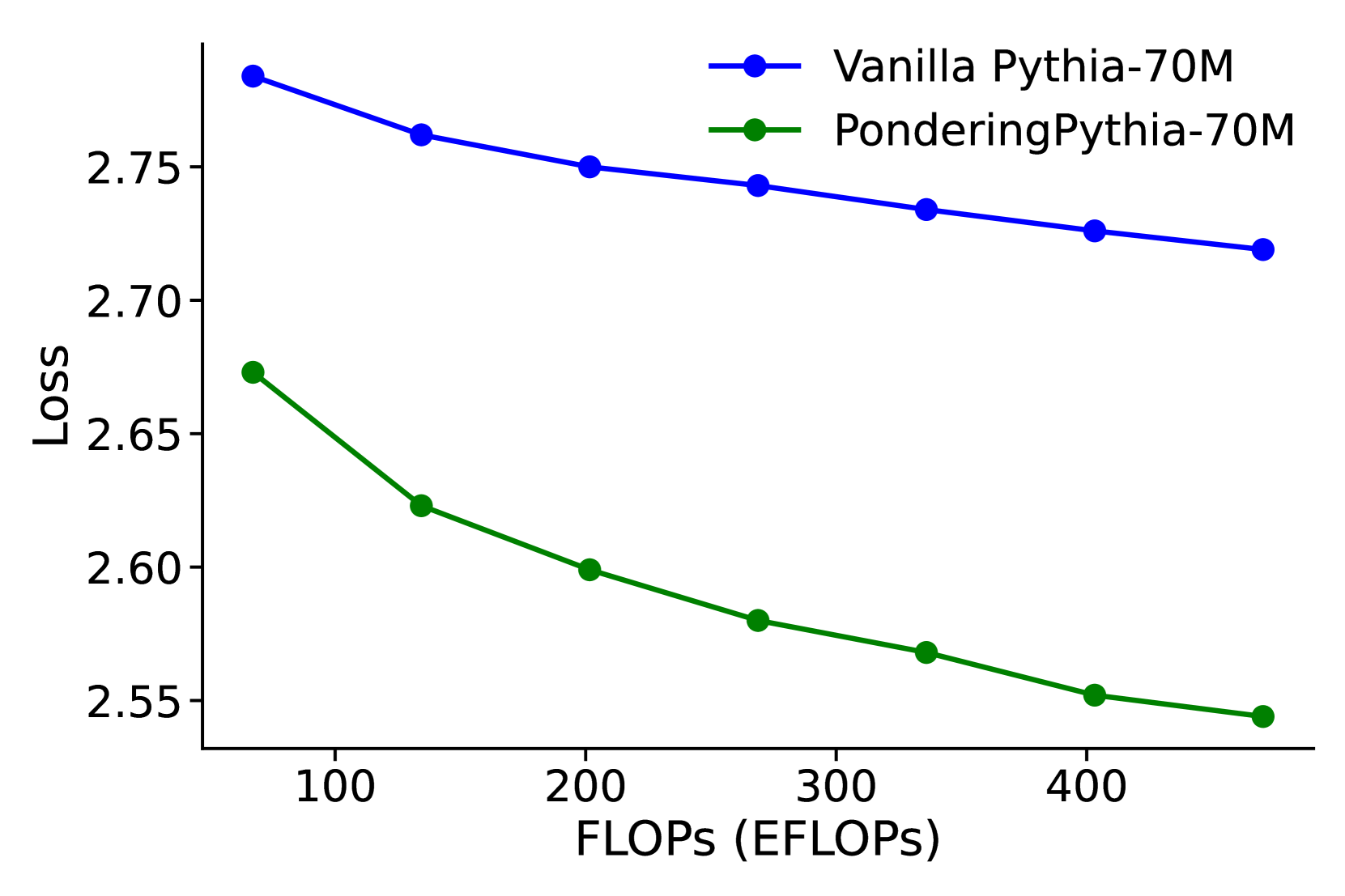
The image is a line graph comparing the **Loss** (y-axis) of two language models—**Vanilla Pythia-70M** (blue line) and **PonderingPythia-70M** (green line)—across varying computational costs (**FLOPs**, x-axis). The graph shows how loss decreases as FLOPs increase for both models, with PonderingPythia-70M consistently outperforming the Vanilla version.
---
### Components/Axes
- **X-axis**: **FLOPs (EFLOPs)**
- Range: 100 to 400 EFLOPs (increments of 50).
- Label: "FLOPs (EFLOPs)" in bold black text.
- **Y-axis**: **Loss**
- Range: 2.55 to 2.8 (increments of 0.05).
- Label: "Loss" in bold black text.
- **Legend**:
- Position: Top-right corner.
- Entries:
- **Blue circle**: "Vanilla Pythia-70M"
- **Green circle**: "PonderingPythia-70M"
---
### Detailed Analysis
#### Vanilla Pythia-70M (Blue Line)
- **Trend**: Loss decreases monotonically as FLOPs increase.
- **Data Points**:
- 100 EFLOPs: ~2.85
- 150 EFLOPs: ~2.78
- 200 EFLOPs: ~2.75
- 250 EFLOPs: ~2.74
- 300 EFLOPs: ~2.73
- 350 EFLOPs: ~2.72
- 400 EFLOPs: ~2.72
#### PonderingPythia-70M (Green Line)
- **Trend**: Loss decreases more steeply than Vanilla Pythia-70M.
- **Data Points**:
- 100 EFLOPs: ~2.67
- 150 EFLOPs: ~2.63
- 200 EFLOPs: ~2.60
- 250 EFLOPs: ~2.58
- 300 EFLOPs: ~2.57
- 350 EFLOPs: ~2.56
- 400 EFLOPs: ~2.55
---
### Key Observations
1. **Performance Gap**: PonderingPythia-70M achieves **~0.1 lower loss** than Vanilla Pythia-70M at all FLOP levels.
2. **Efficiency**: PonderingPythia-70M’s loss decreases more rapidly with increasing FLOPs, suggesting better optimization.
3. **Diminishing Returns**: Both models show reduced loss improvement at higher FLOP levels (e.g., Vanilla’s loss drops by only ~0.03 between 250–400 EFLOPs).
---
### Interpretation
The graph demonstrates that **PonderingPythia-70M** is computationally more efficient than the Vanilla version, achieving lower loss with the same or fewer FLOPs. This suggests architectural or training improvements in PonderingPythia-70M that enhance performance per FLOP. The diminishing returns at higher FLOPs imply that beyond a certain point, additional computational resources yield minimal loss reduction, highlighting potential inefficiencies in scaling.
The consistent outperformance of PonderingPythia-70M across all FLOP levels indicates it may be preferable for applications prioritizing accuracy over raw computational power.