## Diagram: Circle Packing Variations
### Overview
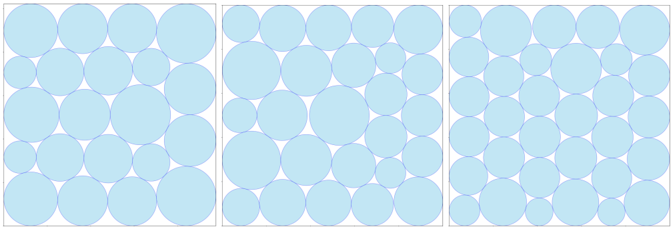
The image presents three square diagrams, each filled with a different arrangement of light blue circles. The circles vary in size and are packed together within the square boundaries. The arrangements differ in the distribution and sizes of the circles.
### Components/Axes
* **Diagrams:** Three separate square diagrams arranged horizontally.
* **Circles:** Light blue circles of varying sizes.
* **Boundaries:** Each diagram is contained within a square boundary.
### Detailed Analysis
**Diagram 1 (Left):**
* Contains a mix of larger and smaller circles.
* The larger circles are concentrated towards the center.
* Smaller circles are positioned around the edges and in the gaps between the larger circles.
* The arrangement appears somewhat structured, with the circles aligned in rows and columns.
**Diagram 2 (Center):**
* Features a wider range of circle sizes compared to Diagram 1.
* The circles are more densely packed.
* The arrangement appears more random, with less visible alignment.
* There are more instances of circles overlapping or touching each other.
**Diagram 3 (Right):**
* The circles are more uniformly sized compared to the other two diagrams.
* The arrangement is more structured, with the circles aligned in a grid-like pattern.
* The packing density is high, with minimal gaps between the circles.
### Key Observations
* The diagrams demonstrate different approaches to packing circles within a square.
* The circle sizes and arrangements vary significantly between the diagrams.
* The packing density and structural organization also differ.
### Interpretation
The image likely illustrates different algorithms or methods for circle packing. The variations in circle size, arrangement, and density suggest different optimization strategies or constraints. The diagrams could be used to compare the efficiency or aesthetic qualities of different packing algorithms. The grid-like structure in the rightmost diagram suggests a more constrained or regular packing approach, while the more random arrangements in the other diagrams suggest more flexible or adaptive methods.