## Line Chart: Verifiability vs. Falsifiability
### Overview
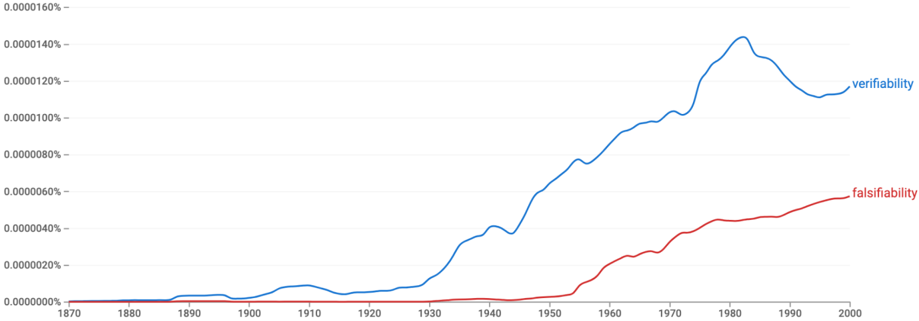
The image is a line chart comparing the frequency of the terms "verifiability" and "falsifiability" over time, from 1870 to 2000. The y-axis represents the percentage of usage, ranging from 0.0000000% to 0.0000160%.
### Components/Axes
* **X-axis:** Represents time, labeled with years from 1870 to 2000 in increments of 10 years.
* **Y-axis:** Represents the percentage of usage, ranging from 0.0000000% to 0.0000160%. The scale is divided into increments of 0.0000020%.
* **Legend:** Located on the right side of the chart.
* "verifiability" is represented by a blue line.
* "falsifiability" is represented by a red line.
### Detailed Analysis
* **Verifiability (Blue Line):**
* From 1870 to approximately 1925, the usage remains relatively flat and near 0.0000000%.
* Around 1925, the usage starts to increase, showing a significant upward trend.
* The line peaks around 1980 at approximately 0.0000145%.
* After 1980, the usage declines slightly, ending around 0.0000115% in 2000.
* **Falsifiability (Red Line):**
* From 1870 to approximately 1950, the usage remains relatively flat and near 0.0000000%.
* Around 1950, the usage starts to increase, showing an upward trend.
* The line continues to rise steadily, reaching approximately 0.0000060% in 2000.
### Key Observations
* The term "verifiability" shows a much earlier and more pronounced increase in usage compared to "falsifiability."
* The peak usage of "verifiability" occurs around 1980, followed by a slight decline.
* The usage of "falsifiability" increases steadily from 1950 to 2000, without a clear peak within the observed timeframe.
* The usage of "verifiability" is consistently higher than "falsifiability" after their respective increases begin.
### Interpretation
The chart suggests that the concept of "verifiability" gained prominence earlier in the 20th century than "falsifiability." The rise of "verifiability" could be linked to the development of logical positivism and its emphasis on empirical verification. The later rise of "falsifiability" might reflect the growing influence of Karl Popper's philosophy of science, which emphasized falsification as a key criterion for scientific theories. The peak and subsequent decline in the usage of "verifiability" could indicate a shift in philosophical focus or a critique of the limitations of verificationism. The steady increase in "falsifiability" suggests a sustained interest in this concept within academic or intellectual discourse.