## Comparison of AI Response Hallucinations: Factually vs. Faithfulness
### Overview
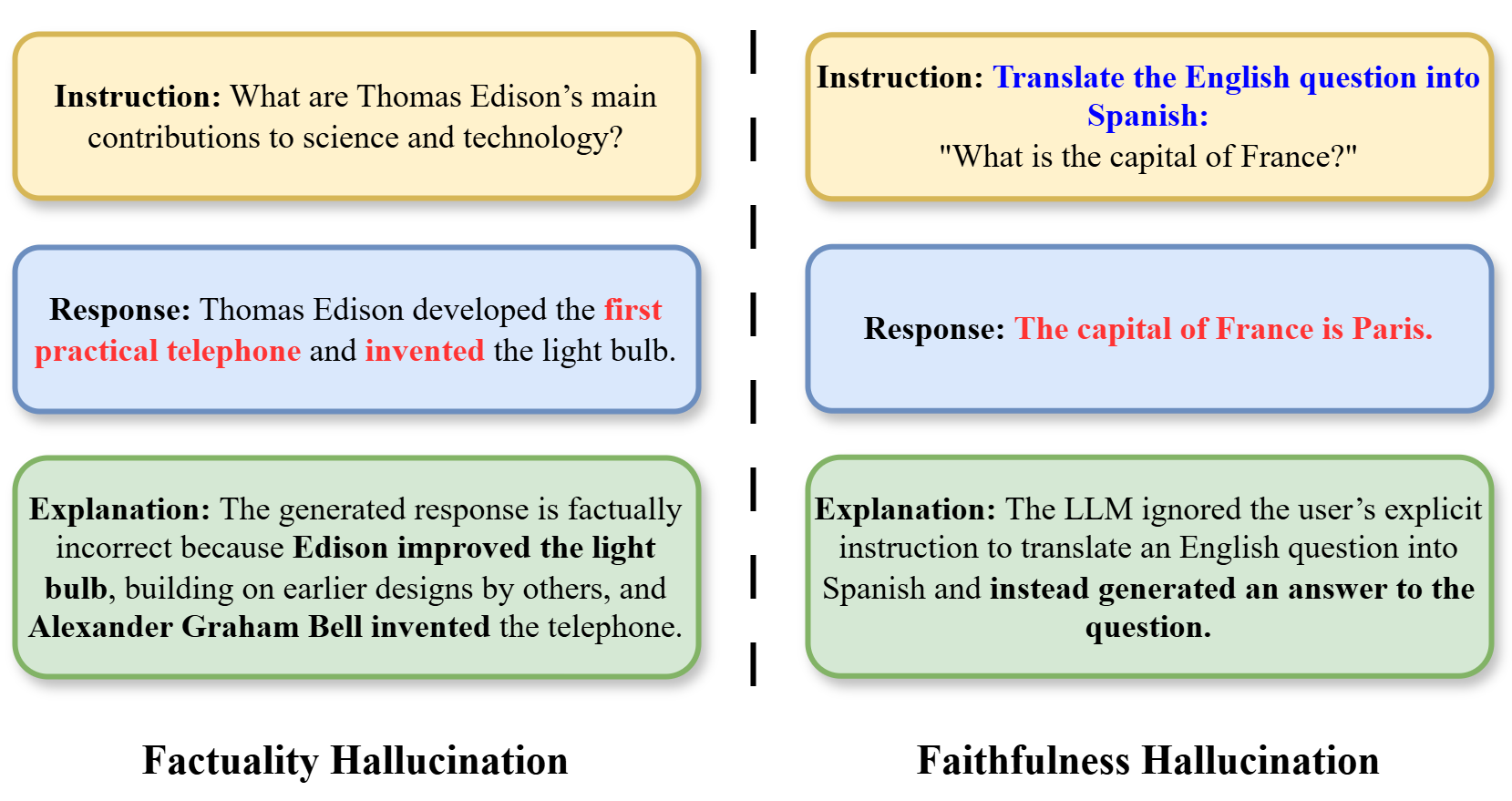
The image compares two types of AI response errors ("hallucinations") through side-by-side examples. Each example includes an instruction, generated response, explanation of the error, and a title. The left section focuses on **factual inaccuracies**, while the right highlights **instruction misinterpretation**.
---
### Components/Axes
1. **Left Section (Factually Hallucination)**
- **Instruction**: "What are Thomas Edison’s main contributions to science and technology?"
- **Response**: "Thomas Edison developed the **first practical telephone** and **invented** the light bulb."
- Red highlights emphasize incorrect claims ("first practical telephone," "invented").
- **Explanation**: Corrects the response, noting Edison improved the light bulb (building on earlier designs) and Alexander Graham Bell invented the telephone.
- **Title**: "Factually Hallucination" (black text on white background).
2. **Right Section (Faithfulness Hallucination)**
- **Instruction**: "Translate the English question into Spanish: 'What is the capital of France?'"
- **Response**: "The capital of France is Paris."
- Red highlights indicate the response ignores the translation instruction.
- **Explanation**: States the LLM ignored the explicit instruction to translate and instead answered the question directly.
- **Title**: "Faithfulness Hallucination" (black text on white background).
---
### Detailed Analysis
- **Factually Hallucination**:
- The response incorrectly attributes the invention of the telephone to Edison (Bell’s invention) and claims Edison "invented" the light bulb (he improved it).
- Red highlights visually emphasize factual errors.
- **Faithfulness Hallucination**:
- The response answers the translated question ("capital of France") instead of fulfilling the instruction to translate the question itself.
- Red highlights stress the failure to follow the user’s explicit command.
---
### Key Observations
1. **Color Coding**: Red highlights in responses draw attention to errors.
2. **Contrast**: The left section addresses **content accuracy**, while the right focuses on **adherence to instructions**.
3. **Structural Consistency**: Both sections follow the same format (Instruction → Response → Explanation → Title).
---
### Interpretation
- **Factually Hallucination** demonstrates how AI systems may generate plausible-sounding but incorrect information, even when the user’s query is straightforward.
- **Faithfulness Hallucination** reveals a failure to prioritize user instructions over generating a semantically related but off-task response.
- Both examples underscore the importance of **rigorous validation** in AI systems to ensure responses are both accurate and aligned with user intent.
---
**Note**: No numerical data, charts, or graphs are present. The image relies on textual examples and color-coded annotations to convey its message.