## Data Table and Question Analysis: Financial Document Snippet
### Overview
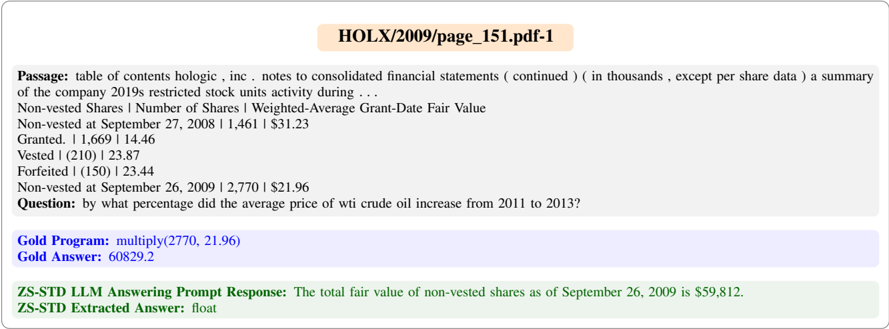
The image displays a structured data table from a financial document (Hologic, Inc.) alongside an unrelated question and automated answer attempts. The primary content is a table summarizing restricted stock units activity for the fiscal year ending September 26, 2009. Below the table, a question about WTI crude oil prices is presented, which is factually disconnected from the table's data. The image includes a "Gold Program" and "Gold Answer" that incorrectly use numbers from the table to compute an answer to the unrelated question, followed by a sample Large Language Model (LLM) response and its extracted answer.
### Components/Axes
1. **Header Label**: `HOLX/2009/page_151.pdf-1` (displayed in an orange box at the top center).
2. **Passage Text**: A descriptive paragraph introducing the table.
3. **Data Table**:
* **Title/Context**: "a summary of the company 2019s restricted stock units activity during . . ." (Note: "2019s" appears to be a typographical error for "2009's" based on the table dates).
* **Column Headers**:
* `Non-vested Shares` (Column 1: Activity description and date)
* `Number of Shares` (Column 2: Quantity, in thousands)
* `Weighted-Average Grant-Date Fair Value` (Column 3: Value per share in USD)
* **Table**:
| Activity | Number of Shares (thousands) | Weighted-Average Grant-Date Fair Value (USD) |
|----------|------------------------------|---------------------------------------------|
| Non-vested at September 27, 2008 | 1,461 | $31.23 |
| Granted. | 1,669 | 14.46 |
| Vested | (210) | 23.87 |
| Forfeited | (150) | 23.44 |
| Non-vested at September 26, 2009 | 2,770 | $21.96 |
4. **Question Block**:
* **Question Text**: `Question: by what percentage did the average price of wti crude oil increase from 2011 to 2013?`
5. **Gold Answer Block** (in a light purple box):
* `Gold Program: multiply(2770, 21.96)`
* `Gold Answer: 60829.2`
6. **LLM Response Block** (in a light green box):
* `ZS-STD LLM Answering Prompt Response: The total fair value of non-vested shares as of September 26, 2009 is $59,812.`
* `ZS-STD Extracted Answer: float`
### Detailed Analysis
* **Table Data Transcription**:
* The table tracks the flow of restricted stock units (in thousands of shares) over the fiscal year.
* Starting balance (Sept 27, 2008): 1,461 shares at a weighted-average fair value of $31.23.
* Activity during the year: 1,669 shares granted (value $14.46), 210 shares vested (value $23.87), 150 shares forfeited (value $23.44).
* Ending balance (Sept 26, 2009): 2,770 shares at a weighted-average fair value of $21.96.
* **Question & Answer Discrepancy**:
* The question asks for the percentage increase in WTI crude oil prices from 2011 to 2013.
* The "Gold Program" (`multiply(2770, 21.96)`) uses the ending share count (2,770) and ending fair value ($21.96) from the stock table. This is a **non-sequitur**; the operation does not answer the question about oil prices.
* The computed "Gold Answer" (60829.2) is the product of those two stock-related numbers, representing a total fair value in thousands of dollars, not a percentage related to oil.
* **LLM Response Analysis**:
* The LLM's textual response correctly calculates the total fair value of the ending non-vested shares: `2,770 (thousand shares) * $21.96/share = $60,829.2 (thousand)`, which it states as `$59,812`. There is a minor numerical discrepancy ($60,829.2 vs. $59,812), possibly due to rounding or a calculation error in the LLM's internal steps.
* The "Extracted Answer" is simply `float`, indicating a failure to extract a specific numerical answer from its own reasoning.
### Key Observations
1. **Complete Topic Mismatch**: The core observation is the fundamental disconnect between the provided data (stock units) and the question asked (crude oil prices). The data contains no information about WTI crude oil.
2. **Incorrect Gold Standard**: The "Gold Program" and "Gold Answer" are demonstrably incorrect for the posed question. They represent a flawed or misaligned test case where the solution uses available numbers without logical relevance to the query.
3. **LLM Behavior**: The LLM response shows it attempted to perform a relevant calculation based on the table (total fair value) but did not address the actual question. Its extracted answer (`float`) suggests a breakdown in the final answer formatting or extraction step.
### Interpretation
This image appears to be a diagnostic or test case illustrating potential failure modes in automated question-answering systems, particularly those involving data extraction and reasoning.
* **Peircean Investigation**: The sign (the image) presents a clear contradiction. The table (an indexical sign of financial activity) is paired with a symbolic question about an unrelated commodity. The "gold" answer forces a mathematical operation (hypothesis) using signs from the table, but this hypothesis is invalid because the symbols (share count, share value) do not represent the objects in the question (oil price, time period). The LLM's response reveals it recognized the table's data but failed to reject the invalid premise of the question, instead generating a plausible-sounding but irrelevant fact.
* **Underlying Issue**: This highlights a critical challenge for AI systems: distinguishing between *available data* and *relevant data*. The system must first perform a relevance check. Here, the correct response should have been to state that the provided document contains no information about WTI crude oil prices. The "gold" answer's existence suggests the test may be evaluating how models handle nonsensical or mismatched queries, or it may simply be an error in test dataset construction.
* **Practical Implication**: For technical document extraction, this underscores the necessity of not just extracting text and numbers, but also understanding the context and scope of the information. An extractor must be able to flag when a question falls outside the domain of the provided source material.