## Diagram: Neural Network Block Architecture
### Overview
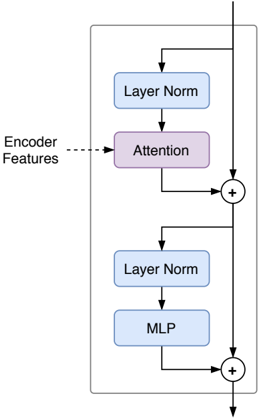
The image displays a schematic block diagram of a neural network layer, characteristic of a Transformer decoder block. The diagram illustrates a sequential data flow through normalization, attention, and feed-forward (MLP) layers, incorporating residual connections (skip connections) at two distinct stages.
### Components/Flow
The diagram is enclosed within a large rectangular container. The flow is primarily top-to-bottom.
**Top Section (Attention Mechanism):**
* **Input:** Data enters from the top of the container.
* **Layer Norm:** A light blue rectangular block labeled "Layer Norm" processes the input.
* **Attention:** A light purple rectangular block labeled "Attention" follows the first Layer Norm.
* **External Input:** A dashed arrow points from the left, labeled "Encoder Features," indicating an external input into the "Attention" block.
* **Residual Connection:** A vertical line runs down the right side of the container. At the output of the "Attention" block, this line meets the block's output at a circle containing a "+" symbol, indicating a summation (residual addition).
**Bottom Section (Feed-Forward Mechanism):**
* **Layer Norm:** The output from the first summation flows into a second light blue rectangular block labeled "Layer Norm."
* **MLP:** This flows into a light blue rectangular block labeled "MLP" (Multi-Layer Perceptron).
* **Residual Connection:** The vertical line on the right continues downward. At the output of the "MLP" block, it meets the block's output at a second circle containing a "+" symbol, indicating a second summation.
* **Output:** The final result exits the container at the bottom.
### Detailed Analysis
* **Color Coding:**
* **Light Blue:** Used for "Layer Norm" and "MLP" blocks, representing standard processing layers.
* **Light Purple:** Used for the "Attention" block, highlighting its distinct role compared to the other components.
* **Structural Logic:**
* The diagram follows a standard "Add & Norm" pattern common in deep learning architectures.
* The presence of the "Encoder Features" input specifically identifies this as a **Cross-Attention** layer within a Transformer decoder.
* The vertical line on the right acts as a "highway" for the residual connection, allowing the original input to bypass the transformation layers and be added back to the processed output.
### Key Observations
* **Sequential Dependency:** The architecture is strictly sequential; the output of the top section (Attention) is the input for the bottom section (MLP).
* **Residual Integration:** There are two distinct residual connections. The first bypasses the Layer Norm and Attention mechanism. The second bypasses the Layer Norm and MLP mechanism.
* **External Dependency:** The "Attention" block is the only component that accepts an external input ("Encoder Features"), distinguishing it from the self-contained nature of the "MLP" block.
### Interpretation
This diagram represents a **Transformer Decoder Cross-Attention Block**.
* **Functionality:** The data flow demonstrates how a decoder integrates information from an encoder. The "Attention" block allows the decoder to focus on specific parts of the encoder's output (the "Encoder Features") relative to the current sequence being processed.
* **Why it matters:** The residual connections (the "+" circles) are critical for training deep neural networks. They mitigate the "vanishing gradient" problem by providing a direct path for gradients to flow backward through the network during training, allowing for the construction of much deeper models.
* **Peircean Investigative Note:** The visual distinction of the "Attention" block (purple) versus the "MLP" block (blue) suggests a functional separation: the purple block is dynamic and context-dependent (based on external encoder features), while the blue blocks are static, learned transformations applied to the data. The structure implies that the model first aligns its internal state with external information (Attention) and then refines that information through a feed-forward network (MLP).