## Diagram: Transformer Decoder Block Architecture
### Overview
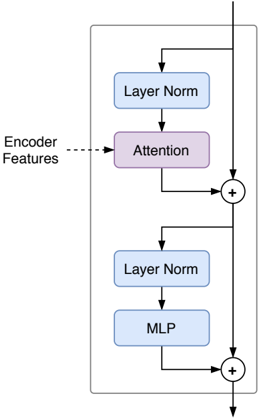
The image depicts a simplified technical diagram of a transformer decoder block, commonly used in sequence-to-sequence models like neural machine translation or text generation. The architecture includes encoder features, attention mechanisms, layer normalization, and a multi-layer perceptron (MLP), with residual connections between components.
### Components/Axes
- **Encoder Features**: Input to the block, represented by a dashed arrow pointing to the "Attention" component.
- **Attention**: Highlighted in purple, indicating its role in weighting input features.
- **Layer Norm**: Two instances (light blue boxes) applied after the attention mechanism and MLP.
- **MLP**: A multi-layer perceptron positioned after the second layer normalization.
- **Residual Connections**: Addition operations (denoted by "+" symbols) combine outputs from previous layers with subsequent inputs.
### Detailed Analysis
1. **Flow Direction**:
- Encoder features → Attention → Layer Norm → MLP → Layer Norm → Final Output.
- Residual connections bypass the attention and MLP blocks, adding their outputs directly to the next layer’s input.
2. **Component Roles**:
- **Attention**: Processes encoder features to generate context-aware representations.
- **Layer Norm**: Stabilizes activations after attention and MLP operations.
- **MLP**: Transforms the normalized output into a higher-dimensional space.
3. **Color Coding**:
- Light blue: Layer normalization and MLP components.
- Purple: Attention mechanism, emphasizing its distinct role.
### Key Observations
- The attention mechanism is the central processing unit, with layer normalization applied after each major transformation.
- Residual connections suggest a design inspired by transformer architectures, enabling deeper networks by mitigating vanishing gradients.
- No numerical values or quantitative data are present; the diagram focuses on structural relationships.
### Interpretation
This diagram illustrates a standard transformer decoder block, where:
- **Encoder Features** provide contextual input for the decoder.
- **Attention** allows the model to focus on relevant parts of the input sequence.
- **Layer Normalization** ensures stable training by normalizing activations.
- **MLP** introduces non-linearity to capture complex patterns.
- **Residual Connections** preserve gradient flow, critical for training deep models.
The architecture aligns with transformer-based models, emphasizing modularity and scalability. The absence of numerical data suggests this is a conceptual representation rather than an empirical analysis.