## Line Charts: World Modeling Accuracy vs. Steps for Different Tasks
### Overview
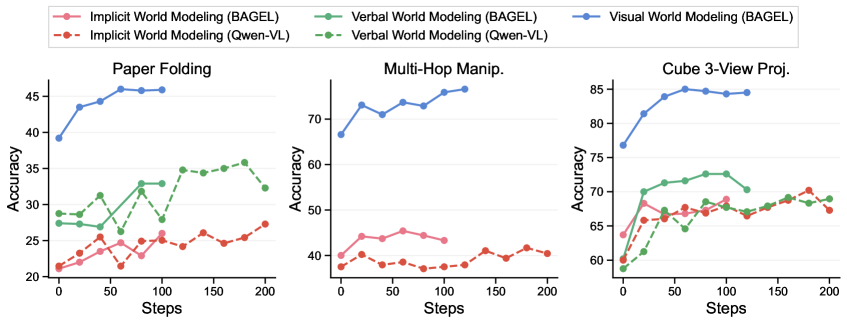
The image presents three line charts comparing the accuracy of different world modeling approaches (Implicit, Verbal, and Visual) using two different systems (BAGEL and Qwen-VL) across three tasks: Paper Folding, Multi-Hop Manipulation, and Cube 3-View Projection. The x-axis represents the number of steps, and the y-axis represents the accuracy.
### Components/Axes
* **Title:** The image contains three separate charts, titled "Paper Folding", "Multi-Hop Manip.", and "Cube 3-View Proj."
* **X-axis:** Labeled "Steps", with a range from 0 to 200, incrementing by 50.
* **Y-axis:** Labeled "Accuracy", with a range from 20 to 45 for "Paper Folding", 40 to 75 for "Multi-Hop Manip.", and 60 to 85 for "Cube 3-View Proj.". The y-axis increments by 5.
* **Legend:** Located at the top of the image.
* Pink Line: Implicit World Modeling (BAGEL)
* Red Dashed Line: Implicit World Modeling (Qwen-VL)
* Green Line: Verbal World Modeling (BAGEL)
* Green Dashed Line: Verbal World Modeling (Qwen-VL)
* Blue Line: Visual World Modeling (BAGEL)
### Detailed Analysis
**1. Paper Folding**
* **Visual World Modeling (BAGEL) - Blue Line:** Starts at approximately 39% accuracy and rapidly increases to approximately 44% by step 50, then plateaus around 46% for the remaining steps.
* **Verbal World Modeling (BAGEL) - Green Line:** Starts at approximately 28% accuracy, increases to approximately 33% by step 50, fluctuates between 30% and 35% until step 200.
* **Verbal World Modeling (Qwen-VL) - Green Dashed Line:** Starts at approximately 28% accuracy, increases to approximately 31% by step 50, then decreases to approximately 26% by step 100, and remains relatively stable around 26% for the remaining steps.
* **Implicit World Modeling (BAGEL) - Pink Line:** Starts at approximately 23% accuracy and gradually increases to approximately 26% by step 200.
* **Implicit World Modeling (Qwen-VL) - Red Dashed Line:** Starts at approximately 22% accuracy and gradually increases to approximately 27% by step 200.
**2. Multi-Hop Manip.**
* **Visual World Modeling (BAGEL) - Blue Line:** Starts at approximately 67% accuracy and increases to approximately 72% by step 25, then fluctuates between 71% and 74% for the remaining steps.
* **Verbal World Modeling (BAGEL) - Green Line:** Not present in this chart.
* **Verbal World Modeling (Qwen-VL) - Green Dashed Line:** Not present in this chart.
* **Implicit World Modeling (BAGEL) - Pink Line:** Starts at approximately 40% accuracy and gradually increases to approximately 45% by step 100, then plateaus around 43% for the remaining steps.
* **Implicit World Modeling (Qwen-VL) - Red Dashed Line:** Starts at approximately 38% accuracy and fluctuates between 38% and 42% for the remaining steps.
**3. Cube 3-View Proj.**
* **Visual World Modeling (BAGEL) - Blue Line:** Starts at approximately 77% accuracy and increases to approximately 84% by step 50, then plateaus around 84% for the remaining steps.
* **Verbal World Modeling (BAGEL) - Green Line:** Starts at approximately 60% accuracy and increases to approximately 72% by step 100, then decreases to approximately 70% by step 200.
* **Verbal World Modeling (Qwen-VL) - Green Dashed Line:** Starts at approximately 59% accuracy and increases to approximately 67% by step 50, then fluctuates between 65% and 70% for the remaining steps.
* **Implicit World Modeling (BAGEL) - Pink Line:** Starts at approximately 62% accuracy and increases to approximately 69% by step 50, then fluctuates between 66% and 69% for the remaining steps.
* **Implicit World Modeling (Qwen-VL) - Red Dashed Line:** Starts at approximately 61% accuracy and increases to approximately 68% by step 50, then fluctuates between 66% and 69% for the remaining steps.
### Key Observations
* Visual World Modeling (BAGEL) consistently achieves the highest accuracy across all three tasks.
* Implicit World Modeling (Qwen-VL) generally performs the worst.
* The performance difference between BAGEL and Qwen-VL is more pronounced in Implicit World Modeling.
* The accuracy tends to plateau after a certain number of steps, suggesting diminishing returns.
### Interpretation
The data suggests that Visual World Modeling (BAGEL) is the most effective approach for these tasks, indicating that visual information is crucial for accurate world modeling. The performance differences between BAGEL and Qwen-VL highlight the impact of the underlying system on the accuracy of world modeling. The plateauing of accuracy after a certain number of steps suggests that there may be a limit to how much the models can learn from additional steps, or that the models have converged to a local optimum. The relative performance of the different modeling approaches varies depending on the task, suggesting that the optimal approach may depend on the specific requirements of the task.