## Line Charts: Build Duration vs. Number of Jobs
### Overview
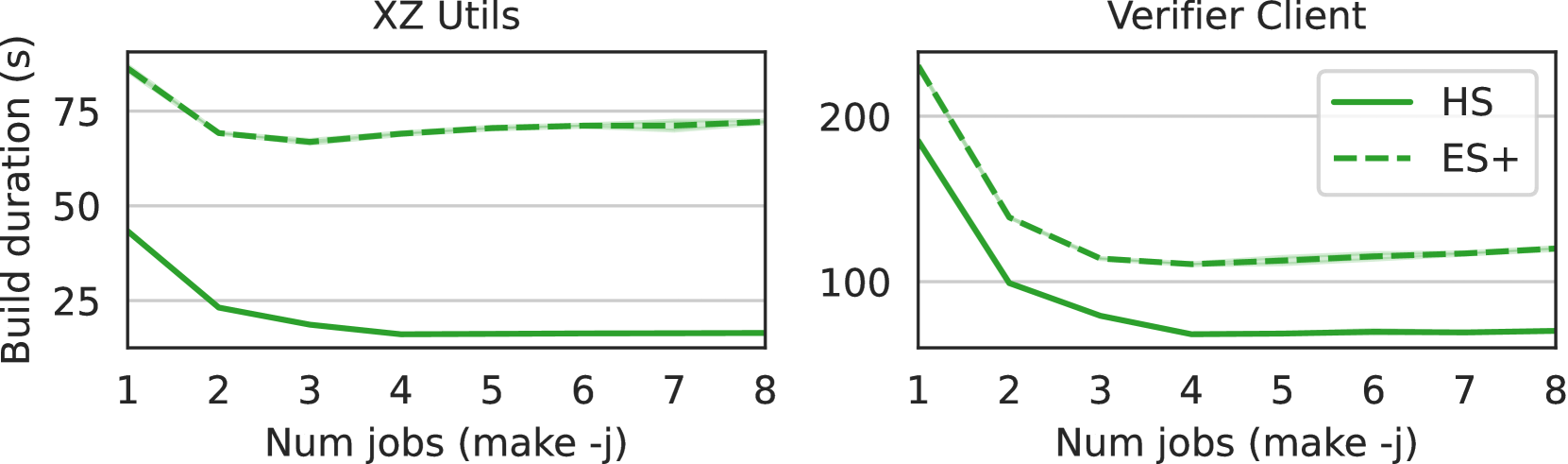
The image contains two line charts comparing the build duration (in seconds) against the number of jobs (using `make -j`) for two different systems: "XZ Utils" and "Verifier Client". Each chart plots two data series: "HS" (solid green line) and "ES+" (dashed green line). The x-axis represents the number of jobs, ranging from 1 to 8. The y-axis represents the build duration in seconds.
### Components/Axes
**Left Chart (XZ Utils):**
* **Title:** XZ Utils
* **Y-axis:** Build duration (s), with markers at 25, 50, and 75.
* **X-axis:** Num jobs (make -j), with markers from 1 to 8.
**Right Chart (Verifier Client):**
* **Title:** Verifier Client
* **Y-axis:** Build duration (s), with markers at 100 and 200.
* **X-axis:** Num jobs (make -j), with markers from 1 to 8.
**Legend (Located in the top-right chart):**
* **HS:** Solid green line
* **ES+:** Dashed green line
### Detailed Analysis
**Left Chart (XZ Utils):**
* **HS (Solid Green):** The build duration decreases sharply from approximately 45 seconds at 1 job to around 15 seconds at 4 jobs. It then remains relatively constant at approximately 15 seconds from 4 to 8 jobs.
* 1 Job: ~45s
* 2 Jobs: ~25s
* 3 Jobs: ~18s
* 4 Jobs: ~15s
* 5 Jobs: ~15s
* 6 Jobs: ~15s
* 7 Jobs: ~15s
* 8 Jobs: ~15s
* **ES+ (Dashed Green):** The build duration starts at approximately 80 seconds at 1 job, decreases to around 65 seconds at 3 jobs, and then slightly increases to approximately 70 seconds at 8 jobs.
* 1 Job: ~80s
* 2 Jobs: ~70s
* 3 Jobs: ~65s
* 4 Jobs: ~68s
* 5 Jobs: ~70s
* 6 Jobs: ~70s
* 7 Jobs: ~70s
* 8 Jobs: ~70s
**Right Chart (Verifier Client):**
* **HS (Solid Green):** The build duration decreases sharply from approximately 220 seconds at 1 job to around 70 seconds at 4 jobs. It then remains relatively constant at approximately 70 seconds from 4 to 8 jobs.
* 1 Job: ~220s
* 2 Jobs: ~100s
* 3 Jobs: ~80s
* 4 Jobs: ~70s
* 5 Jobs: ~70s
* 6 Jobs: ~70s
* 7 Jobs: ~70s
* 8 Jobs: ~75s
* **ES+ (Dashed Green):** The build duration decreases from approximately 210 seconds at 1 job to around 110 seconds at 4 jobs. It then slightly increases to approximately 120 seconds at 8 jobs.
* 1 Job: ~210s
* 2 Jobs: ~150s
* 3 Jobs: ~120s
* 4 Jobs: ~110s
* 5 Jobs: ~115s
* 6 Jobs: ~115s
* 7 Jobs: ~120s
* 8 Jobs: ~120s
### Key Observations
* For both "XZ Utils" and "Verifier Client", the "HS" configuration consistently results in lower build durations compared to the "ES+" configuration, especially as the number of jobs increases.
* The "HS" configuration shows a significant decrease in build duration with an increasing number of jobs, particularly up to 4 jobs. After 4 jobs, the build duration plateaus.
* The "ES+" configuration shows a less dramatic decrease in build duration with an increasing number of jobs, and the build duration tends to stabilize or slightly increase after a certain number of jobs.
### Interpretation
The data suggests that the "HS" configuration is more efficient in utilizing parallel processing for both "XZ Utils" and "Verifier Client" builds. The significant drop in build duration with an increasing number of jobs indicates that the "HS" configuration can effectively distribute the workload across multiple cores. The "ES+" configuration, on the other hand, appears to be less scalable, as the build duration does not decrease as significantly with an increasing number of jobs, and in some cases, it even increases slightly. This could be due to overhead associated with managing the parallel processes in the "ES+" configuration, or limitations in the way the build process is parallelized. The plateauing effect observed in both configurations after 4 jobs suggests that there may be diminishing returns in increasing the number of jobs beyond a certain point, possibly due to resource contention or other bottlenecks.