## Line Charts: Build Duration vs. Number of Parallel Jobs
### Overview
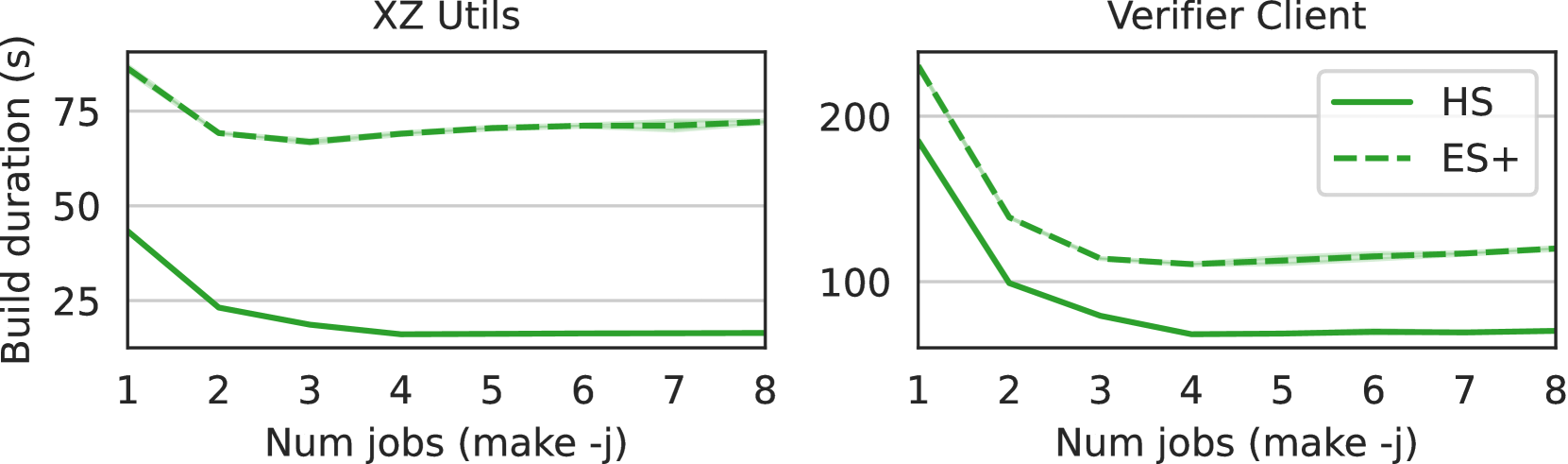
The image contains two side-by-side line charts comparing the build duration (in seconds) of two software projects ("XZ Utils" and "Verifier Client") as a function of the number of parallel jobs used during compilation (specified via `make -j`). Each chart plots two data series: "HS" (solid green line) and "ES+" (dashed green line).
### Components/Axes
* **Chart Titles:**
* Left Chart: "XZ Utils"
* Right Chart: "Verifier Client"
* **Y-Axis (Both Charts):** Label: "Build duration (s)". The scale differs between charts.
* XZ Utils: Ticks at 25, 50, 75. Range appears to be 0 to ~90.
* Verifier Client: Ticks at 100, 200. Range appears to be 0 to ~250.
* **X-Axis (Both Charts):** Label: "Num jobs (make -j)". Ticks at integer values from 1 to 8.
* **Legend:** Located in the top-right corner of the "Verifier Client" chart.
* **HS:** Represented by a solid green line.
* **ES+:** Represented by a dashed green line.
### Detailed Analysis
#### Chart 1: XZ Utils
* **HS Series (Solid Green Line):**
* **Trend:** Sharp initial decrease, followed by a gradual decline that plateaus.
* **Data Points (Approximate):**
* 1 job: ~45 seconds
* 2 jobs: ~25 seconds
* 3 jobs: ~20 seconds
* 4 jobs: ~18 seconds
* 5 jobs: ~17 seconds
* 6 jobs: ~16 seconds
* 7 jobs: ~16 seconds
* 8 jobs: ~16 seconds
* **ES+ Series (Dashed Green Line):**
* **Trend:** Sharp initial decrease, followed by a very slight, steady increase.
* **Data Points (Approximate):**
* 1 job: ~85 seconds
* 2 jobs: ~70 seconds
* 3 jobs: ~68 seconds
* 4 jobs: ~70 seconds
* 5 jobs: ~72 seconds
* 6 jobs: ~73 seconds
* 7 jobs: ~74 seconds
* 8 jobs: ~75 seconds
#### Chart 2: Verifier Client
* **HS Series (Solid Green Line):**
* **Trend:** Sharp initial decrease, followed by a gradual decline that plateaus.
* **Data Points (Approximate):**
* 1 job: ~180 seconds
* 2 jobs: ~100 seconds
* 3 jobs: ~80 seconds
* 4 jobs: ~70 seconds
* 5 jobs: ~70 seconds
* 6 jobs: ~70 seconds
* 7 jobs: ~70 seconds
* 8 jobs: ~70 seconds
* **ES+ Series (Dashed Green Line):**
* **Trend:** Sharp initial decrease, followed by a plateau with a very slight upward trend.
* **Data Points (Approximate):**
* 1 job: ~220 seconds
* 2 jobs: ~140 seconds
* 3 jobs: ~115 seconds
* 4 jobs: ~110 seconds
* 5 jobs: ~112 seconds
* 6 jobs: ~115 seconds
* 7 jobs: ~118 seconds
* 8 jobs: ~120 seconds
### Key Observations
1. **Consistent Pattern:** Both projects and both build configurations (HS, ES+) show a significant reduction in build time when moving from 1 to 2 parallel jobs.
2. **Diminishing Returns:** The benefit of adding more parallel jobs diminishes rapidly after 2-4 jobs. For the HS configuration, build time largely plateaus after 4 jobs. For the ES+ configuration, the time stabilizes or even increases slightly beyond 3-4 jobs.
3. **Performance Gap:** The ES+ configuration consistently has a higher build duration than the HS configuration across all job counts for both projects. The gap is larger in absolute seconds for the Verifier Client.
4. **Project Scale:** The Verifier Client has a significantly longer base build time (at 1 job) than XZ Utils for both configurations, indicating a larger or more complex codebase.
### Interpretation
The data demonstrates the effect of parallel compilation on build performance. The initial steep drop confirms that both projects benefit from parallelization. However, the plateauing and slight increase in the ES+ lines suggest that beyond an optimal point (around 3-4 jobs), the overhead of managing parallel tasks (e.g., context switching, resource contention, dependency synchronization) begins to outweigh the benefits of adding more concurrent processes.
The consistent performance difference between HS and ES+ implies that the ES+ configuration involves additional, time-consuming steps (perhaps more extensive verification, instrumentation, or different compiler flags) that are not fully parallelizable or add fixed overhead. The fact that the pattern is similar across two different projects suggests this is a characteristic of the build configurations themselves, not a project-specific anomaly. For optimal build efficiency, using the HS configuration with 4 parallel jobs appears to be a good balance for these projects.