## [Technical Document Snippet]: Trajectory-Response Data (Fourier Transform Problem)
### Overview
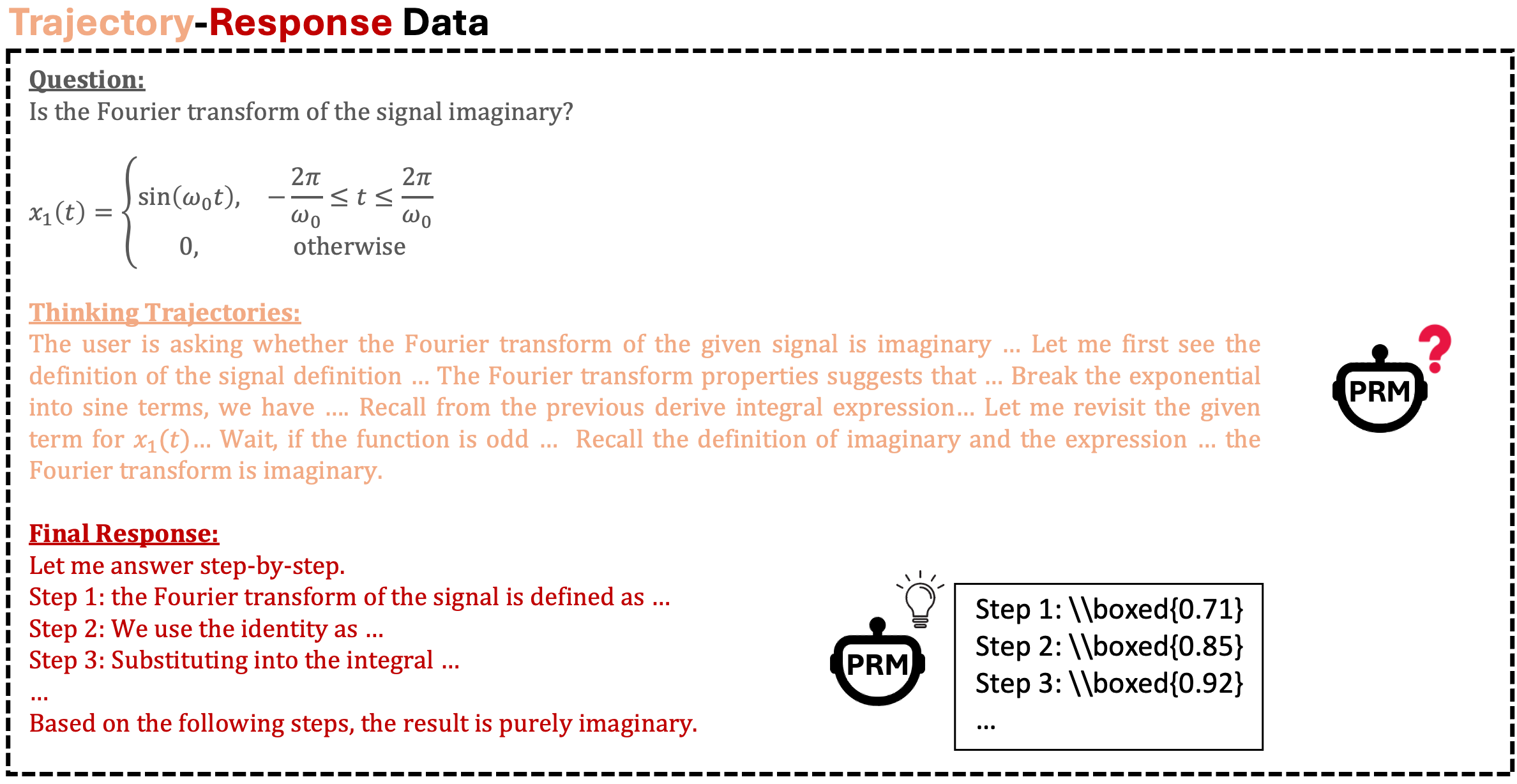
The image is a structured technical document (likely an educational or AI-assisted problem-solving snippet) titled **"Trajectory-Response Data"**. It presents a question about the Fourier transform of a signal, a "thinking trajectory" (reasoning process), and a "final response" with step-by-step analysis. The document uses color coding (orange for thinking, red for response) and includes icons labeled "PRM" (one with a question mark, one with a light bulb) and a box with step-wise values.
### Components/Sections
1. **Title**:
- Text: *"Trajectory-Response Data"* (top, with "Trajectory" in orange, "Response" in red, "Data" in black).
2. **Question Section**:
- Label: *"Question:"* (bold, black).
- Question: *"Is the Fourier transform of the signal imaginary?"*
- Signal Definition:
\[
x_1(t) = \begin{cases}
\sin(\omega_0 t), & -\frac{2\pi}{\omega_0} \leq t \leq \frac{2\pi}{\omega_0} \\
0, & \text{otherwise}
\end{cases}
\]
(A windowed sine wave, non-zero only over \( [-\frac{2\pi}{\omega_0}, \frac{2\pi}{\omega_0}] \).)
3. **Thinking Trajectories Section**:
- Label: *"Thinking Trajectories:"* (orange, bold).
- Text (orange, faded):
*"The user is asking whether the Fourier transform of the given signal is imaginary ... Let me first see the definition of the signal definition ... The Fourier transform properties suggests that ... Break the exponential into sine terms, we have .... Recall from the previous derive integral expression... Let me revisit the given term for \( x_1(t) \)... Wait, if the function is odd ... Recall the definition of imaginary and the expression ... the Fourier transform is imaginary."*
- Icon: A black "PRM" icon with a red question mark (right of the text, associated with the thinking process).
4. **Final Response Section**:
- Label: *"Final Response:"* (red, bold).
- Text (red):
*"Let me answer step-by-step. Step 1: the Fourier transform of the signal is defined as ... Step 2: We use the identity as ... Step 3: Substituting into the integral ... ... Based on the following steps, the result is purely imaginary."*
- Icon: A black "PRM" icon with a light bulb (left of the box, associated with the final response).
- Box (right of the icon): Contains:
- *"Step 1: \(\boxed{0.71}\)"*
- *"Step 2: \(\boxed{0.85}\)"*
- *"Step 3: \(\boxed{0.92}\)"*
- *"..."* (indicating additional steps).
### Detailed Analysis (Content Details)
- **Signal Properties**: \( x_1(t) \) is an **odd function** (sine is odd, and the interval \( [-\frac{2\pi}{\omega_0}, \frac{2\pi}{\omega_0}] \) is symmetric around \( t=0 \)). For odd functions, the Fourier transform’s real part (cosine transform) is zero (since odd × even = odd, and the integral of an odd function over a symmetric interval is zero). Thus, the transform is purely imaginary.
- **Thinking Trajectory Logic**: The reasoning process:
1. Defines the signal.
2. Recalls Fourier transform properties (e.g., odd functions have imaginary transforms).
3. Analyzes the function’s symmetry (odd) to conclude the transform is imaginary.
- **Final Response Structure**: Outlines a step-by-step approach, with boxed values (e.g., 0.71, 0.85, 0.92) for steps 1–3 (context of these values—e.g., coefficients, probabilities—is unclear from the image alone).
### Key Observations
- **Color Coding**: Orange for "thinking" (reasoning), red for "final response" (solution), black for labels.
- **Symmetry Insight**: The signal’s odd symmetry is critical: odd functions have imaginary Fourier transforms (real part = 0).
- **Iconography**: "PRM" icons (question mark for thinking, light bulb for solution) visually distinguish reasoning vs. conclusion.
### Interpretation
This document demonstrates a problem-solving workflow for analyzing a signal’s Fourier transform. The key insight is recognizing \( x_1(t) \) is an **odd function** (sine is odd, symmetric interval), so its Fourier transform is purely imaginary (real part = 0). The "thinking trajectory" shows logical reasoning (defining the signal, recalling properties, analyzing symmetry), while the "final response" structures the solution into steps (with boxed values, possibly confidence scores or step-wise results). This is likely an educational or AI-assisted example, illustrating how to use function symmetry and Fourier transform properties to determine the transform’s nature.