\n
## Diagram: Matrix Multiplication Decomposition
### Overview
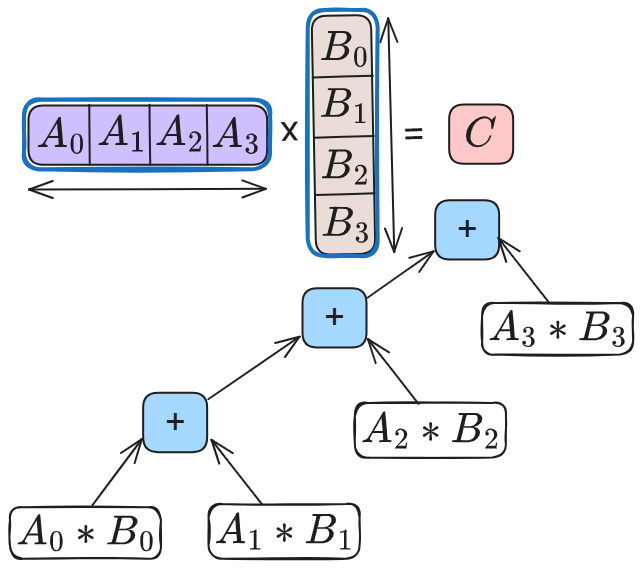
The image depicts a visual breakdown of matrix multiplication. It illustrates how the product of two matrices, represented as A and B, results in a matrix C, and how this multiplication can be decomposed into a series of scalar multiplications and additions.
### Components/Axes
The diagram consists of the following components:
* **Matrix A:** A horizontal rectangular block labeled "A₀ A₁ A₂ A₃".
* **Matrix B:** A vertical rectangular block labeled "B₀, B₁, B₂, B₃".
* **Matrix C:** A single rectangular block labeled "C".
* **Multiplication Symbol:** "x" indicating matrix multiplication.
* **Addition Symbols:** "+" within rounded rectangles, representing addition operations.
* **Scalar Multiplication:** Expressions like "A₀ * B₀", "A₁ * B₁", etc., representing element-wise multiplication.
* **Arrows:** Indicating the flow of operations.
### Detailed Analysis or Content Details
The diagram shows the following decomposition:
The multiplication of matrix A (1x4) and matrix B (4x1) results in matrix C (1x1). The process is broken down as follows:
1. **Scalar Multiplications:**
* A₀ * B₀
* A₁ * B₁
* A₂ * B₂
* A₃ * B₃
2. **First Level of Additions:**
* A₀ * B₀ + A₁ * B₁
* A₂ * B₂ + A₃ * B₃
3. **Final Addition:**
* (A₀ * B₀ + A₁ * B₁) + (A₂ * B₂ + A₃ * B₃) = C
The arrows indicate the flow of data from the scalar multiplications to the addition operations, ultimately resulting in the element of matrix C.
### Key Observations
The diagram clearly illustrates the fundamental operation of matrix multiplication, breaking it down into simpler scalar multiplications and additions. The arrangement of the elements and operations highlights the element-wise nature of the calculation.
### Interpretation
This diagram is a pedagogical tool for understanding matrix multiplication. It visually demonstrates that matrix multiplication is not a single operation but a series of scalar multiplications and additions. The decomposition helps to clarify the relationship between the elements of the input matrices (A and B) and the resulting matrix (C). The diagram is useful for students learning linear algebra or anyone needing a visual reminder of how matrix multiplication works. The diagram does not contain any numerical data, but rather focuses on the conceptual breakdown of the operation. It is a representation of the mathematical process, not a specific calculation with given values.