## Matrix Multiplication Diagram: Distributive Property Illustration
### Overview
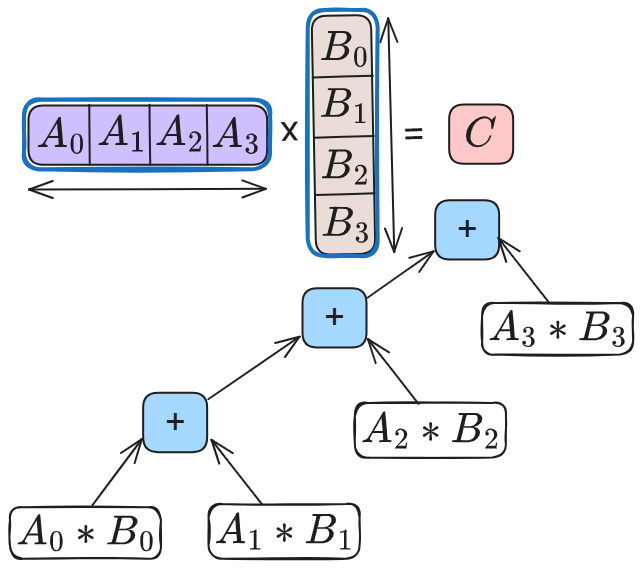
The image depicts a mathematical diagram illustrating the distributive property of matrix multiplication over addition. It shows the step-by-step computation of the product of two matrices (A and B) resulting in a scalar value (C), with explicit breakdowns of element-wise operations and summation.
### Components/Axes
- **Matrix A**: Horizontal row vector labeled `A₀ A₁ A₂ A₃` (1×4 dimensions).
- **Matrix B**: Vertical column vector labeled `B₀ B₁ B₂ B₃` (4×1 dimensions).
- **Result**: Scalar `C` (1×1) positioned to the right of the matrices.
- **Operations**:
- Multiplication (`*`) between corresponding elements of A and B.
- Addition (`+`) of intermediate products to compute the final result.
### Detailed Analysis
1. **Element-wise Multiplication**:
- `A₀ * B₀` (bottom-left)
- `A₁ * B₁` (left-center)
- `A₂ * B₂` (right-center)
- `A₃ * B₃` (top-right)
2. **Summation Flow**:
- Intermediate products are connected via `+` operators:
- `A₀*B₀ + A₁*B₁` (left branch)
- `A₂*B₂ + A₃*B₃` (right branch)
- Final summation: `(A₀*B₀ + A₁*B₁) + (A₂*B₂ + A₃*B₃) = C` (center).
### Key Observations
- The diagram explicitly separates the computation into four distinct element-wise products.
- The summation hierarchy is visually represented with two intermediate `+` nodes before reaching the final result.
- No numerical values are provided; the focus is on symbolic representation of operations.
### Interpretation
This diagram demonstrates the **distributive property of scalar multiplication over addition** in matrix algebra. It visually confirms that the product of two matrices (A and B) is equivalent to the sum of all pairwise products of their corresponding elements. The structure emphasizes the associative nature of matrix multiplication, where intermediate terms are grouped and summed systematically. The absence of numerical values suggests this is a conceptual illustration rather than a computational example.