## Diagram: Taxonomy of AI Reasoning Methods and Models (2022-2025)
### Overview
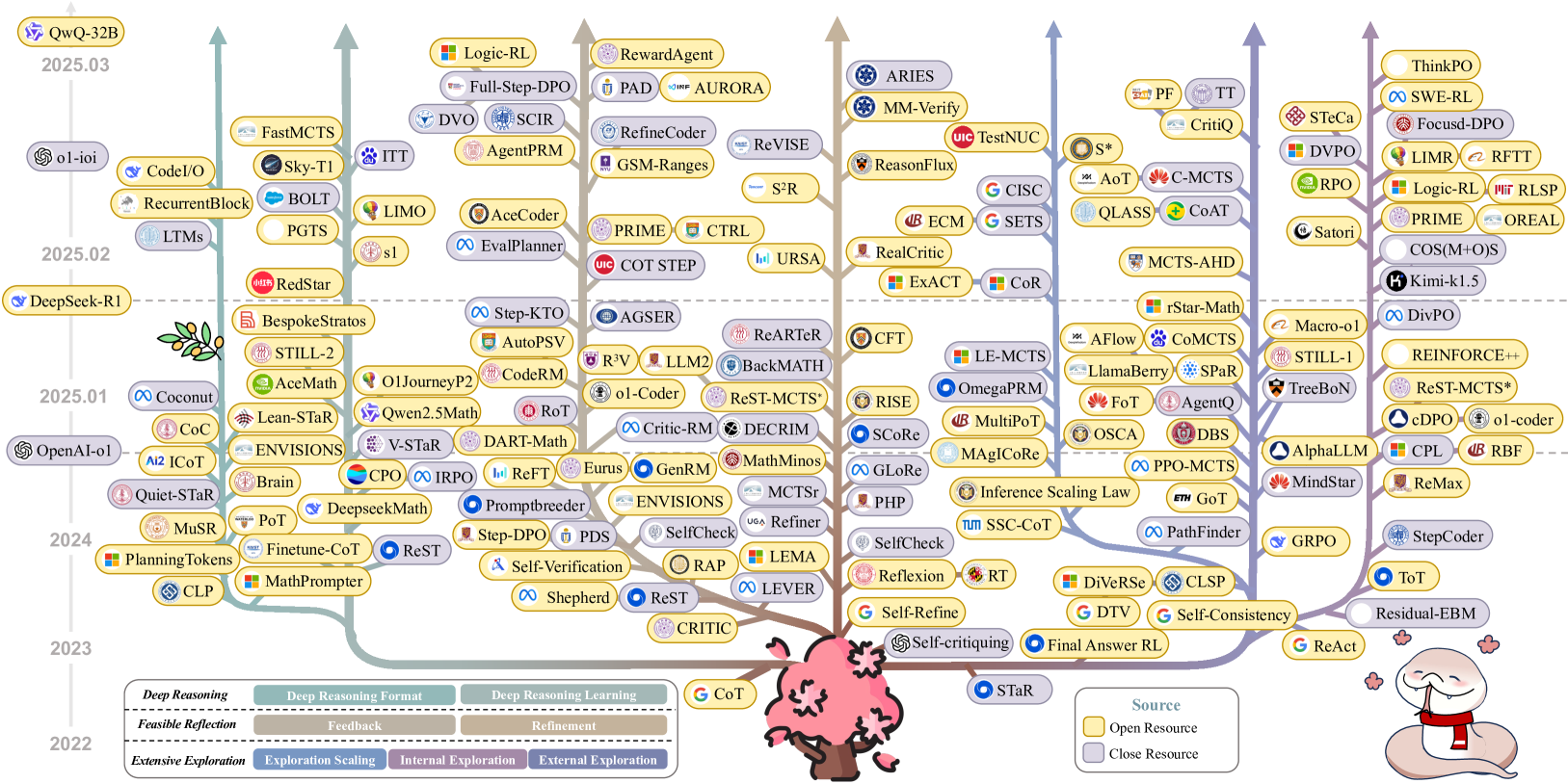
This image is a complex, tree-like taxonomy diagram illustrating the evolution and categorization of AI reasoning methods, models, and research directions from 2022 to March 2025. It organizes numerous named techniques and models into vertical streams, with time progressing from bottom (2022) to top (2025.03). The diagram uses color-coding, icons, and connecting lines to show relationships and lineage.
### Components/Axes
* **Vertical Timeline (Left Axis):** Years and specific months are marked: 2022, 2023, 2024, 2025.01, 2025.02, 2025.03.
* **Horizontal Categories (Bottom Legend):** The diagram's branches are categorized into three primary research directions, each with sub-categories:
* **Deep Reasoning** (Teal/Green palette)
* Deep Reasoning Format
* Deep Reasoning Learning
* **Feasible Reflection** (Brown/Tan palette)
* Feedback
* Refinement
* **Extensive Exploration** (Blue/Purple palette)
* Exploration Scaling
* Internal Exploration
* External Exploration
* **Source Legend (Bottom Right):** A box defines the meaning of node border colors:
* **Yellow Border:** Open Resource
* **Grey Border:** Close Resource
* **Node Elements:** Each node is a rounded rectangle containing a model/method name (e.g., "CoT", "STaR", "o1-coder"). Many nodes have a small icon to their left, indicating the associated organization or framework (e.g., Google's "G", OpenAI's spiral, Anthropic's "A", various university logos).
* **Connectors:** Lines of varying colors (matching the category palettes) connect nodes, indicating relationships, inspiration, or evolutionary paths. The lines converge at a central pink tree-like structure at the bottom, symbolizing a common root or foundation.
### Detailed Analysis
The diagram is densely populated. Below is a structured extraction of the labeled nodes, organized by their vertical timeline position and approximate horizontal category stream.
**2022 (Bottom)**
* **Root/Foundation:** `CoT` (Chain-of-Thought), `STaR` (Self-Taught Reasoner).
**2023**
* **Left (Deep Reasoning):** `PlanningTokens`, `CLP`, `Finetune-CoT`, `MathPrompter`, `ReST`.
* **Center-Left (Feasible Reflection):** `CRITIC`, `Shepherd`, `Self-Verification`, `PDS`, `Step-DPO`, `Promptbreeder`, `ReFT`, `IRPO`, `CPO`, `DeepseekMath`, `PoT` (Program of Thoughts), `Brain`, `ENVISIONS`, `Lean-STaR`, `CoC`, `Quiet-STaR`, `MuSR`.
* **Center-Right (Extensive Exploration):** `Self-Refine`, `Self-critiquing`, `Final Answer RL`, `G ReAct`, `DTV`, `DiVeRSe`, `CLSP`, `RT`, `Reflexion`, `SelfCheck`, `PHP`, `GLoRe`, `SCoRe`, `RISE`, `CFT`, `ReARTe`, `BackMATH`, `ReST-MCTS*`, `o1-Coder`, `DECRIM`, `MathMinos`, `MCTSr`, `Refiner`, `LEMA`, `LEVER`, `RAP`, `GenRM`, `Eurus`, `DART-Math`, `V-STaR`, `Qwen2.5Math`, `O1JourneyP2`, `s1`, `PGTS`, `LIMO`, `ITT`, `Sky-T1`, `BOLT`, `RecurrentBlock`, `CodeI/O`, `LTM`s.
* **Right (Extensive Exploration - continued):** `PathFinder`, `GRPO`, `StepCoder`, `ToT` (Tree-of-Thoughts), `Residual-EBM`, `ReMax`, `RBF`, `CPL`, `AlphaLLM`, `MindStar`, `GoT` (Graph-of-Thoughts), `Inference Scaling Law`, `SSC-CoT`, `PPO-MCTS`, `DBS`, `OSCA`, `FoT`, `AgentQ`, `MAGIcoRe`, `MultiPoT`, `OmegaPRM`, `LE-MCTS`, `CoMCTS`, `AFlow`, `LlamaBerry`, `SPaR`, `rStar-Math`, `MCTS-AHD`, `QLASS`, `CoAT`, `CISC`, `SETS`, `ECM`, `ReasonFlux`, `TestNUC`, `MM-Verify`, `ARIES`, `ReVISE`, `S²R`, `URSA`, `CTRL`, `PRIME`, `COT STEP`, `EvalPlanner`, `AceCoder`, `AGSER`, `Step-KTO`, `AutoPSV`, `CodeRM`, `R³V`, `LLM2`, `RoT`, `BespokeStratos`, `RedStar`, `STILL-2`, `AceMath`, `Coconut`, `OpenAI-o1`, `DeepSeek-R1`.
**2024**
* **Left (Deep Reasoning):** `PlanningTokens`, `CLP`.
* **Center/Right Streams:** Many models from 2023 continue or have derivatives. Notable new entries around the 2024 mark include: `Logic-RL`, `Full-Step-DPO`, `DVO`, `SCIR`, `AgentPRM`, `RefineCoder`, `GSM-Ranges`, `PAD`, `AURORA`, `RewardAgent`, `RLSP`, `OREAL`, `Satori`, `COS(M+O)S`, `Kimi-k1.5`, `DivPO`, `STILL-1`, `Macro-o1`, `REINFORCE++`, `cDPO`, `RBF`.
**2025.01**
* **Left:** `Coconut`, `OpenAI-o1`.
* **Center/Right:** `DeepSeek-R1` (positioned between 2025.01 and 2025.02).
**2025.02**
* **Left:** `o1-ioi`, `LTM`s.
* **Center/Right:** `RedStar`, `BespokeStratos`, `STILL-2`, `AceMath`, `ENVISIONS`.
**2025.03 (Top)**
* **Left:** `QwQ-32B`.
* **Center/Right:** `Logic-RL`, `Full-Step-DPO`, `DVO`, `SCIR`, `AgentPRM`, `RefineCoder`, `GSM-Ranges`, `PAD`, `AURORA`, `RewardAgent`, `ARIES`, `MM-Verify`, `TestNUC`, `ReasonFlux`, `CISC`, `SETS`, `ECM`, `RealCritic`, `ExACT`, `CoR`, `S*`, `AoT`, `C-MCTS`, `QLASS`, `CoAT`, `PF`, `TT`, `CriticQ`, `STeCa`, `DVPO`, `LIMR`, `RFTT`, `RLSP`, `PRIME`, `OREAL`, `Satori`, `COS(M+O)S`, `Kimi-k1.5`, `ThinkPO`, `SWE-RL`, `Focusd-DPO`.
### Key Observations
1. **Temporal Clustering:** There is a significant density of new methods and models appearing in late 2024 and early 2025, indicating a period of rapid advancement and diversification in AI reasoning research.
2. **Categorical Overlap:** Many models, especially those related to Monte Carlo Tree Search (MCTS) variants (e.g., `ReST-MCTS*`, `CoMCTS`, `PPO-MCTS`), appear in the "Extensive Exploration" category but have connections to other streams.
3. **Prominent Organizations:** Icons for Google (G), OpenAI, Anthropic (A), and various academic institutions (e.g., CMU, Stanford, Tsinghua) are frequently attached to nodes, showing the key players in this field.
4. **Evolutionary Lines:** The connecting lines show clear evolutionary paths. For example, foundational methods like `CoT` and `STaR` at the root branch into numerous specialized techniques over time.
5. **Resource Type Distribution:** Both open-source (yellow border) and closed-source (grey border) models are intermixed throughout the taxonomy, suggesting parallel development in both domains.
### Interpretation
This diagram serves as a **conceptual map of the "reasoning" sub-field within large language model (LLM) research**. It visually argues that progress is not linear but occurs along multiple, semi-parallel tracks:
1. **Deep Reasoning:** Focuses on improving the model's internal reasoning format and learning processes (e.g., specialized training for math, code).
2. **Feasible Reflection:** Centers on mechanisms for models to critique, verify, and refine their own outputs using feedback loops.
3. **Extensive Exploration:** Emphasizes search and exploration strategies (like tree search, MCTS) to navigate large solution spaces, often leveraging external tools or verifiers.
The **central pink tree** is a powerful metaphor, suggesting that the diverse "branches" of modern reasoning techniques all grow from a common trunk of early foundational work (`CoT`, `STaR`). The explosion of branches in 2024-2025 highlights the field's shift from proving the viability of reasoning in LLMs to aggressively scaling and specializing these capabilities. The intermingling of open and closed resources indicates a vibrant, competitive ecosystem where ideas likely flow between academic and industrial labs. The diagram is less a strict hierarchy and more a **phylogenetic chart**, showing ancestry, divergence, and the complex ecosystem of ideas driving AI reasoning forward.