\n
## Scatter Plot: Reasoning Chain Length vs. Human Accuracy
### Overview
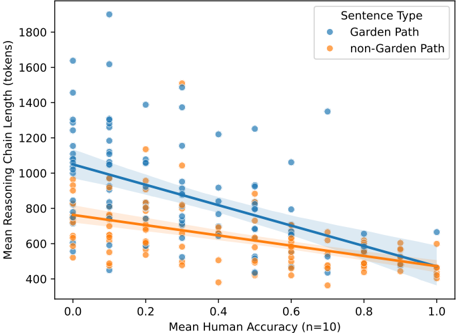
This image presents a scatter plot comparing the relationship between Mean Human Accuracy and Mean Reasoning Chain Length for two types of sentences: "Garden Path" and "non-Garden Path". A regression line with a shaded confidence interval is plotted for each sentence type.
### Components/Axes
* **X-axis:** "Mean Human Accuracy (n=10)", ranging from approximately 0.0 to 1.0.
* **Y-axis:** "Mean Reasoning Chain Length (tokens)", ranging from approximately 400 to 1800.
* **Legend:** Located in the top-right corner.
* **Blue:** "Garden Path"
* **Orange:** "non-Garden Path"
* **Data Points:** Scatter plot points representing individual data instances.
* **Regression Lines:** Solid lines representing the linear regression for each sentence type.
* **Confidence Intervals:** Shaded areas around the regression lines, indicating the uncertainty in the estimated relationship.
### Detailed Analysis
**Garden Path (Blue):**
The blue data points are scattered across the plot. The regression line for "Garden Path" slopes downward, indicating a negative correlation between Mean Human Accuracy and Mean Reasoning Chain Length.
* At an accuracy of 0.0, the reasoning chain length is approximately 1700 tokens.
* At an accuracy of 0.2, the reasoning chain length is approximately 1400 tokens.
* At an accuracy of 0.4, the reasoning chain length is approximately 1200 tokens.
* At an accuracy of 0.6, the reasoning chain length is approximately 900 tokens.
* At an accuracy of 0.8, the reasoning chain length is approximately 700 tokens.
* At an accuracy of 1.0, the reasoning chain length is approximately 500 tokens.
**non-Garden Path (Orange):**
The orange data points are also scattered. The regression line for "non-Garden Path" also slopes downward, but is less steep than the "Garden Path" line.
* At an accuracy of 0.0, the reasoning chain length is approximately 800 tokens.
* At an accuracy of 0.2, the reasoning chain length is approximately 750 tokens.
* At an accuracy of 0.4, the reasoning chain length is approximately 700 tokens.
* At an accuracy of 0.6, the reasoning chain length is approximately 600 tokens.
* At an accuracy of 0.8, the reasoning chain length is approximately 500 tokens.
* At an accuracy of 1.0, the reasoning chain length is approximately 400 tokens.
### Key Observations
* Both sentence types exhibit a negative correlation: as human accuracy increases, the reasoning chain length tends to decrease.
* The "Garden Path" sentences generally require longer reasoning chains than "non-Garden Path" sentences for the same level of human accuracy.
* The confidence intervals overlap significantly, suggesting that the difference in the relationship between the two sentence types may not be statistically significant.
* There is considerable variance in the data points around the regression lines, indicating that other factors may also influence reasoning chain length.
### Interpretation
The data suggests that sentences that are more difficult for humans to understand ("Garden Path" sentences) require more extensive reasoning to process, as evidenced by the longer reasoning chain lengths. As human accuracy improves (i.e., the sentence becomes easier to understand), the need for extensive reasoning decreases. The steeper slope for "Garden Path" sentences indicates that improvements in human accuracy lead to a more substantial reduction in reasoning chain length for these types of sentences. The overlap in confidence intervals suggests that while there is a trend, the difference between the two sentence types isn't definitive. This could be due to the relatively small sample size (n=10) indicated on the x-axis. The scatter plot provides insights into the cognitive effort involved in processing different types of sentences and how this effort relates to human comprehension.