## Hierarchical Set Diagram: Set Inclusion and Operations
### Overview
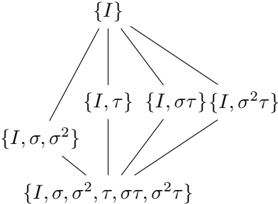
The image depicts a hierarchical diagram illustrating set inclusions and operations involving a base set {I} and derived subsets through combinations of σ (sigma) and τ (tau) operations. The structure shows parent-child relationships between sets, with arrows indicating subset relationships.
### Components/Axes
- **Root Node**: {I} (topmost element)
- **First-Level Subsets**:
- {I, τ}
- {I, στ}
- {I, σ²τ}
- **Second-Level Subsets**:
- From {I, τ}:
- {I, σ, σ²}
- {I, σ², τ, στ, σ²τ}
- From {I, στ}:
- {I, σ, σ²}
- {I, σ², τ, στ, σ²τ}
- From {I, σ²τ}:
- {I, σ, σ²}
- {I, σ², τ, στ, σ²τ}
- **Final Combined Set**: {I, σ, σ², τ, στ, σ²τ} (bottom node)
### Detailed Analysis
1. **Root to First-Level**:
- {I} branches into three distinct subsets:
- {I, τ} (adds τ to I)
- {I, στ} (adds στ to I)
- {I, σ²τ} (adds σ²τ to I)
2. **First-Level to Second-Level**:
- Each first-level subset splits into two branches:
- **{I, τ}**:
- {I, σ, σ²} (adds σ and σ² to I)
- {I, σ², τ, στ, σ²τ} (combines σ², τ, and their products)
- **{I, στ}**:
- {I, σ, σ²} (same as above)
- {I, σ², τ, στ, σ²τ} (same as above)
- **{I, σ²τ}**:
- {I, σ, σ²} (same as above)
- {I, σ², τ, στ, σ²τ} (same as above)
3. **Final Combined Set**:
- All elements from the second-level subsets merge into {I, σ, σ², τ, στ, σ²τ}, representing the union of all operations.
### Key Observations
- **Recurring Subsets**: {I, σ, σ²} and {I, σ², τ, στ, σ²τ} appear multiple times, suggesting they are foundational or intermediate results.
- **Symmetry**: The diagram shows symmetry in how σ and τ operations combine across branches.
- **Hierarchical Depth**: Three levels of hierarchy (root → first-level → second-level → final set).
### Interpretation
This diagram likely represents a mathematical or computational framework where:
1. **{I}** is the initial state or identity set.
2. **σ and τ** are operations or parameters applied to I, with σ² indicating repeated application (e.g., σ² = σ∘σ).
3. The hierarchy shows how combinations of σ and τ expand the set {I} into increasingly complex subsets.
4. The final set {I, σ, σ², τ, στ, σ²τ} represents the closure of all possible operations under σ and τ.
The structure implies a systematic exploration of set expansions through algebraic or logical operations, possibly in contexts like group theory, automata theory, or formal language systems. The repeated subsets suggest intermediate states or equivalence classes in the process.