## Diagram: Hasse Diagram of Subgroup Lattice
### Overview
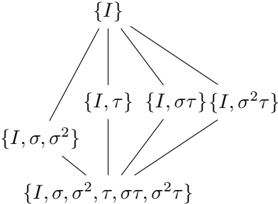
The image displays a Hasse diagram, a type of mathematical diagram used to represent a finite partially ordered set (poset). In this specific case, it illustrates the subgroup lattice of a finite group, showing the containment relationships between various subgroups. The diagram is composed of nodes (sets of elements) connected by lines, where a line from a higher node to a lower node indicates that the lower set is a subgroup contained within the higher set.
### Components/Axes
* **Nodes:** The diagram consists of five distinct nodes, each labeled with a set of mathematical symbols enclosed in curly braces `{}`. The symbols appear to be elements of a group, likely using standard notation where `I` represents the identity element, and `σ` (sigma) and `τ` (tau) represent other group elements (e.g., rotations and reflections).
* **Connections (Edges):** Straight lines connect the nodes to indicate the "is a subgroup of" or "is contained in" relationship. The direction is implicit: a node higher in the diagram contains the nodes below it to which it is connected.
* **Spatial Layout:**
* **Top (Level 1):** A single node `{I}` is positioned at the top center.
* **Middle (Level 2):** Three nodes are arranged horizontally below the top node. From left to right, they are: `{I, σ, σ²}`, `{I, τ}`, and `{I, στ}`. A fourth node, `{I, σ²τ}`, is positioned to the right of `{I, στ}`, slightly offset but still in the middle tier.
* **Bottom (Level 3):** A single, larger node `{I, σ, σ², τ, στ, σ²τ}` is positioned at the bottom center.
### Detailed Analysis
The diagram explicitly defines the following sets and their containment relationships:
1. **Node `{I}` (Top):** This is the trivial subgroup containing only the identity element. It is connected by lines downward to all four nodes in the middle tier, indicating it is a subgroup of each of them.
2. **Middle Tier Nodes:**
* `{I, σ, σ²}` (Left): A subgroup of order 3. It is connected only to the top node `{I}` and the bottom node.
* `{I, τ}` (Center-Left): A subgroup of order 2. It is connected to the top node `{I}` and the bottom node.
* `{I, στ}` (Center-Right): A subgroup of order 2. It is connected to the top node `{I}` and the bottom node.
* `{I, σ²τ}` (Right): A subgroup of order 2. It is connected to the top node `{I}` and the bottom node.
3. **Node `{I, σ, σ², τ, στ, σ²τ}` (Bottom):** This is the entire group, containing all six listed elements. It is connected by lines upward to all four nodes in the middle tier, indicating that each of those sets is a subgroup of this full group.
**Relationship Summary:** The diagram shows that the trivial group `{I}` is contained within four distinct proper subgroups: one of order 3 (`{I, σ, σ²}`) and three of order 2 (`{I, τ}`, `{I, στ}`, `{I, σ²τ}`). All four of these proper subgroups are, in turn, contained within the full group of order 6.
### Key Observations
* **Group Structure:** The pattern is characteristic of the **dihedral group D₃** (also isomorphic to the symmetric group S₃), which is the group of symmetries of an equilateral triangle. The elements correspond to: `I` (identity), `σ` (rotation by 120°), `σ²` (rotation by 240°), and `τ`, `στ`, `σ²τ` (three distinct reflections).
* **Subgroup Types:** The lattice clearly distinguishes between the cyclic subgroup of rotations (order 3) and the three non-cyclic subgroups of reflections (each of order 2).
* **Maximal Subgroups:** The four nodes in the middle tier are the maximal proper subgroups of the full group. No other subgroups exist between them and the full group.
* **Minimal Nontrivial Subgroups:** The three order-2 subgroups are minimal nontrivial subgroups (they contain no nontrivial proper subgroups other than `{I}`).
### Interpretation
This Hasse diagram is a concise visual representation of the internal algebraic structure of the group D₃/S₃. It answers the question: "What are all the possible subgroups of this group, and how are they related by inclusion?"
* **What it Demonstrates:** It shows that the group is not simple (it has proper normal subgroups, like `{I, σ, σ²}`). It illustrates the concept of a subgroup lattice, a fundamental tool in group theory for understanding a group's composition.
* **Relationships:** The lines encode the partial order of inclusion. The diagram's height represents the "size" or complexity of the subgroups, from the smallest (trivial) at the top to the largest (the whole group) at the bottom.
* **Notable Pattern:** The symmetry of the diagram reflects the symmetry of the group itself. The three order-2 subgroups are structurally identical (conjugate subgroups) and occupy equivalent positions in the lattice, connected identically to the top and bottom nodes. The order-3 subgroup is unique and occupies a distinct position.
* **Underlying Information:** From this diagram, one can deduce the group's order (6), the number and sizes of its subgroups, and infer properties like the existence of normal subgroups (the order-3 subgroup is normal, as it has index 2). It serves as a complete "map" of the group's subgroup structure.