## Code Snippet: Rust atoi Implementation
### Overview
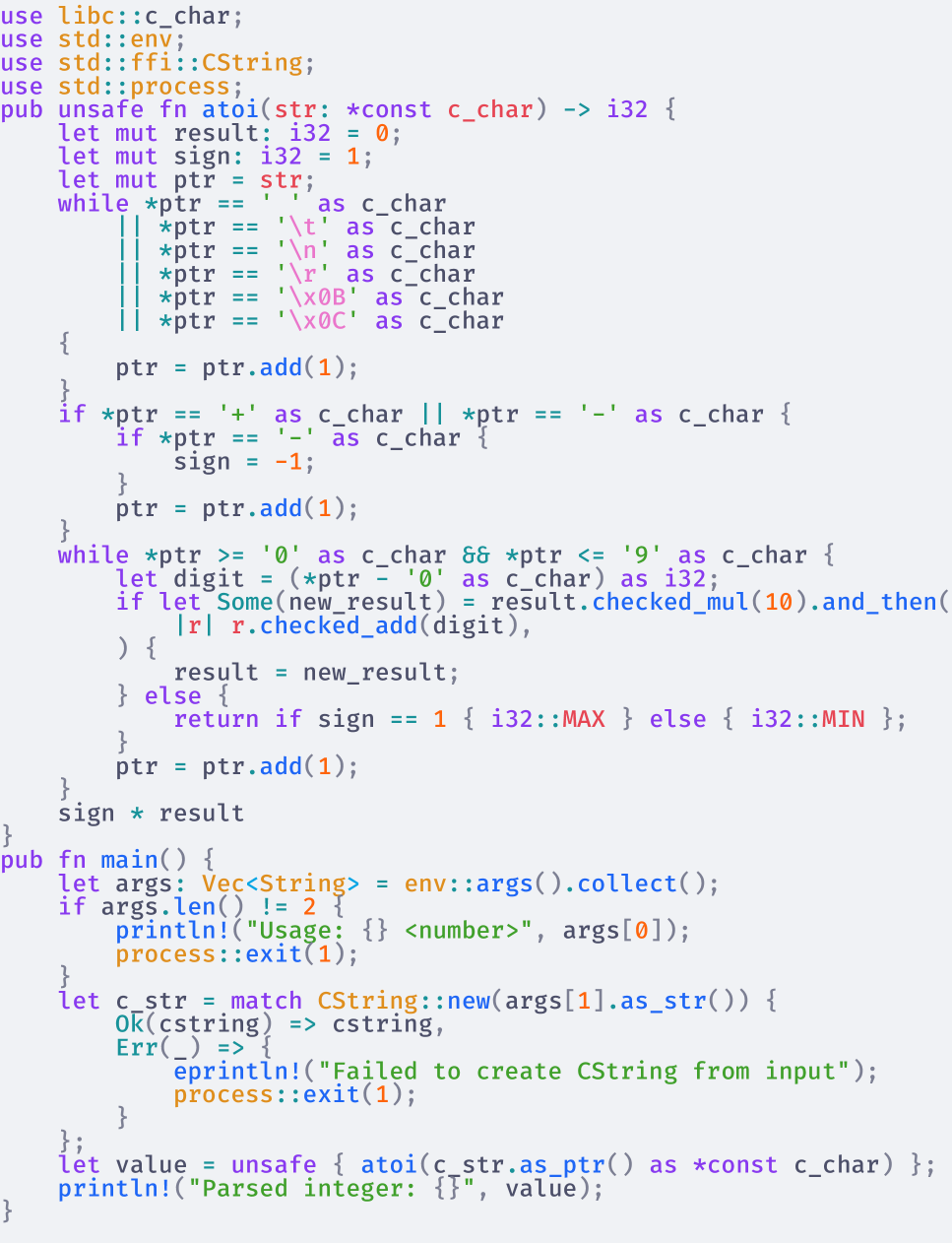
The image presents a Rust code snippet that implements the `atoi` function, which converts a string to an integer. It also includes a `main` function that parses a command-line argument as an integer using the `atoi` function and prints the result.
### Components/Axes
* **Libraries:** `libc`, `std::env`, `std::ffi::CString`, `std::process`
* **Functions:** `atoi`, `main`
* **Variables:** `result`, `sign`, `ptr`, `digit`, `new_result`, `args`, `c_str`, `value`
* **Data Types:** `c_char`, `i32`, `String`, `Vec`
### Detailed Analysis or ### Content Details
**1. `atoi` Function:**
* **Signature:** `pub unsafe fn atoi(str: *const c_char) -> i32`
* Takes a C-style string (`*const c_char`) as input.
* Returns an `i32` (32-bit integer).
* Marked as `unsafe` because it deals with raw pointers.
* **Initialization:**
* `let mut result: i32 = 0;`: Initializes the result to 0.
* `let mut sign: i32 = 1;`: Initializes the sign to positive (1).
* `let mut ptr = str;`: Initializes a pointer `ptr` to the beginning of the input string.
* **Whitespace Skipping:**
* A `while` loop iterates as long as the character pointed to by `ptr` is a whitespace character (space, tab, newline, carriage return, vertical tab, form feed).
* `ptr = ptr.add(1);`: Increments the pointer to the next character.
* **Sign Handling:**
* An `if` statement checks if the current character is '+' or '-'.
* If it's '-', the `sign` variable is set to -1.
* `ptr = ptr.add(1);`: Increments the pointer.
* **Digit Conversion:**
* A `while` loop iterates as long as the character pointed to by `ptr` is a digit ('0' to '9').
* `let digit = (*ptr - '0' as c_char) as i32;`: Converts the character to its integer value.
* **Overflow Check:**
* `result.checked_mul(10).and_then(|r| r.checked_add(digit))`: Safely multiplies the current result by 10 and adds the new digit, checking for overflow.
* If overflow occurs, `new_result` will be `None`.
* **Overflow Handling:**
* If `new_result` is `None`, the function returns `i32::MAX` if the sign is positive, or `i32::MIN` if the sign is negative.
* `ptr = ptr.add(1);`: Increments the pointer.
* **Return Value:**
* `sign * result`: Returns the final integer value, taking the sign into account.
**2. `main` Function:**
* **Argument Parsing:**
* `let args: Vec<String> = env::args().collect();`: Collects command-line arguments into a vector of strings.
* `if args.len() != 2`: Checks if exactly one argument (besides the program name) is provided.
* If not, prints a usage message and exits with code 1.
* **String Conversion:**
* `let c_str = match CString::new(args[1].as_str())`: Attempts to convert the argument string to a C-style string.
* If the conversion fails, prints an error message and exits.
* **`atoi` Call:**
* `let value = unsafe { atoi(c_str.as_ptr() as *const c_char) };`: Calls the `atoi` function with the C-style string.
* **Output:**
* `println!("Parsed integer: {}", value);`: Prints the parsed integer value.
### Key Observations
* The `atoi` function handles whitespace, signs, and overflow.
* The `main` function parses command-line arguments and uses the `atoi` function to convert the argument to an integer.
* The code uses `unsafe` blocks because it deals with raw pointers.
* Error handling is present for invalid input (incorrect number of arguments, failure to create CString).
* The code uses `checked_mul` and `checked_add` to prevent integer overflow.
### Interpretation
The code provides a functional implementation of the `atoi` function in Rust. It demonstrates how to handle C-style strings, parse numerical input, and perform error checking. The use of `unsafe` blocks highlights the need for careful memory management when working with raw pointers in Rust. The overflow checks ensure that the program behaves predictably even when given very large input values. The `main` function provides a simple example of how to use the `atoi` function in a real-world scenario.
```