\n
## Code Snippet: Rust Function Definitions
### Overview
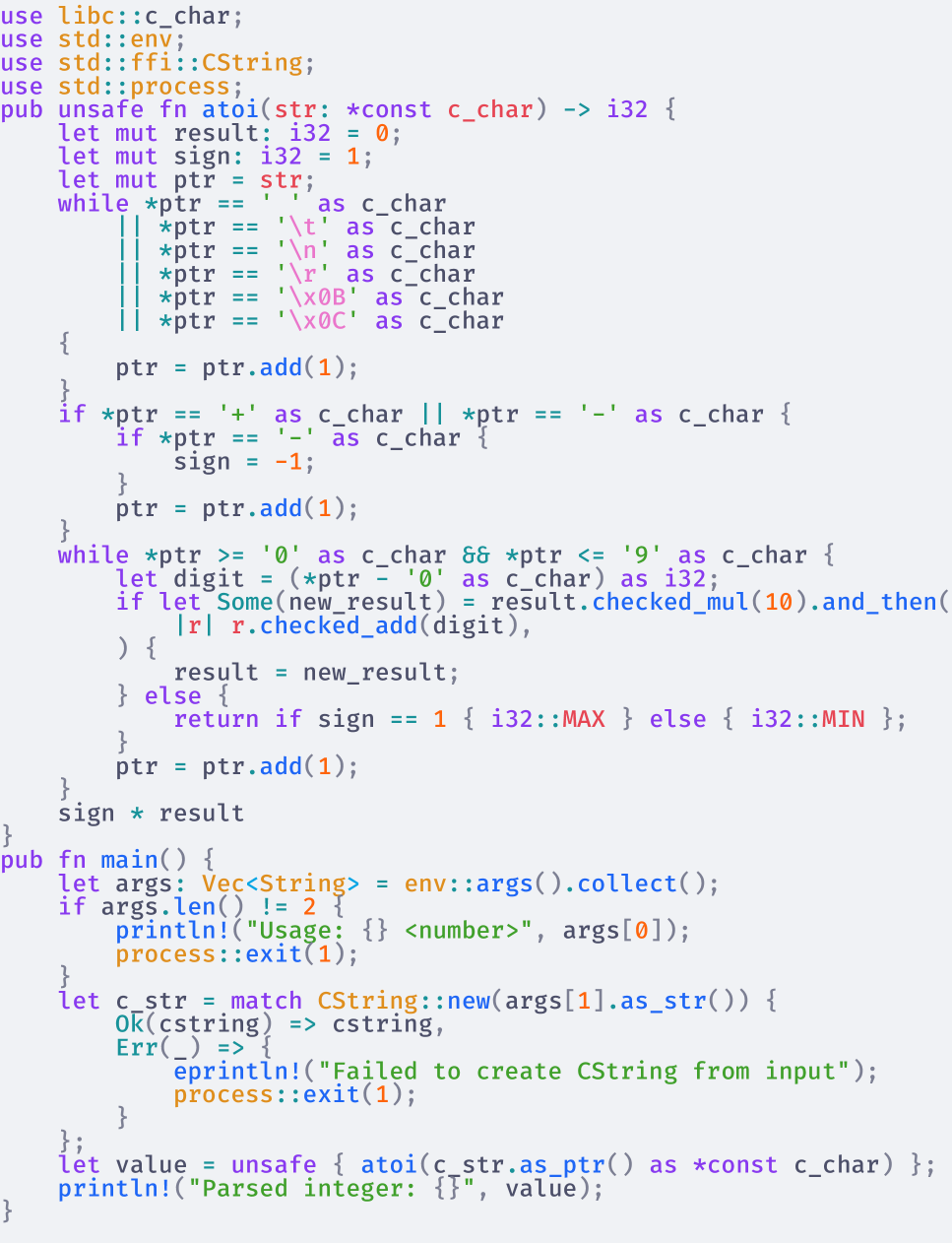
The image contains a Rust code snippet defining two functions: `atoi` and `main`. The `atoi` function appears to convert a C-style string to an i32 integer, handling potential signs and validating input. The `main` function parses command-line arguments, attempts to convert the first argument to an integer using `atoi`, and prints the parsed value.
### Components/Axes
There are no axes or charts in this image. It is a block of code. The code is structured into function definitions, control flow statements (while loops, if statements), and variable declarations.
### Detailed Analysis or Content Details
**Function `atoi`:**
```rust
use libc::c_char;
use std::env;
use std::ffi::CString;
use std::process;
pub unsafe fn atoi(str: *const c_char) -> i32 {
let mut result: i32 = 0;
let mut sign: i32 = 1;
let mut ptr = str;
while *ptr == '\t' as c_char || *ptr == '\n' as c_char || *ptr == '\r' as c_char || *ptr == '\x0B' as c_char || *ptr == '\x0C' as c_char {
ptr = ptr.add(1);
}
if *ptr == '+' as c_char || *ptr == '-' as c_char {
if *ptr == '-' as c_char {
sign = -1;
}
ptr = ptr.add(1);
}
while *ptr >= '0' as c_char && *ptr <= '9' as c_char {
let digit = (*ptr - '0' as c_char) as i32;
if let Some(new_result) = result.checked_mul(10).and_then(|r| r.checked_add(digit)) {
result = new_result;
} else {
return if sign == 1 { i32::MAX } else { i32::MIN };
}
ptr = ptr.add(1);
}
sign * result
}
```
* The function takes a `*const c_char` (a C-style string pointer) as input.
* It initializes `result` to 0 and `sign` to 1.
* It skips leading whitespace characters (tab, newline, carriage return, vertical tab, form feed).
* It checks for an optional sign (+ or -) and updates the `sign` variable accordingly.
* It iterates through the remaining characters, converting digits to integers and building the `result`.
* It uses `checked_mul` and `checked_add` to prevent integer overflow. If overflow occurs, it returns `i32::MAX` or `i32::MIN` depending on the sign.
* Finally, it returns the signed `result`.
**Function `main`:**
```rust
pub fn main() {
let args: Vec<CString> = env::args().collect();
if args.len() != 2 {
println!("Usage: {} <number>", args[0]);
process::exit(1);
}
let c_str = match CString::new(args[1].as_str()) {
Ok(cstring) => cstring,
Err(_) => {
eprintln!("Failed to create CString from input");
process::exit(1);
}
};
let value = unsafe { atoi(c_str.as_ptr() as *const c_char) };
println!("Parsed integer: {{}}, value)", value);
}
```
* The function retrieves command-line arguments as a vector of `CString` objects.
* It checks if exactly one argument is provided (besides the program name). If not, it prints a usage message and exits.
* It attempts to create a `CString` from the first argument. If this fails (e.g., due to invalid UTF-8), it prints an error message and exits.
* It calls the `atoi` function to convert the `CString` to an i32 integer. The `unsafe` block is necessary because `atoi` is declared as `unsafe`.
* It prints the parsed integer value.
### Key Observations
* The `atoi` function is marked as `unsafe`, indicating that it relies on potentially unsafe operations (e.g., raw pointer dereferencing).
* The `main` function performs basic argument parsing and error handling.
* The code uses `checked_mul` and `checked_add` to handle potential integer overflows, which is good practice for robust code.
* The code uses `CString` to interface with C-style strings, which is common in Rust when interacting with C libraries.
### Interpretation
The code provides a basic implementation of an integer parsing function (`atoi`) and a main function that demonstrates its usage. The `atoi` function is designed to be relatively robust by handling whitespace, signs, and potential integer overflows. The `main` function provides a simple command-line interface for parsing integers. The use of `unsafe` in the `atoi` function suggests that it relies on low-level operations that require careful attention to memory safety. The code demonstrates a common pattern in Rust for interacting with C-style strings and handling potential errors. The error handling in `main` is basic, but sufficient for a simple example. The overall structure is clear and well-organized, making it easy to understand the purpose and functionality of the code.