TECHNICAL ASSET FINGERPRINT
5d6209bc0ce982b00091777a
Click to view fullscreen
Press ESC or click to close
FOUND IN PAPERS
EXPERT: healer-alpha-free VERSION 1
RUNTIME: free/openrouter/healer-alpha
INTEL_VERIFIED
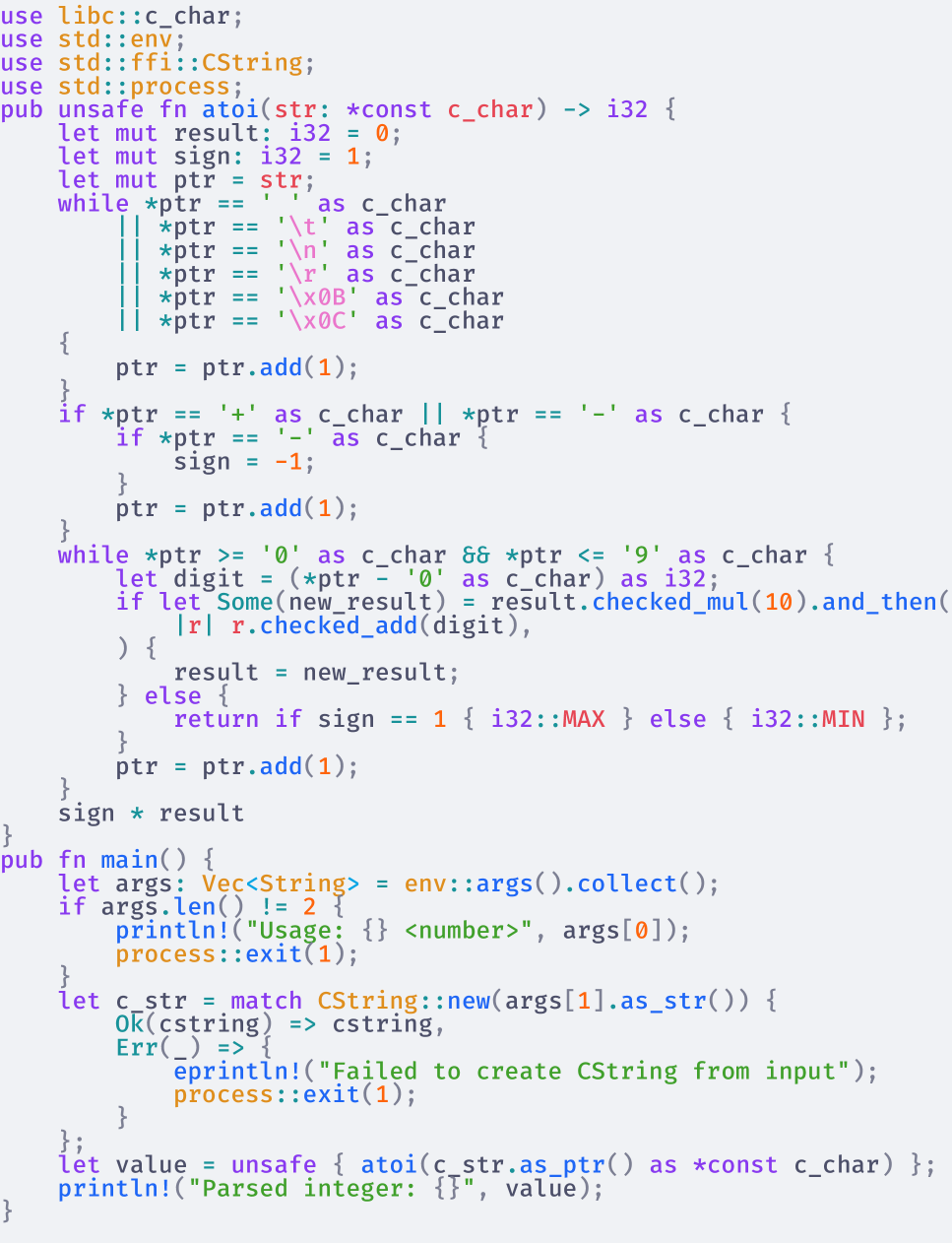
## Code Screenshot: Rust Implementation of `atoi` Function
### Overview
The image displays a screenshot of Rust source code implementing a custom `atoi` (ASCII to integer) function and a `main` function to demonstrate its usage. The code is presented in a text editor or IDE with syntax highlighting. The primary language is **Rust**.
### Components/Axes
This is not a chart or diagram with axes. The components are the code's syntactic and logical elements:
- **Import Statements**: Lines 1-4 (`use libc::c_char;`, `use std::env;`, `use std::ffi::CString;`, `use std::process;`).
- **Function `atoi`**: An `unsafe` public function (lines 5-40) that converts a C-style string (`*const c_char`) to a 32-bit signed integer (`i32`).
- **Function `main`**: The program's entry point (lines 42-60).
- **Variables & Logic**: Includes mutable variables (`result`, `sign`, `ptr`), loops, conditional checks, and arithmetic operations.
- **Error Handling**: Uses `match` for `CString` creation and `process::exit` for fatal errors.
### Detailed Analysis
**Full Code Transcription:**
```rust
use libc::c_char;
use std::env;
use std::ffi::CString;
use std::process;
pub unsafe fn atoi(str: *const c_char) -> i32 {
let mut result: i32 = 0;
let mut sign: i32 = 1;
let mut ptr = str;
while *ptr == ' ' as c_char
|| *ptr == '\t' as c_char
|| *ptr == '\n' as c_char
|| *ptr == '\r' as c_char
|| *ptr == '\x0B' as c_char
|| *ptr == '\x0C' as c_char
{
ptr = ptr.add(1);
}
if *ptr == '+' as c_char || *ptr == '-' as c_char {
if *ptr == '-' as c_char {
sign = -1;
}
ptr = ptr.add(1);
}
while *ptr >= '0' as c_char && *ptr <= '9' as c_char {
let digit = (*ptr - '0' as c_char) as i32;
if let Some(new_result) = result.checked_mul(10).and_then(
|r| r.checked_add(digit),
) {
result = new_result;
} else {
return if sign == 1 { i32::MAX } else { i32::MIN };
}
ptr = ptr.add(1);
}
sign * result
}
pub fn main() {
let args: Vec<String> = env::args().collect();
if args.len() != 2 {
println!("Usage: {} <number>", args[0]);
process::exit(1);
}
let c_str = match CString::new(args[1].as_str()) {
Ok(cstring) => cstring,
Err(_) => {
eprintln!("Failed to create CString from input");
process::exit(1);
}
};
let value = unsafe { atoi(c_str.as_ptr() as *const c_char) };
println!("Parsed integer: {}", value);
}
```
**Logical Flow of `atoi` Function:**
1. **Initialization**: Sets `result` to 0, `sign` to 1, and a pointer `ptr` to the input string.
2. **Whitespace Skipping**: A `while` loop advances `ptr` past any leading whitespace characters (space, tab, newline, carriage return, vertical tab, form feed).
3. **Sign Handling**: Checks for an optional leading '+' or '-'. If '-', sets `sign` to -1. Advances the pointer past the sign character.
4. **Digit Conversion**: A `while` loop processes consecutive digit characters ('0'-'9').
* Converts the character to its integer value (`digit`).
* Uses `checked_mul(10)` and `checked_add(digit)` to safely accumulate the result, preventing overflow.
* If an overflow occurs (the `checked_*` methods return `None`), it immediately returns `i32::MAX` for a positive sign or `i32::MIN` for a negative sign.
* Otherwise, updates `result` and advances the pointer.
5. **Return**: Returns the final `result` multiplied by the `sign`.
**Logical Flow of `main` Function:**
1. **Argument Collection**: Collects command-line arguments into a `Vec<String>`.
2. **Argument Check**: Verifies exactly one argument is provided (plus the program name). Prints a usage message and exits with code 1 if not.
3. **CString Conversion**: Attempts to convert the input argument to a null-terminated `CString`. Prints an error to stderr and exits on failure.
4. **Function Call**: Unsafely calls `atoi` with a raw pointer to the `CString`'s content.
5. **Output**: Prints the parsed integer value.
### Key Observations
1. **Safety**: The `atoi` function is marked `unsafe` because it dereferences a raw pointer (`*const c_char`). The `main` function encapsulates this unsafety in a single, controlled call.
2. **Robustness**: The implementation includes explicit checks for integer overflow using Rust's safe checked arithmetic methods (`checked_mul`, `checked_add`), returning the maximum or minimum `i32` value on overflow, mimicking common C library behavior.
3. **Whitespace Handling**: It correctly handles a comprehensive set of ASCII whitespace characters, not just spaces.
4. **Error Handling in `main`**: The `main` function provides basic user feedback for incorrect usage and internal errors (CString creation failure).
5. **Syntax Highlighting**: The code uses color to distinguish elements: purple for keywords (`use`, `pub`, `unsafe`, `fn`, `let`, `mut`, `while`, `if`, `return`, `match`), orange for types (`i32`, `String`, `Vec`), green for string literals, and blue for function/variable names.
### Interpretation
This code is a faithful Rust reimplementation of the classic C library function `atoi`. Its primary purpose is educational or for FFI (Foreign Function Interface) contexts where a Rust program needs to parse C-style strings.
* **What it demonstrates**: It showcases how to work with raw pointers and C-style strings in Rust (`unsafe` blocks, `*const c_char`), while still leveraging Rust's safety features where possible (checked arithmetic, `Result`/`Option` for error handling in `main`). It also illustrates command-line argument processing.
* **Relationship between components**: The `atoi` function is a pure, low-level conversion routine. The `main` function acts as a driver, handling the higher-level concerns of program execution, argument validation, and error reporting before passing the cleaned data to the unsafe core function.
* **Notable patterns/anomalies**:
* The overflow behavior (returning `i32::MAX`/`MIN`) is a specific design choice that matches some, but not all, C library implementations. Others might have undefined behavior on overflow.
* The function stops parsing at the first non-digit character after the sign, which is standard `atoi` behavior. It does not report errors for non-numeric trailing characters (e.g., `"123abc"` would parse as `123`).
* The code is a complete, compilable Rust program, not just a function snippet.
DECODING INTELLIGENCE...