# Technical Data Extraction: Current Density and Streamline Plots
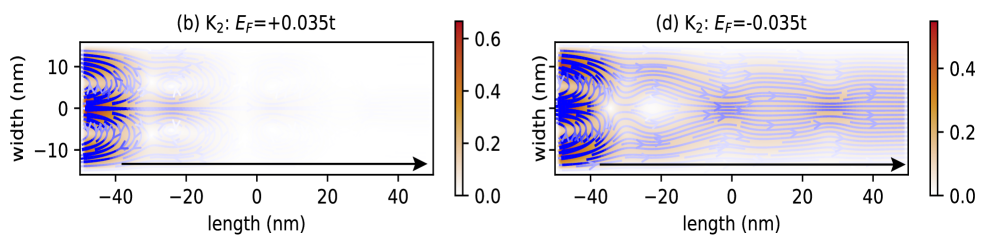
This document provides a detailed technical extraction of the data and visual components from the provided image, which consists of two side-by-side heatmaps with overlaid streamlines, likely representing electronic transport properties in a nanostructure.
## 1. General Metadata
* **Language:** English
* **Image Type:** Scientific Heatmaps / Streamline Plots
* **Coordinate System:** Cartesian (Length vs. Width)
* **Units:** Nanometers (nm) for spatial dimensions; $t$ (hopping parameter) for energy.
---
## 2. Component Isolation: Plot (b)
### Header Information
* **Label:** (b)
* **Title:** $K_2: E_F = +0.035t$
* **Interpretation:** This plot represents the $K_2$ valley/state at a positive Fermi energy of $0.035t$.
### Axis Configuration
* **Y-axis (Left):** "width (nm)"
* **Range:** -10 to 10 (with visible ticks at -10, 0, 10).
* **X-axis (Bottom):** "length (nm)"
* **Range:** -40 to 40 (with visible ticks at -40, -20, 0, 20, 40).
* **Directional Indicator:** A black arrow at the bottom of the plot area points from left to right (negative to positive length).
### Colorbar (Legend)
* **Location:** Right side of plot (b).
* **Scale:** Linear, from 0.0 to 0.6.
* **Color Gradient:** White (0.0) $\rightarrow$ Light Orange $\rightarrow$ Dark Brown/Rust (0.6).
* **Function:** Represents the magnitude of a physical quantity (likely current density).
### Data Visualization & Trends
* **Heatmap Trend:** The highest intensity (dark orange/brown, $\approx 0.4 - 0.5$) is concentrated on the far left side (length $\approx -50$ to $-40$ nm) near the center and edges of the width. The intensity decays rapidly as length increases. By length $= 0$ nm, the intensity is nearly zero (white).
* **Streamlines:** Blue lines with arrows indicate flow direction.
* **Pattern:** On the left, there are circular/vortex-like patterns.
* **Flow:** The flow appears to enter from the left, circulate in the region between -50 and -20 nm, and then dissipate.
---
## 3. Component Isolation: Plot (d)
### Header Information
* **Label:** (d)
* **Title:** $K_2: E_F = -0.035t$
* **Interpretation:** This plot represents the $K_2$ valley/state at a negative Fermi energy of $-0.035t$.
### Axis Configuration
* **Y-axis (Left):** "width (nm)"
* **Range:** -10 to 10 (ticks at -10, 0, 10).
* **X-axis (Bottom):** "length (nm)"
* **Range:** -40 to 40 (ticks at -40, -20, 0, 20, 40).
* **Directional Indicator:** A black arrow at the bottom points from left to right.
### Colorbar (Legend)
* **Location:** Right side of plot (d).
* **Scale:** Linear, from 0.0 to 0.4 (Note: The peak scale is lower than in plot b).
* **Color Gradient:** White (0.0) $\rightarrow$ Light Orange $\rightarrow$ Dark Brown/Rust (0.4).
### Data Visualization & Trends
* **Heatmap Trend:** Unlike plot (b), the intensity in plot (d) is sustained across the entire length of the channel.
* **Left Region (-50 to -30 nm):** High intensity (dark orange, $\approx 0.3 - 0.4$) near the top and bottom edges.
* **Central/Right Region (-20 to 50 nm):** The intensity fluctuates but remains significant ($\approx 0.1 - 0.2$), showing a "beating" or oscillatory pattern along the length.
* **Streamlines:** Blue lines with arrows.
* **Pattern:** Shows a more laminar, forward-moving flow compared to plot (b).
* **Flow:** The streamlines originate at the left and propagate through the entire length to the right boundary, following a wavy path that corresponds to the intensity fluctuations in the heatmap.
---
## 4. Comparative Summary
| Feature | Plot (b) $E_F = +0.035t$ | Plot (d) $E_F = -0.035t$ |
| :--- | :--- | :--- |
| **Max Intensity** | $\approx 0.6$ (Higher) | $\approx 0.4$ (Lower) |
| **Spatial Decay** | High; signal vanishes by $x=0$. | Low; signal persists to $x=50$. |
| **Flow Character** | Localized vortices/backflow. | Extended propagation/forward flow. |
| **Symmetry** | Concentrated at the injection point. | Distributed throughout the nanostructure. |
**Conclusion:** The data indicates a strong asymmetry in transport for the $K_2$ state depending on the sign of the Fermi energy. Positive $E_F$ results in localized, non-propagating states, while negative $E_F$ allows for extended propagation across the length of the device.